
Jun 18 •
WELCOME TO THE MESSY IN-BETWEEN!
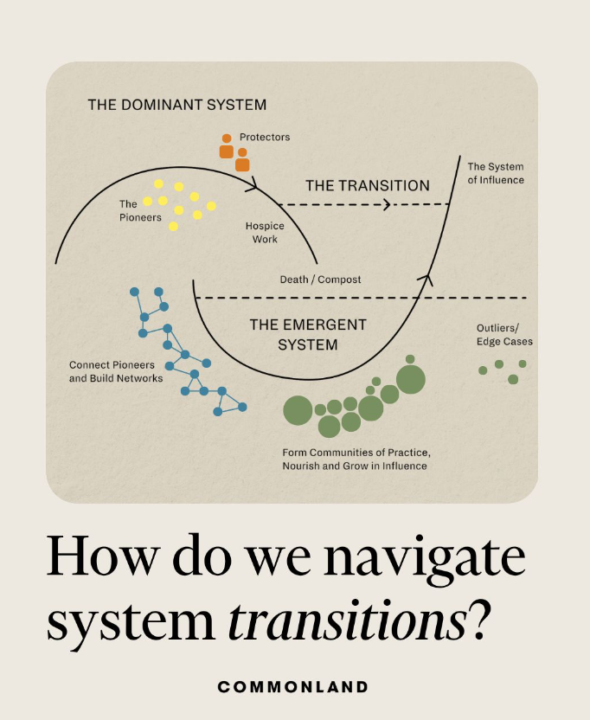
Where do you find yourself in this moment of systems transition? Are you pioneering the new? Hospicing the old? Supporting the in-between? Systems change happens in an uneasy space—between what’s fading and what’s yet to fully emerge. While we see glimpses of a regenerative future, extractive systems still dominate. So, how do we navigate this transition? 👉 Enter the Berkana Two Loops Model Developed by The Berkana Institute, Margaret Wheatley and Deborah Frieze, in the '90s this model maps out how systems change. As one system declines, another slowly emerges—not through sudden transformation, but through intentional transition. But here’s the uncomfortable truth: the old system doesn’t go quietly. So, who drives the transition? 🚀 Pioneers emerge first, those brave enough to experiment with new ways of thinking and doing. Without connection and support, those pioneering voices can easily be drowned out by the dominant system. THIS is why community matters. Pioneers need networks—to share, to connect, to recognise they’re not alone. 🤲🏽 Protectors, meanwhile, are those working within the current system—they nurture the new ideas, they carve out space for them to grow. But it's not only about innovation. Some fulfil the role of hospice workers for the old system—gently guiding it to a close while composting what’s worth keeping. 🌱 It’s about holding onto the best of the old, while gracefully letting the rest go. Where do you find yourself in this moment of transition? What would your role be within the Berkhana Two Loops Model? Let us know in the comments! 🌍✨ Thank you commonland for the reminder!

22d •
IDG and the promise it holds that makes us want to participate...
IDG holds a promise… something it stands for… and that emanates from it... that makes many come to it… what is it?... Maybe it does not matter... maybe what matters is 'how is it living up to its own promise?'... Inner Development... but anyway, what is it? ...what is this promise for you?
Mar 15 •
Caring for the Earth
This is one of so many projects of indigenous stewards caring for the Earth. It holds a special place in my heart and I wanted to share it with you. I’ve always been in love with trees, especially old ones. In this 5-minute video, Inside Kanaka Bar’s Conservation Plan: Protecting Rare Ecosystems & Indigenous Culture, hear from Kanaka community members as they discuss their vision and the ecological and cultural significance of this protected area initiative. This project is on the west coast of Canada in British Columbia. What projects that care for the Earth do you hold close to your heart?
Aug 10 •
Global Conscious Food Systems Summit - online!
Food systems globally won’t change because of another panel on “sustainability.” They’ll change when the world stops treating farmers, land and community as mere line items. That’s the premise behind the Global Conscious Food Systems Summit, organised by Conscious Food Systems Alliance, happening in Bhutan from 1–4 September. And you don’t need a plane ticket to be part of it! Alongside the livestream, five regional online gatherings will run daily during the summit, in partnership with Alef Trust : Africa, Asia, Europe, Latin America, North America. Real conversations, in your own time zone, in English, French or Spanish. I’ll be holding space as Sense Maker for the Africa gathering. This means my job is to actually listen, not perform listening, and carry what’s real in our region back into the room in Bhutan and into the Conscious Food Systems Alliance. If you work in food, farming, policy or business anywhere in Africa and you’re tired of talking about change without making any, this is your chance to say what you’re seeing, name what your region actually needs, and have it land somewhere real. Register here: https://consciousfoodsystems.org/online-participation/
13d •
Reframing economy
I have been following online the Global Conscious Food System Summit currently happening in Bhutan and will write more about it later, probably next week. But for now I just want to quote one of the speakers today, Mr John Fullerton, Founder of Capital Institute. He said: "Economy is not a machine to be optimised or controlled but it needs to be seen, managed and governed as if it were a living organism, made up of living systems called human beings". I love this reframing. It moves the economy away from being a cold, emotionless machine optimised for growth and serving only a few, and reimagining it as a living organism: impermanent, always changing, and made up of human beings. But being alive doesn't automatically make something fair. A living system can still be governed to serve the few. That's the real shift I believe Fullerton is pointing to: not just what the economy is, but how it is governed. Right now, too many of us live as fearful, exhausted servants to the economy. It should be the other way around: an economy governed to serve humans, with people and all living beings at its center. Curious to hear what you think!

1-30 of 245
skool.com/innerdevelopmentatwork
Learn with like minded global practitioners and professionals bringing regenerative & emotionally mature leadership into real organizational contexts.
Leaderboard (30-day)
1

+8
2

+8
3
+7
4
+7
5
+6
Powered by