
Write something

1d •
What's one pricing read (or listen) you would recommend for the holidays?
Howdy pricing people! As we wrap up 2025, I'm curious: What's one piece of pricing content that really landed for you this year? Could be a book, an article, a podcast, or even just an idea that you found and immediately had to share. Drop it in the comments. Would love to see what resonated across the community! I'll start: I love the concept of Value Literacy that I learned from @Mark Stiving. He defines Value literacy as the understanding of how buyers perceive value, evaluate tradeoffs, and decide what to pay. Highly recommend the full post to go deeper on the concept. I expect this to become even more important in 2026, especially as we enter the Credit Apocalypse. Look forward to seeing what you all recommend so I can load up my holiday reading list 🙂 Happy Holidays! Rob + John
5d •
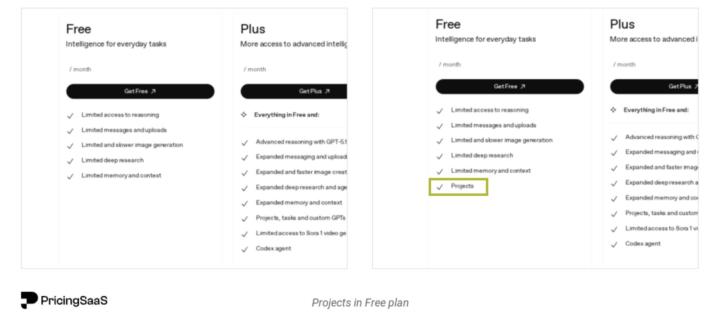
OpenAI just added Projects to the ChatGPT Free Plan.
OpenAI just made Projects free for all 800M ChatGPT users. I like the move for a few reasons: 1. Projects is habit-forming. A place to keep stray notes about all the topics you care about. 2. Projects deepens usage. Adding instructions and context requires a level of depth beyond simple prompts. 3. This combo of stickiness and deeper usage should drive more upgrades. Stickier product + more sophisticated usage means users will hit their usage limits more often (and maybe using Projects makes them curious about Tasks and Custom GPTs?). Even if they don’t upgrade, they're less likely to leave ChatGPT. What do y'all think?

5d •
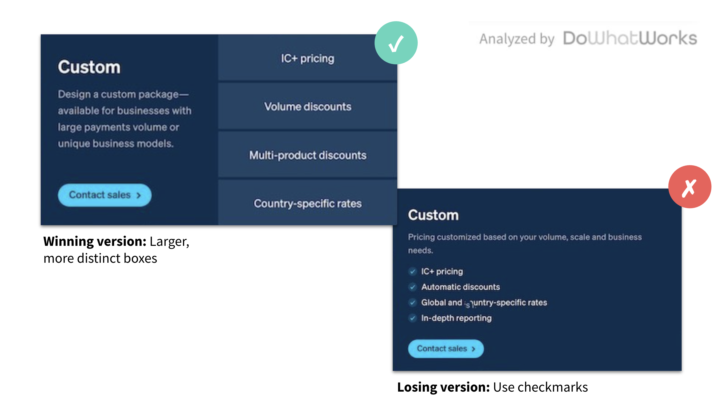
Stripe A/B pricing test around how to display information
Sometimes it's not what you say on your pricing page, it’s how you display that information. I looked at hundreds of A/B tests that have the exact same info, but try…. A grid vs. bullets More white space vs. less white space Bigger text vs. smaller text Image + Stats vs. just stats Although best practices vary depending on industry, location, company stage, and a slew of other factors (we help you navigate that at DoWhatWorks!). Here are two principles that apply to the vast majority of the winning results… → It is easier to read the key thing you want the prospect to see. That is often bigger font, more white space around stats/text, visuals to highlight the key stats etc.. When a page is visually cluttered (images or text), those versions almost always lose. Stripe has been fascinating as a case study here because recently I was going through their tests (I include one around their pricing in the visual deck on this post) and over 90% of their tests can be boiled down to “simplification” and “clarity”. The versions that are simpler and clearer win. → Expectation to reality matching. When I click this button, or tile, what happens next? Simple, clear CTA text wins. Also, helpful subtext below buttons or header/subheader framing can help contribute to clarity here. → Don't make your prospect do math. We find time and time again that the versions of pricing pages with the least required computation win (so the 2-months free, and then 70% off for the first year... yeah, don't do that) When I look at recent website updates from Stripe, Ramp, Cartra, and dozens of others, I find a lot of the same information, but displayed in ways that are far more digestible.
3
0
Oct 29 •
Is there a perfect amount of pricing plan tiers?
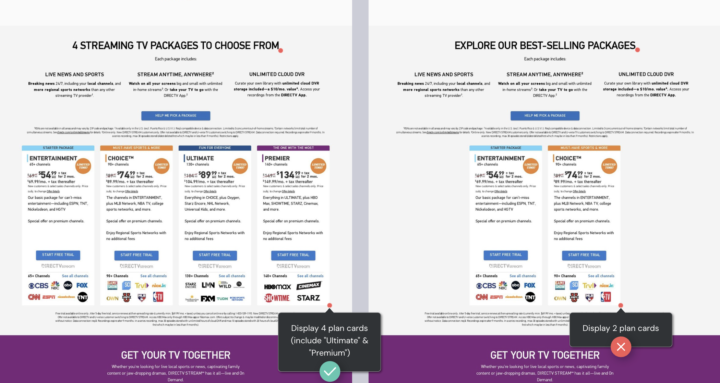
I have spent a lot of time digging into our DoWhatWorks database of A/B tests from the top brands in the world to answer this question. It's a complicated one, with variance by industry and many other variables. That being said, in general, here are a few takeaways from the data... - 4 pricing plans seem to be a sweet spot that performs well for most brands and wins against 1, 2 or 3 plans - 2 pricing plans, seems to have a slight edge over 1 or 3 pricing plans. - 5 pricing plans often wins over 1, 2 or 3 pricing plans. Below you see a test from DirectTV where they tested into 4 pricing plans over 2. Again, there is a lot of nuance here, but some interesting directional guidance.

28d •
Pricing for Membership (B2B on-line training)
Hi all. I have a question about "pricing" that is not related to SaaS, but rather to transforming Professional Services into ARR. Two years ago we started an initial experiment: delivering live online training to IT professionals working in SMEs, using a membership-based approach. Our value proposition: - 8 courses scheduled throughout the year - Two yearly membership options for the customer: - 1) Membership for 1 participant: X€ - 2) Membership for up to 3 participants: 1.6 × X€ (It worked. And we were so happy that we (I) made the BIG mistake: not considering at all - for the second year - the physiological Churn Rate..) For next year, we want to apply the same business model to end-user training (Office M365 Apps). OUR PRODUCT: 8 courses scheduled in advance for all of 2026 OUR TARGET: small/micro companies (2 to 10 potential users) OUR COST STRUCTURE: main costs are fixed (trainer, organization), so the number of people per company in each class is not an issue. PRICING IDEA: offer customers a flat yearly price, divided into tiers that help maintain profitability. We are considering pricing per Company, based on the total number of attendees per course. For example: - 1–2 attendees - 2–5 attendees - 5–10 attendees - I would appreciate any suggestion on how to keep the pricing simple and fair for both sides I have already interviewed about 5 customers who are interested in the concept, but I have not shared any pricing with them yet. Do you thing that pricing per tier is the best options or do you think we have to think in a different way? Thanks in advance to all. Claudio
1-30 of 131

skool.com/pricingsaas
The first stop for SaaS pricing and packaging.
Leaderboard (30-day)
1
+10
2

+9
3

+5
4

+5
5

+5
Powered by