
Write something
Pinned

2d •
5 Style Deals Worth Your Attention This Week!
Found a few solid menswear markdowns worth a look this week. 1. Thursday Boots Frontier — Arizona Adobe - Product name: Thursday Boots Frontier Arizona Adobe (Seconds) - Store: Thursday Boots - Original price: $220 - Sale price: $129 - Discount: 41% off - The Frontier is Thursday's rugged everyday boot — Goodyear welted, full-grain leather upper, and at this price you're getting their toughest silhouette for less than their entry-level Captain. - Link: https://thursdayboots.com/products/_thrscnd_frontier-arizona-adobe 2. Cuts Divine Fleece Hoodie - Product name: Divine Fleece Hoodie — Latte Classic-fit - Store: Cuts Clothing - Original price: $118 - Sale price: $48 - Discount: 59% off - Cuts' signature Divine Fleece is stupid soft — it's the kind of hoodie that ruins you for everything else. Under $50 for a piece that normally runs near $120 is as good as it gets. - Link: https://www.cutsclothing.com/products/divine-fleece-hoodie-latte 3. Peter Manning NYC Performance Jogger - Product name: Performance Jogger — Grey - Store: Peter Manning NYC - Original price: $138 - Sale price: $88 - Discount: 36% off - PMNYC's performance joggers are built for shorter guys who are tired of rolling their cuffs — four-way stretch, tailored cut, and actually hits at the ankle. Sharp enough to wear out, comfortable enough to live in. - Link: https://www.petermanningnyc.com/products/performance-jogger-grey 4. Thursday Boots Frontier — Tobacco - Product name: Thursday Boots Frontier Tobacco (Seconds) - Store: Thursday Boots - Original price: $220 - Sale price: $129 - Discount: 41% off - Same Frontier build as the Arizona Adobe but in a rich tobacco leather that ages beautifully. At 41% off you're basically paying sneaker money for a boot that'll outlast five pairs of sneakers.
Pinned

Jun 5 •
Why Join RMRS Premium?
I’ve stacked so much value into RMRS Premium that seriously it’s a no-brainer YES decision to join. https://www.skool.com/rmrs/plans The details? - Monthly Q&A "Inner Circle Mastermind" LIVE Calls with Antonio & Expert Guests - Access To 6 Micro-Courses Designed To Level Up Your Image - Access To The Monthly Challenge & Prize Eligible - A Man's Guide To Style Course & Dress Like A Man eBook - As a Patron the "activity" requirement doesn't apply to you. Thank you for your support! - The Style System ($1,000 Value) a proven step-by-step program to transform your image - Premium "White Glove" DM support to help you buy the RIGHT clothing at the BEST price - $1,000+ in Discount Codes at your favorite retailers (Save $$$ building your wardrobe!) - Invite To LIVE Event (Dallas, Oct 2026) Click here to join us - https://www.skool.com/rmrs/plans
60
0

2d •
Black
One of my client’s lost her 88 year old mother in a car accident. I chose to go with a medium grey MTM suit and a black belt, black OTC socks, black shoes and a black band on my 1940’s Bulova. While I am at the age where funerals have become much more common, tragedy’s such as these are even more sad for family’s.


4h •
An extended 'Boots Theory' of socioeconomic unfairness...
While I'm not going to delve into the pros and cons of any economic or political system in this post - and I encourage others to refrain from doing so - I had a recent conversation on this very topic in which I expanded on the original concept after explaining its origin and felt that there are, in fact, a number of lessons to be learned from it. Originating from a series of fantasy novels by Terry Pratchett, the 'Boots Theory' of socioeconomic unfairness, as generally stated by Captain Samuel Vines, is that the wealthy are wealthy because they can afford to spend less money. His example was a pair of boots. A pair of quality boots that would last a man 10 years might cost $50, which a wealthy man could afford to buy. A cheap pair of boots, however, might only cost $10, which a poor man could afford to buy. However, when the cardboard started to break down, the poor man ended up with wet feet and needed to replace those boots every year. So, after 10 years, the wealthy man has spent $50 on boots while the poor man has spent $100 - and still has wet feet. While this illustration may or may not have been literal in that fantasy world, it can certainly be taken figuratively in the real one. Quality items typically last longer than inferior ones. However, the expansion I made on the topic - still figuratively centered around boots - is that the original illustration, while elementary, is actually also underselling the point. You see, it ignores the factors of time and redundancy. Following the original illustration, a wealthy man can afford to buy five pairs of quality boots in different styles and/or colors - along with higher-cost maintenance products to accompany them. For the sake of argument, let's say that adds another $50 - bringing the grand total to $300. This allows the wealthy man to rotate his boots, making each last much longer than if they were worn every day. A wealthy man also has the time to regularly maintain his boots - especially the ones he isn't wearing, giving them time to rest and dry. As a result, that wealthy man could expect to get well over 60 years' worth of boot wear out of that $300. Meanwhile, the poor man can only afford one pair of cheap boots at a time and has neither the extra time nor the energy to keep them properly maintained. As a result, for him, we are back to the original calculation, plus a little extra cost, averaged out to each year, for things like patches, broken laces, and the emergency replacement pair of boots from time to time ahead of the expected 1-year lifespan - bringing the poor man's annual cost up to, say, $15. This means that after 60 years, the poor man has spent three times the amount the wealthy man has spent on boots.


4m •
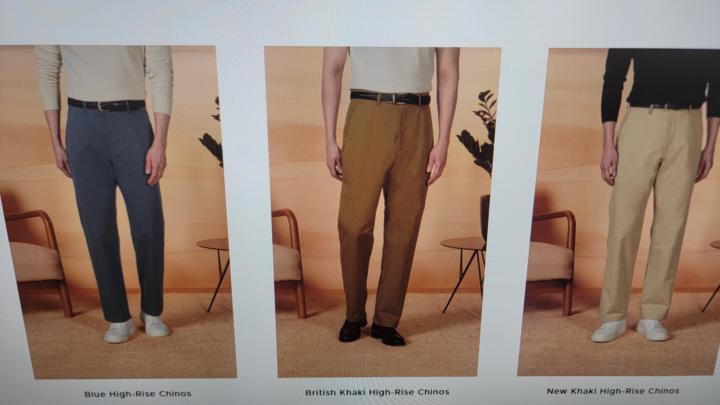
Chino pants advice
Hello everyone, I need to upgrade my wardrobe in a more casual fashion choice. I have tried Penguin Brand which i think is Nordstrom house brand its okay. I have tried Tommy Hilfigure Chinos, love the fabric, the feel, the fit, the color options. But the color fades fast. For the price i pay for it expected them to last longer than 1-2 washes. I am looking for more natural fibers, like 97% cotton and 2--3% elastic. Anyone has experience with Spier and Mackay? Their Chino's are about under $100 a pair, Men's Warehouse sells a good pair for about $50 (i never had a complaint from their product) but I do know they have degraded in quality over time. That is why I am thinking of shopping somewhere else. Any advise would be grateful 🙏. My budget under $100 Fit: not slim and not baggy Look: like James bond casino Royale fit. Materal: the more natural the better. Minimum 95% cotton. Side note: the 3 chinos shown are from Spier and Mackay 2nd photo is from MW.
0
0
1-30 of 30,681

skool.com/rmrs
Leverage style to earn more money and build unshakeable confidence. This is a community for professional men serious about self-improvement.
Leaderboard (30-day)
1

🔥
+4122
2

🔥
+2197
3

🔥
+2129
4

🔥
+2095
5
+1983
Powered by