Activity
Mon
Wed
Fri
Sun
Nov
Dec
Jan
Feb
Mar
Apr
May
Jun
Jul
Aug
Sep
Oct
What is this?
Less
More
Technician Find Community
590
Free
34 contributions to Technician Find Community

Aug 4 •
You're Not Too Busy to Focus. You're Busy Because You Haven't Decided.
One shop owner admitted it on the EasyBench call last week. Nobody said anything for a few seconds, because he'd described the whole room. "I'm busy all day, every day. I don't know if I'm busy on the right things." He wasn't complaining. That's what made it land. Nobody jumped in. You could feel guys running their own week against that sentence and not liking the math. It costs a man something to say that in front of other owners. Owners aren't supposed to be confused. Everybody in the building is waiting on you for the answer. Then another owner answered him in four words. "Read The One Thing." Good advice. Incomplete advice. Most owners who read that book close it fired up. They block off Tuesday morning. By Thursday he's back in the bays with a scan tool in his hand. The book is right. It's also missing a step. You cannot find your one thing without two pieces of information. Most owners have never written down either one. Both of them are in here. By the end you'll know the one thing to do tomorrow before you touch anything else. And why the other forty can wait. "WORK ON THE BUSINESS, NOT IN IT" HAS NEVER ONCE HELPED YOU AT 7:15 ON A TUESDAY You've heard that line four hundred times. From a stage. From a coach. From a guy in a Facebook group who has never had a tech call out. It's true. It's also useless as an instruction. At 7:15 AM on a Tuesday a tech calls out, eleven cars are promised by five, and the parts guy left a voicemail you already know you're going to hate. Nobody has told you which of those to drop. In most businesses, urgent and unimportant are easy to tell apart. The email chain nobody needs. The meeting about the meeting. You can spot the junk from across the room. Your shop doesn't work that way. The comeback is urgent and important. The customer standing in your lobby is urgent and important. The delayed part is holding a car that's holding a bay that's holding your week. You are not wrong to handle any of it. That's the trap. It isn't laziness. Laziness would be easy to spot and easy to fix.


1 like • Aug 5
This is amazing Chris. My whole issue is I learn so much and don't use most of what I learn. I have a tremendous opportunity with my life and my business and I am really going to take this on! In Chapter 11 of the book it says to have as many people as you can to hold you accountable also. I am starting with you guys!
Jun 5 •
Don't add accountability
A shop owner said this to his manager last week. Not to a tech he was about to write up. To his manager. About himself. "I haven't done a thing I promised you yet. But that's because I can't figure it out." He wasn't slacking. He was buried. And he was doing the exact thing to himself that runs good techs out the door. Here's how accountability actually sounds. Not in a book. In your own head, on a Sunday night. Did you do the thing you said you'd do? No. Why not? And then the explanation. Car count was down. The advisor quit. Your kid had a thing. All true. All real. And every word makes you feel a little worse. Okay. Put it back on the list for next week. And around you go. Same list. Same Sunday. Same knot in your gut, a notch tighter every lap. When that voice comes from somebody else, you can walk. Quit, leave, stop answering — there's always a door. But it's not somebody else. It's you. You're the boss and the kid both. There's no door out of your own head. So you do the next easiest thing. You quit the work. You stop setting the goal. Because not setting it hurts less than missing it again. That's not laziness. That's self-protection. And it's the real reason your best ideas die in a notebook on your desk. People will tell you the fix is rest. Take a vacation. Make some time for yourself. You already know how that goes. An owner said it better than I could: vacation just means a bigger pile when you get back. Rest fixes one thing. Being tired. It does nothing for the loop, because the loop was never about energy. It was about the question. So change the question. Stop asking yourself whether you did your homework. Ask two other things instead. What worked. And what did you learn. That's it. Those are the only two things in the past worth anything to you, because they're the only two you can build on. Everything else is just a reason to feel bad. And feeling bad has never moved a single car through a single bay. Wins and lessons. Then you find the one thing in the way, you move it, and you pick the next move.

1 like • Jun 17
You have no idea how this just hit me. I started using the Copilot and never finished, like I have been running my business for 37 years. Its painful! I will start using it again. Thanks for writing this and thanks for doing all that you do!
Jun 15 •
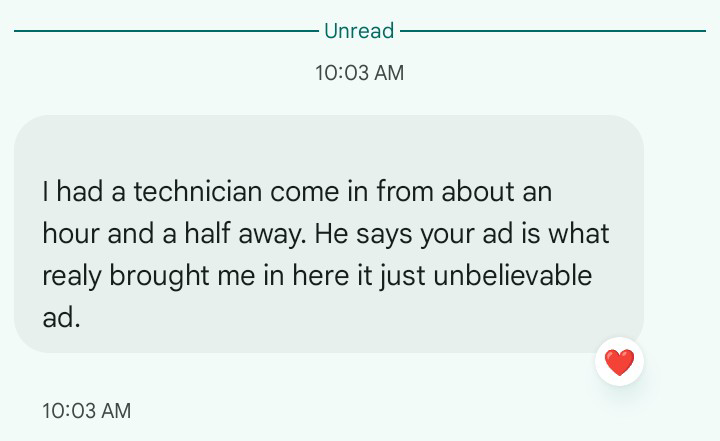
Don't ever forget this...
I'm about to hop on a plane after two amazing shop visits in Washington and I got this text from a shop owner in Iowa. Just a reminder of the power of a well-written ad.
2 likes • Jun 17
Warms My Heart! Thanks for doing what you do!
May 20 •
The Best Clients I've Ever Worked With Don't Call Me at 11pm
The shop owners I work with aren't the ones at the end of their rope. They're the ones who refuse to get there. That distinction looks small from the outside. It's the difference between the shops that win at staffing and the shops that don't. One owner knew his master tech was going to part-time at year-end. He started the conversation in September. Another owner's B-tech committed to a John Deere job — in writing — for a July start. He started the conversation in March. Another owner watched his 40-year veteran tear a shoulder for the second time. He didn't wait for the retirement announcement. He moved the next week. Another owner was buying his business partner out at year-end. He knew his shop was about to change hands and the tech mix had to be right before it did. He moved in June. Every one of these owners had something in common, and it wasn't the trigger. The trigger varied — relocation, retirement, succession, expansion, injury, a buyout, the offer a tech couldn't refuse. What they shared was the timing. They picked up the phone before the bay was empty. Most shop owners think of the staffing problem as a binary. You either have enough techs or you don't. You're either fine or you're scrambling. That framing is wrong. And it's quietly expensive. The real frame is trigger-with-runway versus trigger-without-runway. The trigger is the same in both cases. A tech is leaving. Capacity is changing. A wave is forming. The difference is when the owner picks up the phone. The panicker picks up the phone after the tech walks out. He's calling from zero leverage. The planner picks up the phone before. He's calling from full leverage. Same trigger. Different timing. Different leverage. Different outcome. What the planner has that the panicker doesn't isn't money. The planner often spends less — because he's not paying the premium that comes with a job posting marked "urgent." It isn't market. The planner is often in a worse market — rural Pennsylvania, small-town Iowa, a county with one dealership and three independents recruiting from the same twenty techs.
1 like • May 21
BENCH
May 15 •
Your Best Tech Already Decided You Don't Exist
It's 6:47 PM on a Tuesday. A 38-year-old master tech named Jason is standing at his toolbox, still in uniform, still in someone else's shop. He's been there since 7 AM. He stayed late because his service writer told a customer her car would be ready by 8 AM. Nobody told Jason. His back hurts. He hasn't seen his kids awake since Sunday. And a thought is sliding through his head for the third time this week: I'm worth more than this. He's not on Indeed. He's not refreshing your careers page. He's not going to apply to your "Now Hiring — $30/hr — Apply Today" ad. Not because the ad is bad. Because the ad is answering a question Jason isn't asking yet. And he's the tech you want. Here's the part most shop owners have never been told: YOU'RE NOT RUNNING ONE HIRING CAMPAIGN. YOU'RE RUNNING FIVE. YOU'VE ONLY EVER BUILT ONE. Every tech in your market goes through five distinct stages before he ever clocks in at your shop. Each stage is a different person, with a different question, with a different filter on what he'll let into his attention. The "now hiring" ad you've been running for four years answers the question at Stage 4. Roughly 80% of the techs you want are sitting at Stages 1 and 2. You're shouting into a room they're not in yet. Worse — and I'll prove this in a minute — the way most shops run their hiring ads is actively repelling the techs they're trying to attract. Let me walk you through the stages. Then I'll show you the unfair advantage hiding in plain sight, and what one of my members did with it last quarter. 👉 Stage 1 — Awareness. (Where 70% of the techs in your market actually live.) Jason isn't job-hunting. He's pain-hunting. He's scrolling Facebook on the couch after his kids go to bed. He's thumbing past his cousin's vacation photos. The voice in his head is not "I should update my resume." The voice in his head is "I know I deserve better — but what if every shop is just as bad as this one?" That voice is the only thing standing between you and a hire.

3 likes • May 17
Boy,that was eye opening!
1-10 of 34

Active 31d ago
Joined Jan 14, 2024
Powered by