

May 30 •
The Fight You're Already Winning
"I can't pay what the dealer pays." You've said it. I've heard it a hundred times. It's one of the most expensive sentences in this business — and not for the reason you think. WrenchWay and ASE just surveyed more than 5,500 people in this trade. One number in there should stop you cold. They asked techs at dealerships if they feel valued and respected by management. 39% said yes. They asked techs at independent shops the same thing. 61% said yes. Then they asked if they'd recommend their shop to a friend. Dealership: 36%. Independent: 63%. Almost two to one. On the exact thing a raise can't buy. So why do you keep losing techs to them? Because you've been guarding the wrong door. Pay is how a tech walks in. It's almost never why he walks out. Think about the last good one who walked. Was it really about a couple of bucks an hour? Or did he stop seeing a reason to stay? Here's what they actually leave for. Not money. A map. Techs don't quit jobs. They quit dead ends. A raise answers one question: "What do I make?" That's not the question keeping your best guy up at night. His question is, "Where am I going?" And in most shops, the honest answer is: nowhere. Same bay, same work, same ceiling, five years from now. You don't fix that with a few more dollars per hour. You fix it with a future he can see. Here's the part that stung when I sat with the data. They asked owners and techs the same question: is this trade getting better? 40% of owners said yes. Only 23% of techs agreed. That's not an industry statistic. It's personal. It's the exact distance between how good you think your shop feels — and how it actually feels standing under a lift at 4:30 on a Friday afternoon. Every "I never saw it coming" resignation lives in that gap. And the owners it happens to aren't bad owners. They're good ones. With a blind spot. You're not losing. You're winning the hard part. The part that takes years — culture, respect, a crew that actually likes working for you — you've already built. The data proves it.

May 2 •
$5,000 in Pizza Saved Them 10 Years of Turnover
Can $5K in pizza outwork $60K in turnover? A $5K weekly lunch habit beats a $60K bad hire — if you ask the right question and shut up after. In this post: - The question that turns "fine" into a fix. - Why monthly meetings fail where weekly ones win. - The ten-second discipline that makes or breaks the meeting (and it's not the lunch). - The math: $29,500 per bay × 50% gross profit, and why $5K starts looking cheap. - The six-step Monday version — including the week most owners quit before it works. 4 min read. Short on time? Watch or listen to the video walkthrough below while you're on the go. ___ Five thousand dollars a year. That's what a shop in the Midwest spends on Thursday lunch for the team. They've been doing it for ten years. They've fired exactly two people in that time. Most of the team has been there since the day they were hired. It's not the lunch. Same day, every week. That's the cadence. One question with a specific shape: "If we tweaked one process around here, what would you tweak?" Then the owners shut up. Three things, working together. None of them work alone. WHY WEEKLY Most shops run feedback as an event. Annual reviews. Quarterly check-ins. Maybe a monthly meeting if the owner is ambitious. Each one fails for a different reason. Annual reviews show up too late. By the time you hear about the broken process, the tech has either worked around it or left. Quarterly check-ins turn into HR theater. Everyone shows up with rehearsed answers because they've had three months to forget what was actually irritating them in March. Monthly meetings get closer. But the average tech has already swallowed three or four small complaints by the time the meeting comes around. Most won't bother resurfacing them. Weekly is different. The irritation is fresh. The tech remembers the exact thing that broke yesterday. The fix is still cheap. Frequency is what converts feedback into a culture. Without it, feedback decays into compliance — and compliance is what techs do right before they update their resume.

May '25 •
How does your shop stack up?
I was asked recently by a podcast host what technicians should look for when searching for a shop. I answered off the cuff with what I've seen over the years that separates the shops that really take care of their employees from those who don't. I thought it was a pretty good answer in the moment but the question nagged at me long after the interview. So I teamed up with my buddy ChatGPT and ran some prompts to find out what the common threads are between the shops we've worked with that hire faster and retain longer. Then I compiled them together into a checklist for technicians (see below). How does your shop stak up with my list? Am I on the mark or totally off-base? Would love to get your feedback. ___________________________________________________________________________________________________ Technician's Checklist for Identifying a Good Auto Repair Shop to Work For: 1. Company Culture & Values - Prioritizes culture-fit when hiring. - Demonstrates clear mission and core values emphasizing integrity, communication, and teamwork. - Environment encourages positive attitude, open communication, and mutual support. 2. Leadership & Management - Owner or management has direct industry experience as technicians. - Management maintains an open-door policy for employees. - Regular, structured feedback meetings between management and employees (e.g., quarterly goals meetings, daily huddles and 1-on-1's). 3. Work Environment - Well-equipped, Modern facilities with necessary diagnostic tools and equipment. - Access to comprehensive resources, including tools, laptops/tablets, diagnostic software, and digital inspection processes. - Shop promotes efficiency and organized workflow to minimize downtime and maximize earning potential. 4. Training & Development - Strong emphasis on ongoing training and professional development (ASE certifications encouraged and incentivized). - Clearly defined apprenticeship or mentorship programs. - Opportunities to attend industry-specific training courses and certifications, often employer-paid.

Oct '25 •
I asked over 100 techs why they quit. Here’s the pattern.
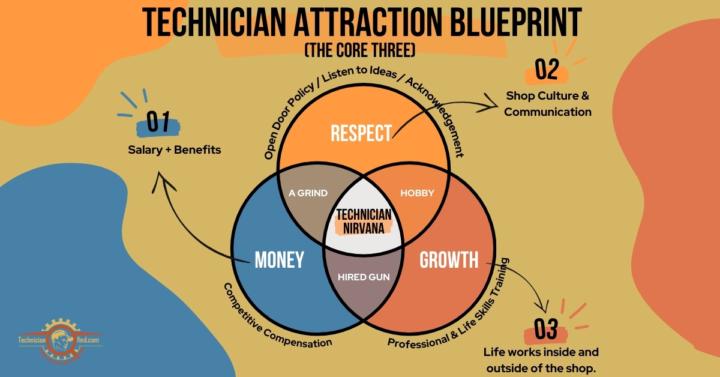
As an industry, we keep saying we’re “short on techs,” but the best ones aren’t hiding—they’re just ignoring shops that look the same. After 7 years of conversations and 100+ exit interviews, the pattern is blunt: 1) Wrong pond, wrong bait.We blast generic job-board ads and expect top performers to bite. They don’t. They move through referrals, reputation, and communities where your shop rarely shows up. 2) Leaving beats staying (on paper). Great techs flirt with opening a shop not because they want payroll headaches, but because it promises three things they’re missing: respect, control over income, and real growth. 3) The 3-circle gap (why they quit): - Respect: Real open-door policy, not lip service. Clear communication, decisions with tech input. - Money: Competitive comp that tracks value, not tenure. Transparent paths to higher earnings. - Growth: Personal AND Professional training, tooling, and a ladder beyond “turn more hours”. Great employees want to go with shops that want their life to work inside and outside of the shop. When all three circles overlap, two things happen fast: - Retention sticks. People stop taking recruiter calls. - Attraction turns magnetic. You stop “hiring” and start selecting. The “shortage” mostly exists in shops trying to win with one circle (usually Money) and hoping the rest will sort itself out. If you want fewer resignations this quarter, start here: audit your Respect–Money–Growth overlap. Then replace job-board spam with proof—tech-facing videos, team-led referrals, and visible systems that make great techs say, “Yep, I can thrive there.” The future isn’t about convincing kids to join the industry—it’s about building shops worth joining.
Sep '25 •
He was about to lose his 3 best techs (until he tried this Monday morning ritual)
Yesterday I heard a story from a client that I had to share. Mike, a shop owner from Dallas called his business coach in a panic. "I just found out through the grapevine that THREE of my best techs are looking at other shops," he said. "One already has an offer. I had no idea they were unhappy." Sound familiar? Here's the kicker: All three techs had been with Mike for 5+ years. They weren't leaving for money. They were leaving because of something Mike never saw coming - they felt invisible. One tech later told him: "You talk to me when something's broken or when I mess up. But you never ask how I'm doing or what would make my job better." Ouch. LESSON: Mike learned something that changed everything: Exit interviews are autopsies. By then, your tech is already gone. What he needed were "Stay Interviews" - proactive, 10-minute weekly conversations that catch problems while you can still fix them. Here's the exact system Mike implemented (that kept all 3 techs from leaving): The Monday Morning Stay Interview Process Step 1: The 3-Question Check-In (5 minutes) Every Monday, Mike asks each of his top techs: 1. "What's one thing that went well for you last week?" 2. "What's one frustration you're dealing with right now?" 3. "If you could change one thing about your job this week, what would it be?" Step 2: The Early Warning Scorecard (2 minutes) Mike tracks these 5 flight-risk indicators weekly: - Energy level (1-10) - Tool/equipment complaints - Customer and team interactions and overall mood - Initiative on jobs (taking on challenges vs. bare minimum) - Water cooler talk (engaged vs. withdrawn) Any score dropping 2+ points = immediate deeper conversation Step 3: The Fix-It Promise (3 minutes) Mike commits to addressing ONE issue each week - even small ones. - Week 1: Fixed the shop fan that had been broken for 6 months - Week 2: Changed the parts ordering process that was driving everyone crazy - Week 3: Started rotating who gets the gravy jobs

1-30 of 40

skool.com/technicianfind
Proven templates, strategies, training and top-level networking to help independent auto repair shops hire quality staff faster.
Leaderboard (30-day)
1

+3
2

+2
3

+2
4

+2
5

+1
Powered by