

17h •
Sunday Qi Talk
Hey everyone—this Sunday we’re kicking off our monthly Qi Talk series 🌀 Qi Talk is a relaxed, open Q&A space for our community. You can ask questions about Tai Chi, Qigong, training, or just share what you’ve been working on and experiencing in your practice. The Qi Talk will start at 10:15am this Sunday following the Qi & Flow class and a short break. To get things started, drop your questions or topics in this thread ahead of time so we can make sure to cover them. Even if you can’t attend live, you’ll still benefit from the discussion. And of course, you’re welcome to join live and ask questions in real time. Looking forward to hearing what’s on your mind and seeing some of you there 🙏
5d •
Xin Qi Shen Newsletter | Beginner's Mind
For many years, decades actually, one of my teacher's Andy Dale produced an in house newsletter. I have archived almost all of the material and with his permission will be sharing articles and pieces from the vast collection. I thought it fitting to start with a piece on "Beginner's Mind" that I can remember reading way back when I first began training.
Oct '25 •
Coffee & Qi 咖啡话
Join me tomorrow morning for our first Coffee & Qi from 11:30-12:30pm PST. We can enjoy a simple chat about the practices we now share. If you have any questions or topics drop them in the comments or just ask away tomorrow. In China, it is quite common for teachers and students to sit over tea before or after class and discuss the practice. Over the years, all my teachers, whether they were from China or someplace else had their own way of going about this. Here in Visalia we have a local coffee shop that I have always loved. When I moved away to China I would get beans from them any chance I could get. After I moved back I liked taking students there and introducing them to this local gem. Our small town had grown so much in the time I was gone, but Mavericks Coffee still was relatively undiscovered. Of course, our chats would usually center around qi gong, tai ji, marital arts and general practice topics and that is why we now have Coffee & Qi! No beverage needed:).
Oct '25 •
"Don't insist and don't resist"
This saying was oft repeated by one of my teachers, so much so that I still hear it in my own practice for which I am very thankful. As with any principle it is there as a gentle reminder, to be recalled only as needed. In this way we can simply relax and be present as our practice unfolds around us. If you feel like you are forcing a movement or not quite getting it, then allow those concepts to guide your intention and your individual connection to the practice to grow. Please feel free to ask questions or comment on any of the topics or concepts shared in this section.
Jan 14 •
A Student of Your Breath | 8 Qualities of the Breath
The Qualities of the breath. The breath is something that is intrinsically linked to our practice and something that is often overlooked in other physical practices. You can look up and google many different kinds of breath work and even become a certified master of breathing;). So how does qi gong view breathing? Well first, let’s not over worry about breathing wrong or incorrectly. If you are currently alive then your breath is doing a great job of keeping you functioning and thinking, especially since the brain uses way more oxygen than almost any other part of the body, so thank your breath for all those good ideas:). Rather than think that we need to control our breath, instead look to become a student of your breath. Listen and observe for how it is already working alongside your movement and posture doing a great job without you ever having had to do a thing. To quote Sun Tzu, “The breath sets the strategy”, and how we connect to our breath is directly related to our concept of ‘song’. By taking the mental posture of a student, we can then relax into the deeper systems that bring stabilization and ease into our state. It is also good to know that the air we breath and exchange with the environment is an aspect of environmental Qi, which is something different from the qi we are observing within our system. The beauty of the breath is that it is something we can use to ‘shine a flashlight’ or “create resonance” within our entire body, but the respiratory process is contained within some very specific spaces and uses logical mechanics. Overtime, there is an integration of sensory inputs that will help support and benefit the system. It is as simple as beginning to learn more about the breath and how to interact and perceive it. Below are a list of qualities we can learn to observe and look for in our breath. These are intentions that we can carry with us to gently influence the nature and quality of our breath over time. Remember, intention is like a rock you cast into a pool. We are looking and listening for the splash and ripples and feeling for the change in current. They are also guides for further study as we can begin to learn what other aspects of our practice need to be present and cultivated to draw out these qualities more easily.

1-15 of 15
skool.com/rootedalchemy
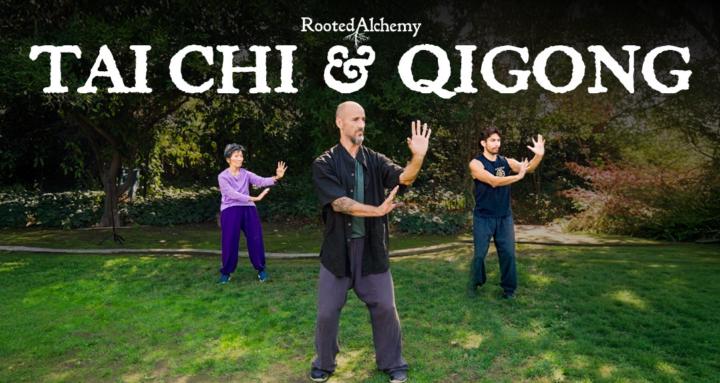
Rooted Alchemy makes Tai Ji and Qi Gong accessible, artistic, and enjoyable—helping people transform their inner world through ancient practice.
Leaderboard (30-day)
1

+650
2

+439
3

+198
4

+195
5

+185
Powered by