
Write something

⭐
🔥
3d •
New inside the classroom: The Baker’s Business Library
This is where I’ll be adding the more polished, deeper-dive lessons, walkthroughs, calculators, and practical tools that do not always fit neatly inside a single module. Think of it as a growing reference shelf for the business side of baking: production, pricing, planning, markets, systems, and the little details that make the work easier to repeat. The first lesson is Market Levain, a walkthrough on scaling your starter for real batch sizes without turning your mother starter into a giant science project. Start there, and keep an eye on this section. I’ll be adding more. https://youtu.be/FR3915Hlizw
⭐
🔥
2d •
Your customers don’t hate sourdough. They hate over fermented sourdough.
There’s a difference, and it costs you sales. The person who wrinkles their nose at your table and says “oh, sourdough’s too sour for me” isn’t rejecting sourdough. They’re remembering the last aggressively tangy, gummy slice somebody handed them and called artisan. That loaf sat in bulk too long. The starter was past its window. Nobody controlled the ferment, so the ferment ran the show. Flavor isn’t luck. It’s a decision you make, and it starts before you ever mix dough. It starts in your starter. A starter fed and used at its peak gives you that clean, mild, slightly sweet, nutty bread that turns a “too sour for me” customer into a repeat buyer. A starter you pulled hours past peak, or one you’ve been neglecting, brings sharp acid and a flavor most people at a farmers market don’t want. Same flour. Same hands. Completely different sale. If you’re selling bread, this is the whole game. You’re not just baking loaves. You’re building a flavor people come back for. And you can’t build it consistently until you can read your starter and time it on purpose. That’s exactly what this video walks through. Flavor control, and how all of it traces back to the jar on your counter. Watch it here: https://youtu.be/4N4nCAnV5yU Then come tell me: what’s the feedback you hear most at your table, and does “too sour” show up more than you’d like? Perfection is not required. Progress is. ~ Henry ⭐🔥
⭐
🔥
4d •
When Things Go Wrong
Here's something I don't see taught enough, so I built a whole lesson around it. Module 6.5, The Bad Loaf, the Missed Order, the Lost Customer. If you sell bread long enough, you're going to have a bad day. A loaf comes out underbaked and you don't catch it in time. Somebody drives out for a preorder you forgot to bag. A regular tries something new, doesn't love it, and you can see it on their face. It happens to every baker who's ever set up a table. It's happened to me. Here's the part most folks get wrong. They think the goal is to never make the mistake. It isn't. You will make the mistake. The goal is what you do in the ninety seconds after. Because a mistake handled well doesn't cost you a customer. It's the thing that turns them into a regular. People don't remember the perfect transactions. They remember the time something went sideways and you made it right without making them feel bad about it. A few things I've learned the hard way: Own it fast and plain. "You're right, that one's on me." No excuses, no long story about your oven. The apology stays short, the fix gets bigger. Make it right generously. Replace it, refund it, hand them the next one on the house. Whatever it costs you is cheaper than the customer you lose and the ten people they tell. Don't grovel. Owning a mistake and drowning in it are two different things. Fix it, mean it, move on. Confidence reassures people. A puddle of apology just makes them uncomfortable. That's the heart of it. The full lesson has the actual word-for-word recovery scripts for all three situations, the ones you can practically read off your phone in the moment your stomach drops and your mind goes blank. Every baker needs these before they need them. Not the day it happens. Want to see how the whole system works, no pressure and nothing to buy to look? Here's the walk-through: https://skoo.ly/walkthrough

⭐
🔥
8d •
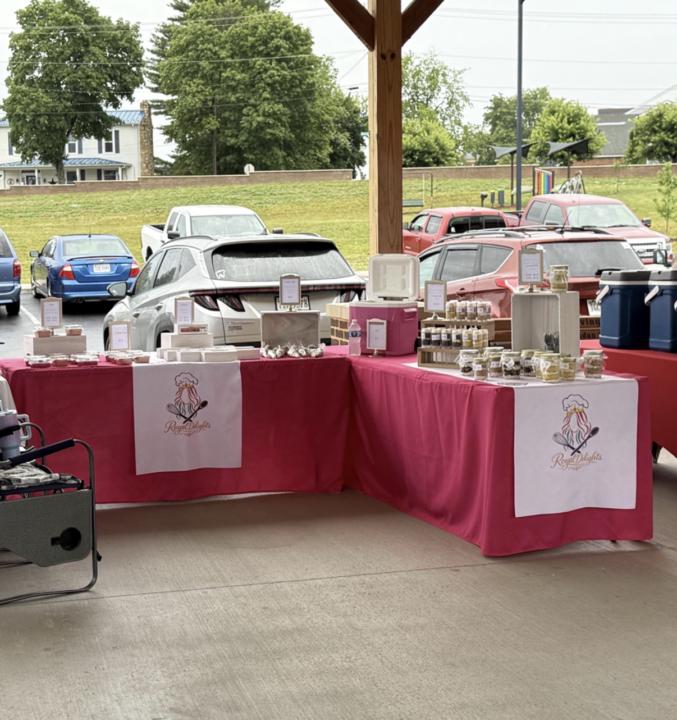
What a real market table looks like
This is @Kim Cochran’s setup from Royal Delights this past Saturday. I want to walk through it, because she’s doing almost everything right and there’s a lot here to learn from. Start with the shape. Most bakers set up one long table and stand behind it like a cashier. That table becomes a wall. Kim went with a U, and that horseshoe pulls people into her space. They slow down, they step in, and once they’re inside they’re browsing instead of walking past. Her cloths drop all the way to the floor and they match. That’s what separates a business from a bake sale. Nobody sees the totes and the backup bins underneath. It’s clean and it’s finished. Her branding repeats. The Royal Delights logo is on both runners and on her signage, same mark every time. When a customer sees the name three times before they’ve said a word, she stops reading as somebody’s mom selling cookies and starts reading as a bakery. The product is tiered. She’s using risers to build height, so everything climbs instead of lying flat. A full, stacked table tells the customer other folks have been buying and there’s plenty to go around. A sparse table says the opposite. Prices are out where people can see them. A lot of customers will walk rather than ask what something costs. Kim took that friction away. One color story, pink and white, right down to the cooler. Even the cold items that have to stay cold got worked into the look instead of fighting it. And her chair’s off to the side, so she can step out and greet somebody instead of being walled in. She also showed up in the rain. That’s its own kind of marketing. When people learn you’re there every Saturday no matter the weather, you become the stop they plan around. The one thing left for Kim is a website, and that’s what we’re building now. The table only sells to the people in front of it. A site is what lets a Saturday customer find her again on Wednesday and order for the following week. That’s how a market table turns into a real bakery with repeat customers.
⭐
🔥
13d •
Your booth is the first impression.
Before a single person tastes your bread, they've already decided something about you from 20 feet away. Most of us never see our own booth the way a customer does. We're standing behind it, looking out. The customer's standing in front of it, looking in, and that's the view that decides whether they stop or keep walking. " Here's your homework this week, and it takes five minutes. Set up your booth exactly the way you'd run it on market day. Tablecloth, signage, the bread, the price cards, all of it. Then walk around to the front. Stand where your customer stands. Take a step back and take a photo. Now look at that photo like you've never seen your bread before. Is the name easy to read? Can you tell what things cost without asking? Does it look like a business, or like a folding table somebody threw together? Where does your eye land first, and is that where you'd want it to land? You'll spot things in that photo you'd never catch standing behind the table. That's the whole point. Post your booth photo in the comments if you're up for it. We'll give each other honest, kind feedback, the kind that actually helps you sell more on Saturday. Perfection is not required. Progress is. ~Henry⭐🔥

1-9 of 9

skool.com/from-oven-to-market
🌾Turn your baking into real income. Learn to price right, sell legal, and sell out at farmers markets. For home bakers, no commercial kitchen needed.
Leaderboard (30-day)
1

+168
2

🔥
+122
3

+109
4

🔥
+91
5

🔥
+61
Powered by