Activity
Mon
Wed
Fri
Sun
Jan
Feb
Mar
Apr
May
Jun
Jul
Aug
Sep
Oct
Nov
What is this?
Less
More
Owned by Sheldon
Move smarter, feel stronger, live fully. Join a community built for movement, injury prevention, and peak performance—at any age or stage.
Memberships
Supple Athlete +
318 members • $75/month
Creators
16k members • Free
Skool Add-ons
652 members • Free
Lifestyle Foundr Group™
8.7k members • Free
Viral Coach Training Material
18.2k members • Free
Skoolers
183.7k members • Free
9 contributions to Movement Based Therapy

Sep 25 •
Why 9 Times Out of 10 Mobility Will Always Trump Stability
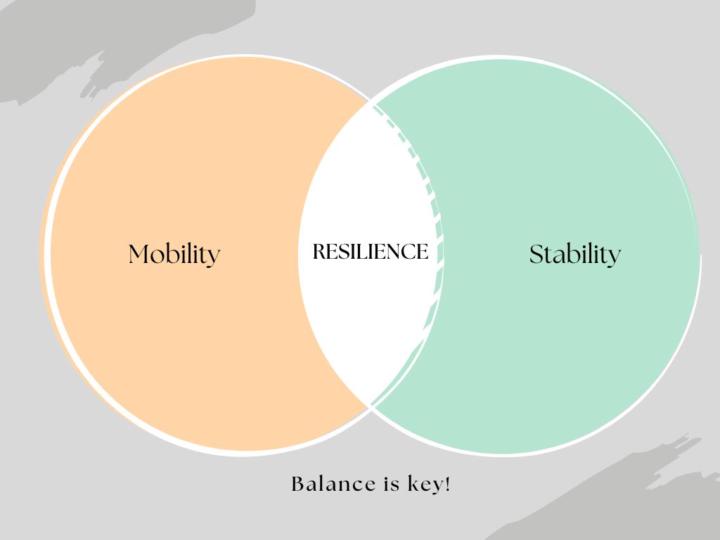
We love to talk about “stability training.” Core work, planks, balance drills — all important tools. But here’s the truth: if a joint doesn’t have adequate mobility, there’s no point in locking it down with stability drills. Think of it like this: trying to stabilize a joint without mobility is like putting concrete around a rusty hinge. You’re making it rigid, not functional. True movement requires both range of motion and control. But mobility almost always comes first. The Mobility–Stability Puzzle: Movement is seen as a hierarchy: - Mobility is the foundation — the ability of a joint to move freely through its intended range. - Stability is built on top — the control and strength to manage that range. If mobility is missing, stability can’t express itself properly. You end up with rigidity, compensation, or even pain. Picture recommendation: A simple infographic showing a pyramid with “Mobility” at the base and “Stability” on the next level above it. Caption: “Mobility creates the foundation for stability.” The Splits Analogy: Imagine someone who can drop into a full splits. Impressive, right? Now watch them get out of it. More often than not (ESPECIALLY they've never heard of Moves Method ;) ), they tuck and roll out of the position. That’s because they’ve got mobility (the ability to drop into the position) but lack stability (the ability to control their way back up using the muscles involved). If mobility and stability were in balance, that same person could press themselves back up with control — no barrel roll required. Why Mobility Comes First - Without mobility, stability = rigidity. You’re just reinforcing a limited pattern. - With mobility, stability = control. You unlock functional, adaptable movement. - Together, mobility + stability = resilience. That’s when performance and injury prevention truly thrive. Here’s the big takeaway: train mobility first, then layer stability. Otherwise, you’re just teaching your body how to be stiff, not strong.
Poll
1 member has voted
1 like • 6d
@Jordan Engeman Thanks for sharing! There is definitely a balance of being able to perform the work that needs to get done, but even more so the importance of self-care. We can't pour from an empty bowl, and it sounds like you started to recognize early on where you could end up if you continued doing things the way you were. I'm glad that were able to work together, and each time we connect I get excited to hear about the progress you make each week. Keep getting after it, keep filling up that bowl 🙌🏽 💛
Jul 24 •
🛌 Stiff Neck? Sleep Better!
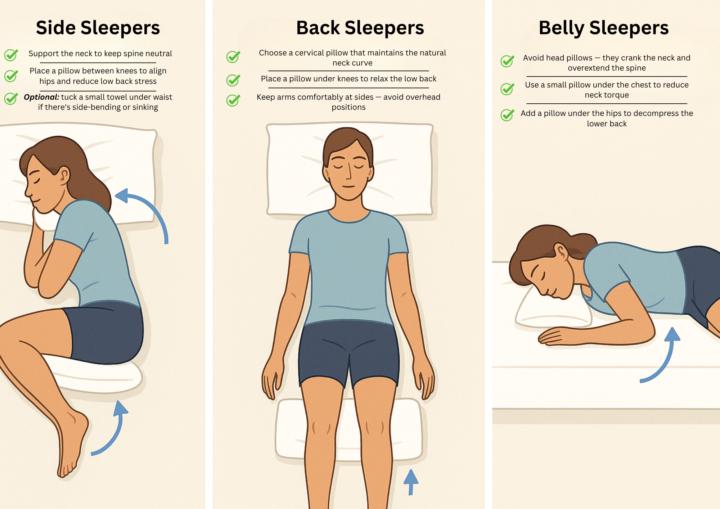
How Nighttime Posture Shapes Your Daytime Movement Ever wake up with a stiff neck, shoulder tension, or low back pain — even though you didn’t do anything “wrong”? Chances are, your sleep position is quietly contributing to those morning aches. How you sleep matters. It's not just about getting enough hours — it's about how your body is aligned for 6–8 hours straight. Think of sleep as passive recovery time. If your alignment is off, your tissues are under strain for hours without support or movement. Over time, this can feed into chronic tightness, pain, and even poor posture habits during the day. Let’s break it down by sleep position — with visuals to guide you toward smarter nighttime strategies: 🛏️ 1. Side Sleepers: Neck and Hips in Harmony What to fix:Most side sleepers use a pillow that lifts the head but lets the neck drop. Over time, this leads to neck strain, shoulder compression, and spinal asymmetry. What to do instead: ✅ Use a contoured or thicker pillow that fills the space between your neck and mattress — not just under your head. Your neck should stay in line with your spine, not bent sideways. ✅ Add a pillow between your knees. This helps align your hips, reduces tension in your lower back, and prevents torque through the pelvis. ✅ Tuck a small rolled towel under your waist if you have a side-body curve or feel your spine sagging. 🛏️ 2. Back Sleepers: Support the Curves What to fix:Back sleeping can feel natural, but many people use high pillows that push the head forward, flatten the neck curve, and overstretch upper back muscles. What to do instead: ✅ Use a thin pillow or cervical support pillow that cradles the neck and keeps the head neutral. ✅ Add a pillow under the knees to flatten the lumbar curve and offload pressure from the low back. ✅ Keep arms down by your sides or gently rested on the stomach — arms overhead can compress the shoulders and stretch nerve pathways overnight. 🛏️ 3. Belly Sleepers: The Problem Child (But We Get It) What to fix:Stomach sleeping puts the neck in full rotation for hours and compresses the lower back. It’s the least optimal position for spinal alignment — but many people can’t fall asleep any other way.
1
0
Jul 14 •
🌟 Rolling Beyond Babies: How Developmental Positions Shape Our Movement for Life
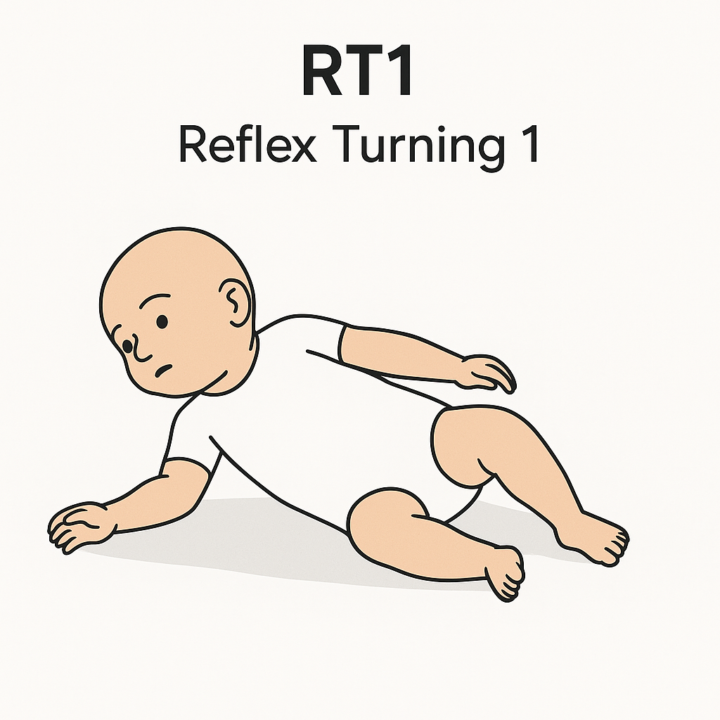
Ever wonder why babies move so effortlessly? Why they roll, twist, and push up without any “core workout”? It’s because they follow a brilliant, natural blueprint of movement that we often lose as adults. But what if you could reconnect to that same foundation to build stronger, more functional movement today? In this post, we’ll explore three powerful positions — RT1, RT2, and RT3 — not just as “baby milestones,” but as adult movement superpowers. Discover how they shape your strength, stability, and freedom, and learn exactly how to reintroduce them into your daily routine or training. ⸻ 🌀 RT1: The Head Leads the Way What is RT1? RT1 (Reflex Turning 1) is the first stage of turning development in infants, usually around 4 months. Here, movement begins with the head and upper trunk, while the pelvis stays quiet. This sets the stage for independent head and neck control and dissociating upper from lower body — foundational skills we need throughout life. Why it matters for adults ✅ Looking over your shoulder when driving. ✅ Rotating to reach for something behind you without twisting your hips. ✅ Supporting healthy neck mobility to reduce tension and headaches. RT1 helps us reclaim healthy cervical and upper thoracic mobility, crucial for efficient, pain-free movement. ⸻ 🌊 RT2: Rolling from the trunk What is RT2? By about 4.5–5 months, infants enter RT2. Here, they begin using segmental trunk rotation, involving the pelvis and trunk muscles to roll onto the side. This phase represents our first real experience of diagonal movement and integrated trunk control. Why it matters for adults ✅ Rolling out of bed. ✅ Throwing, swinging a racquet or club. ✅ Transitioning through twisting movements in sports or daily life. RT2 restores our ability to move the spine segmentally, engage the oblique system, and coordinate the entire trunk — all keys to powerful, safe rotational movement. ⸻ 🐯 RT3: Prone and Proud What is RT3? Around 5.5–6 months, babies progress to RT3: moving fully onto their belly and supporting on their forearms or hands with the head up and trunk extended. This phase builds strength for future crawling and sitting.
1
0
Jul 13 •
🎙️ Beyond the “Core”: Mastering True Trunk Stability | EP3
Hey movement family! In Episode 3 of the MBT Podcast, we go beyond the “core” — because it’s so much more than just crunches or chasing six-pack abs. We break down what true trunk stability really means:✅ How your core is actually a dynamic system of muscles and fascia working together✅ Why internal pressurization is key to real stability and spine protection✅ The role of deep stabilizers like the diaphragm, pelvic floor, and obliques✅ How trunk stability influences your efficiency and power in sports and everyday life I also share some of my favorite foundational positions and drills you can start using right now to build resilience, improve performance, and move with more intention. Whether you’re an athlete, coach, therapist, or just someone who wants to feel and move better — this episode will give you actionable tools and a new mindset around core training. 🎧 The episode will be live soon on all major podcast platforms (Spotify, Apple Podcasts, etc.). More details to come! 💬 After you listen, drop a comment below: - What was your biggest takeaway? - Which drill are you going to try first? - What questions do you have about building trunk stability? 🙏 I appreciate all of your support. Let’s discuss and keep moving with purpose!
1
0
Jul 9 •
✅ New Guide Drop: Fix Your Back Pain — Step-by-Step PDF
Hey everyone! 👋 I just uploaded a brand new step-by-step guide on back pain relief — and it’s live now under Guides & Ebooks! This PDF breaks down exactly how to assess your movements, find which direction is most limiting, and start moving in a way that actually reduces your pain (instead of just masking it). In this guide, you'll learn: ✔ How to figure out which directions feel most restricted✔ Safe ways to test and introduce new movements✔ How to know if your pain is improving (or when to stop)✔ Tips to build stability and strength after pain reduces Whether you're dealing with nagging low back pain, sciatica-type symptoms, or just want to understand your body better — this is for you. 👉 Check it out now in the "Guides & Ebooks" section! As always, feel free to drop any questions or share your progress in the comments. I’d love to help guide you through it. With gratitude, Sheldon
1
0
1-9 of 9

@sheldon-victorine-6552
Hi, i'm Sheldon and I help people move with purpose and overcome injuries so that they can get back to doing what they love. Check out my group!
Active 3h ago
Joined Jul 4, 2025