
Write something

Jul 24 •
🛌 Stiff Neck? Sleep Better!
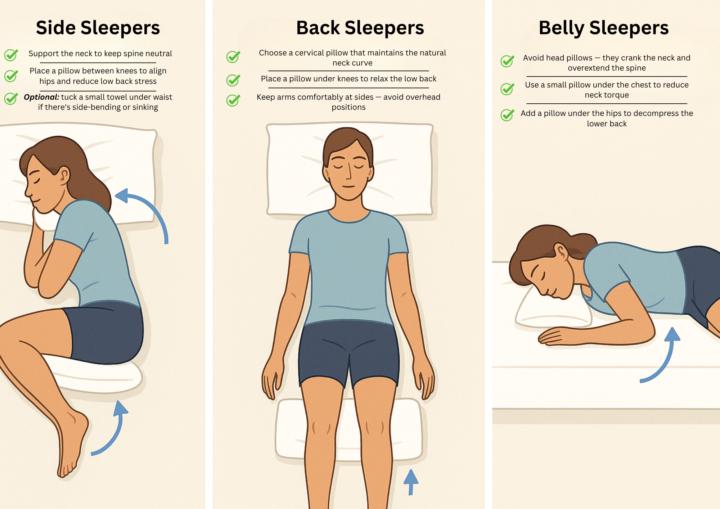
How Nighttime Posture Shapes Your Daytime Movement Ever wake up with a stiff neck, shoulder tension, or low back pain — even though you didn’t do anything “wrong”? Chances are, your sleep position is quietly contributing to those morning aches. How you sleep matters. It's not just about getting enough hours — it's about how your body is aligned for 6–8 hours straight. Think of sleep as passive recovery time. If your alignment is off, your tissues are under strain for hours without support or movement. Over time, this can feed into chronic tightness, pain, and even poor posture habits during the day. Let’s break it down by sleep position — with visuals to guide you toward smarter nighttime strategies: 🛏️ 1. Side Sleepers: Neck and Hips in Harmony What to fix:Most side sleepers use a pillow that lifts the head but lets the neck drop. Over time, this leads to neck strain, shoulder compression, and spinal asymmetry. What to do instead: ✅ Use a contoured or thicker pillow that fills the space between your neck and mattress — not just under your head. Your neck should stay in line with your spine, not bent sideways. ✅ Add a pillow between your knees. This helps align your hips, reduces tension in your lower back, and prevents torque through the pelvis. ✅ Tuck a small rolled towel under your waist if you have a side-body curve or feel your spine sagging. 🛏️ 2. Back Sleepers: Support the Curves What to fix:Back sleeping can feel natural, but many people use high pillows that push the head forward, flatten the neck curve, and overstretch upper back muscles. What to do instead: ✅ Use a thin pillow or cervical support pillow that cradles the neck and keeps the head neutral. ✅ Add a pillow under the knees to flatten the lumbar curve and offload pressure from the low back. ✅ Keep arms down by your sides or gently rested on the stomach — arms overhead can compress the shoulders and stretch nerve pathways overnight. 🛏️ 3. Belly Sleepers: The Problem Child (But We Get It) What to fix:Stomach sleeping puts the neck in full rotation for hours and compresses the lower back. It’s the least optimal position for spinal alignment — but many people can’t fall asleep any other way.
1
0
Jul 14 •
🌟 Rolling Beyond Babies: How Developmental Positions Shape Our Movement for Life
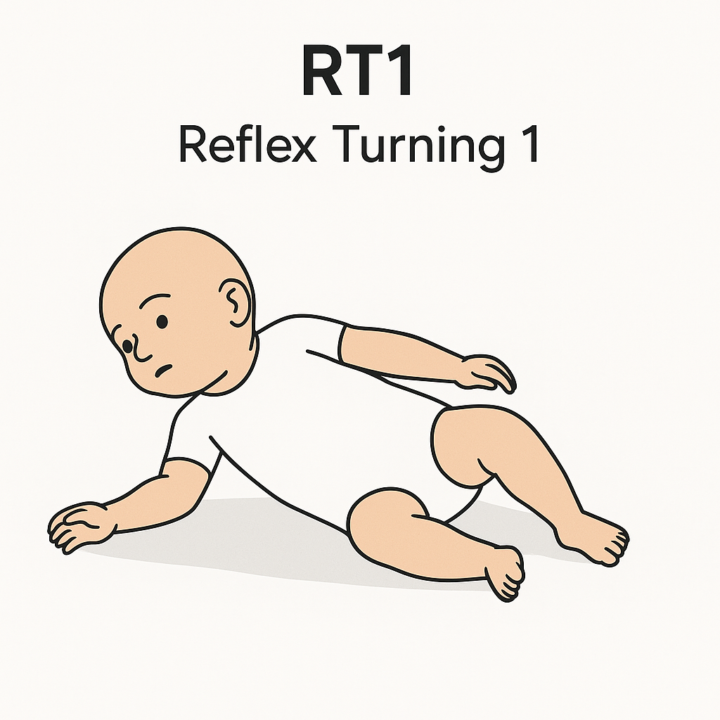
Ever wonder why babies move so effortlessly? Why they roll, twist, and push up without any “core workout”? It’s because they follow a brilliant, natural blueprint of movement that we often lose as adults. But what if you could reconnect to that same foundation to build stronger, more functional movement today? In this post, we’ll explore three powerful positions — RT1, RT2, and RT3 — not just as “baby milestones,” but as adult movement superpowers. Discover how they shape your strength, stability, and freedom, and learn exactly how to reintroduce them into your daily routine or training. ⸻ 🌀 RT1: The Head Leads the Way What is RT1? RT1 (Reflex Turning 1) is the first stage of turning development in infants, usually around 4 months. Here, movement begins with the head and upper trunk, while the pelvis stays quiet. This sets the stage for independent head and neck control and dissociating upper from lower body — foundational skills we need throughout life. Why it matters for adults ✅ Looking over your shoulder when driving. ✅ Rotating to reach for something behind you without twisting your hips. ✅ Supporting healthy neck mobility to reduce tension and headaches. RT1 helps us reclaim healthy cervical and upper thoracic mobility, crucial for efficient, pain-free movement. ⸻ 🌊 RT2: Rolling from the trunk What is RT2? By about 4.5–5 months, infants enter RT2. Here, they begin using segmental trunk rotation, involving the pelvis and trunk muscles to roll onto the side. This phase represents our first real experience of diagonal movement and integrated trunk control. Why it matters for adults ✅ Rolling out of bed. ✅ Throwing, swinging a racquet or club. ✅ Transitioning through twisting movements in sports or daily life. RT2 restores our ability to move the spine segmentally, engage the oblique system, and coordinate the entire trunk — all keys to powerful, safe rotational movement. ⸻ 🐯 RT3: Prone and Proud What is RT3? Around 5.5–6 months, babies progress to RT3: moving fully onto their belly and supporting on their forearms or hands with the head up and trunk extended. This phase builds strength for future crawling and sitting.
1
0
Jul 8 •
🎥 New Video: Mastering the Lateral Step Out!
I love using the lateral step out as an introductory exercise when I’m introducing single leg stability and coordination work. This movement teaches you how to properly shift your weight, engage your foot "quadrupod" (big toe, pinky toe, medial+lateral heel), and control your hip and knee alignment — all foundational skills before we move on to more challenging variations. For those of you on a rehab plan or just starting to build back toward full function and activity, this is a perfect starting point. It’s simple, controlled, and helps you feel where your body should be in space before progressing. Eventually, we’ll level up to the 3-way toe touch variation (2nd attached video), which challenges your stability even more dynamically. But for now, focus on nailing this basic pattern. ✅ Check it out and let me know in the comments: Did you feel your foot and quad working? Any surprises?
1
0
1-3 of 3
powered by
skool.com/movement-based-therapy-2420
Move smarter, feel stronger, live fully. Join a community built for movement, injury prevention, and peak performance—at any age or stage.
Suggested communities
Powered by