Activity
Mon
Wed
Fri
Sun
Jun
Jul
Aug
Sep
Oct
Nov
Dec
Jan
Feb
Mar
Apr
What is this?
Less
More
Memberships
SQL Answers - Data & AI
293 members • Free
Dissertation Help Community
3.7k members • Free
Builders by Buildy.ai
3.5k members • Free
Building in public by Daniel
16k members • Free
JEKPOINT BOOTCAMP
121 members • Free
JavaScript
324 members • $1
Vibe Coding Pro Club
2.8k members • $29/month
Python Developers
1.2k members • Free
Learn Microsoft Fabric
16.8k members • Free
15 contributions to The Energy Data Scientist

8d •
Energy and AI
sharing the Energy and AI report. How AI will impact the energy sector, from jobs, to actual performance and salaries. It also says AI is becoming closely linked with the energy system because data centres need large amounts of reliable electricity, and global data-centre electricity consumption is expected to more than double to around 945 TWh by 2030, with AI as the main driver. At the same time, tit says that AI can help the energy sector by improving renewable forecasting, grid operation, maintenance, industrial efficiency, transport, buildings and energy innovation.
1 like • 8d
So main message is that AI is both an electricity-demand challenge and a useful tool for making energy systems more efficient, but this will require better grids, better data, and collaboration between the tech and energy sectors.

Mar 31 •
🚨 NEW EXECUTIVE BRIEF: Energy Intensity & The Impact of Oil Shocks
Here is the macroeconomic breakdown from our latest intelligence report: Oil price shocks (such as disruptions at the Strait of Hormuz) hurt developing economies far more than richer ones. Why does this happen? Because developing countries use more energy per unit of economic output and depend heavily on imported fuel and industrial inputs. Richer economies have steadily improved their energy efficiency since 1990 by shifting toward services, while developing economies remain stuck in energy-intensive manufacturing. Furthermore, because oil and gas are key inputs for fertilizers, chemicals, and plastics, a fuel shock rapidly ripples into food security and industrial production, widening the economic gap between rich and poor nations. 🔑 KEY CONCEPT: Energy Intensity (EI) The attached screenshot illustrates Energy Intensity—the ratio of energy supply to GDP output. Essentially, it measures how much energy an economy consumes to produce a unit of economic value. 🔻 High EI (Low Efficiency): Lots of fuel is needed to generate GDP (represented by a large barrel with a small money pile). 🟢 Low EI (High Efficiency): A small amount of energy produces a large pile of economic output (represented by a small barrel with a large money pile). 📊 DOWNLOAD THE REPORT: Head over to the "Energy Market Intelligence" section inside the Classroom tab to download the full PDF. The report includes all downloadable market diagrams and official citation links (Financial Times, WSJ, Bloomberg).

1 like • Mar 31
thank you !
Mar 10 •
Uncomfortable truths for Workplace
I see many students who want to stay home and so they ask for remote work all the time. Also I see many who go to work and do not dress well. Here is the truth for the job: Truth1: Go 3-4 times every week to the office so others see you. Your presence is very important. Smile and be professional. This plays a role for your promotion. If you stay home most of the time, you will not be promoted and people will forget you. Truth2: Do not use AI a lot at workplace because every computer has trackers and gives your managers a distribution of time (with plots) of how much you used AI and for how long. There is a software (hidden) that summarises your activity on the computer at work. So be careful : if they see that you cannot write code, and all you do is copy-paste from Chat GPT the code, they will fire you sooner or later. Silently one day they will fire you and they will not tell you why most likely. Be careful. Also you can use it on your phone, but it is time consuming.. Ofcourse they have AI tools but you must write code yourself. Truth3: If you go to non-code positions, it is more stressful and more competitive than code positions. Often, you get lower salary also. Because people in energy are scared of coding, and do not like it. So you get an advantage if you can code , understand code etc. Not super . Just basic things. Eg understand Python . Understand ML. etc Truth4: Do not share personal stories with co-workers. They are competing with you for promotion so they want you to fail ... Be careful. Do not share sensitive things. Truth5: Becareful of your social media presence. Managers spy on you e.g. they have fake profiles and are your friends. They will find your second, third etc profiles. They can find your anonymous X profile where you troll people . They have the ability to find you because they have software tools that you do not know . Truth6: yes the online courses here are all you need. But please fix your CV. Align it with energy companies. Do not just design your CV yourself. Get feedback here. Most CVs look rubbish. Try work on your CV carefully.

Mar 8 •
Notes from Recent Talks: Employment Trends
I pulled together some notes from recent discussions on employment conditions across countries, especially for energy/utility roles. Sharing here in case it helps anyone comparing markets. I have attached the Excel file. The file is broader employment/job-market comparison by country, and only one part of it is energy-related via the “Utility Sector Security” column.Useful if you’re comparing job stability vs compensation in the broader energy sector. Big picture: - USA = highest salaries, but weaker general job security and social safety net - UK / Australia = strong employment protections and very stable utility-sector roles - France = strongest labor protections and very hard to dismiss employees - Switzerland = very high salaries with a strong financial safety net
0 likes • Mar 10
Yes. Those who select to do easy things (e.g. just write reports, go to meetings and play with their phones, and use AI all the time thinking that managers do not notice it), will be first in line to lose their jobs. Also: even if they give remote jobs , ALWAYS go to the office at least 2-3 times every week. If you stay at the comfort and warmth of your home, you will not get promoted. Your presence is super important. Always choose the uncomfortable.
Mar 9 •
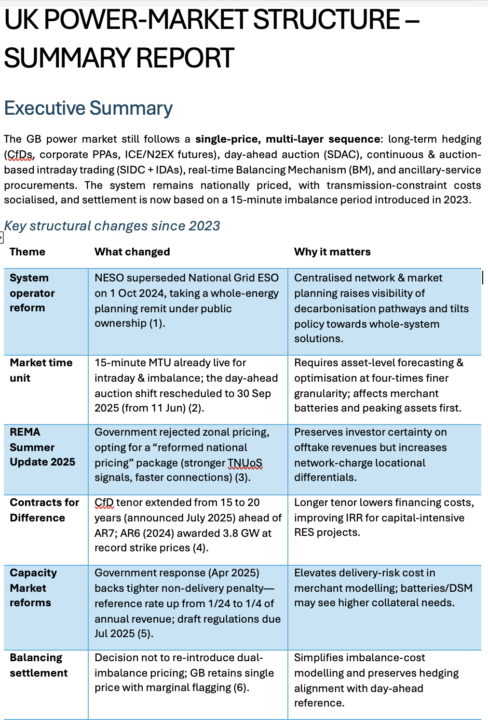
New Report: UK Power Market Structure (2026)
I’ve uploaded a new report on the UK Power Market. It gives a practical overview of how the market works across each layer, from long-term contracts and day-ahead trading to intraday markets, balancing, and ancillary services. It also highlights the most important recent reforms, pricing trends, and the structural features shaping the market today. It is like a cheat sheet, concisely giving an overview of a complex market . The UK market is often seen as a model market because it is one of the most mature, transparent, and actively reformed power markets in the world. So, understanding how it operates helps bring much more clarity to power markets globally. The UK markett is moving fast on market reform, which makes it a very useful case study for where global power markets may be heading. You can find and download the report in the Classroom, under Energy Industry Support ( a special section focused on analysing trends and key topics in the energy industry using simple language). Attached is a screenshot from the report.
0 likes • Mar 10
Thank you. It has all components I need.
1-10 of 15

@mohamed-benali-9679
lecturer and consultant - gas, power
Active 8d ago
Joined Sep 23, 2025
INFP
Morocco