Activity
Mon
Wed
Fri
Sun
Jun
Jul
Aug
Sep
Oct
Nov
Dec
Jan
Feb
Mar
Apr
What is this?
Less
More
Memberships
SAT Prep
16.8k members • Free
Math as a Creative Force
112 members • Free
E v Mobile charging club
21 members • Free
AutoCAD Electrical
94 members • Free
Blinking Battery Recharge
8 members • $7/month
The Solar Network
44 members • Free
Photovoltaik
376 members • Free
Ruta del Electricista
182 members • Free
Energising Futures
33 members • Free
23 contributions to The Energy Data Scientist

24d •
Interview - Shell trading : applied Python
I found a recent query asked in an interview with SHELL TRADING & SUPPLY for the role of Quantitative Analyst (Power & Gas Desk) and was the second Round , which is Technical Panel | 12 March 2026. This round is that you are seated at a glass table in a meeting room and three interviewers face you ( a senior quant, a trading desk lead, and an HR partner). You are handed an iPad showing a single code snippet. No phones, no AI tools, no internet access. You have like 60 seconds (the more it takes you to reply, the worse ....) to explain your answer out loud... (try not to shake from stress). Only to face another question. So the question is about this following Python expression: pythonx = [a] + (b or []) They first ask what does this line do? To explain it in plain English. Then you reply. And if you don't reply , they tell you the answer... where you say , you knew it but your mind got blocked . Anyways, and then they ask you to give an example of where this code would be useful on an energy trading desk. So again you can't use AI. " If we allowed you to use AI, we wouldn't need to hire you" is their answer. So the answer, for the record , is this: That this code creates a list that always starts with a. If b is a non-empty list, it gets appended. if b is None or empty, it defaults to an empty list so we dont get an error. This is a safe way to build a list without crashing the program. On a trading desk, 'a' could be today's base-load power contract, and 'b' could be an optional list of additional hedges . So, every day, the desk must trade one core electricity contract ( that's 'a', it's always there). But some days there are also extra gas or peak-hour deals on the table ( that's 'b'). Some days 'b' has things in it, some days it's empty. The line of code just starts the list with the one deal we always need, and then places the extras if there are any and if there aren't, don't break the code.
0 likes • 24d
The USA office pays roughly $$180k base (fixed annual salary before bonuses) and $200k to$300k+ total comp (base plus bonus, signing package, and any other cash).
0 likes • 24d
The Europe office (London) is at $150k base, and $170k total comp. The Singapore office is around $130k base, $200k total comp. Dubai office (is operating well ) offers $140k base tax-free and $230k total comp. It has an Africa office at $70k base, and $110k total comp (which is good because purchasing power is strong). The salaries are quite the same they said based on purchasing power locally.

Mar 13 •
Interview question
I share a recent interview question asked by Baringa (this is a consulting company focused strongly on energy, utilities, and the energy transition). From a student forum / database (for internship). The question was: 'Why do some renewable power plants continue generating electricity even when electricity prices turn negative? and when do prices become negative ? do you know any example? '
0 likes • Mar 13
thank you! can we explain more ?

Feb 18 •
New Online Course: Deterministic Optimisation in Python
A new course, "Deterministic Optimisation in Python", is now live in the Classroom (see screenshot attached). It is course number 114. This is a beginner-level course (no need to even know Python) with no prerequisites. Optimisation is used when we want to minimize or maximize something. In most cases we want to minimize some cost. Here we have a smart building and we want to minimize its daily operational cost. The simplest form of optimisation is "deterministic' , which means that all the data are known, and they are given to the Optimisation model. There is no 'uncertainty'. When an optimisation model is not 'stochastic' then by default it is 'deterministic'. So we typically do not use the word 'deterministic' because in 90% of the cases, it is implied. In reality there is always some uncertainty. For example, we may not know the electricity demand every hour. So, the smart building has residents who consume electricity. We do not know how much this electricity will be tomorrow. Instead of modelling this uncertainty using some advanced method (in which case, we would speak about 'stochastic optimisation') , we use 24 values for the demand, and 24 values for the renewable output, and this makes the model 'deterministic'. We use Gaussian (Normal) distribution and from this distribution we randomly select ('sample') 24 values for the electricity demand, and 24 values for the renewable output. In most of the energy projects we use deterministic optimisation with known data i.e. some official source will give us the data. In the event that they won't give us the data, we can make assumptions e.g. like in this course we make the 'Gaussian assumption' i.e. we assume the demand follows the Normal distribution. We will walk through the entire process step-by-step: from setting up the Python environment and generating synthetic data using numpy, to formulating the mathematical model in Pyomo and analyzing the results with pandas and matplotlib. This course provides aa very good practical experience, which is popular in real-world projects.
0 likes • Feb 19
@Manuel S the normal procedure in my case has been like this
Feb 4 •
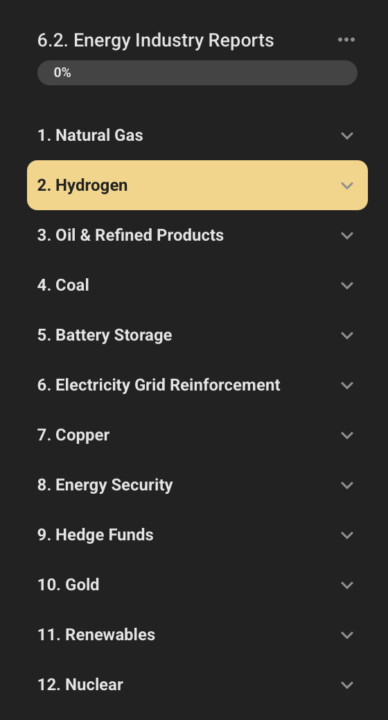
New Report on Hydrogen
A new report on energy trends has been published and can be found by clicking on ‘Classroom’ and navigating to Section 6.2 (see the attached screenshot). You can use this report and the visualisations it includes, in your own projects, work, or studies, without limits. This report explains the progress for the UK’s hydrogen rollout. The report includes diagrams and flowcharts that provide context, and also a list of relevant sources that were used to complete this report. These sources are from the Financial Times, Wall Street Journal, the Economist and Investors Chronicle (all sources are available inside the report). Your subscription in this Skool community gives you access to paywalled energy-economics articles from these publications (Financial Times etc) indirectly through these reports. I have also included some explanations and additional text that explains some details. The text is written in beginner-friendly, easy-to-understand language. Reading these reports can help with interviews, meetings, presentations, networking, and public speaking. Strongly recommended.
0 likes • Feb 4
Glass furnaces run for 15-year campaigns without stopping. Missing a refurbishment window locks in carbon emissions for a decade. This makes the timing of hydrogen availability critical.
Jan 13 •
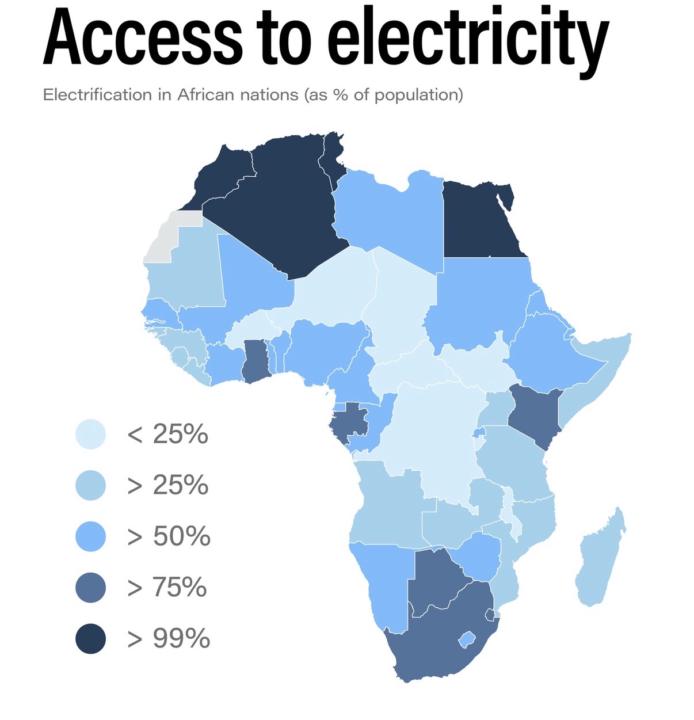
Access to Electricity in Africa
The attached plot shows the level of electricity in Africa. How best can it increase? using smart grids? micrograms?
1-10 of 23

@chinedu-okafor-3651
MSc Student Software Engineering Applied to Economics
Active 24d ago
Joined Oct 14, 2025
Nigeria