Activity
Mon
Wed
Fri
Sun
Jun
Jul
Aug
Sep
Oct
Nov
Dec
Jan
Feb
Mar
Apr
What is this?
Less
More
Memberships
The Energy Data Scientist
672 members • Free
16 contributions to The Energy Data Scientist

1d •
PDF on China-Australia energy cooperation
I was at a conference, and this is a presentation by a China Analyst, Climate Energy Finance at a conference on Australia–China green economy cooperation. Key points are: - China dominates global clean energy and clean tech manufacturing, holds ~40% of global solar, leads global EV sales (2.4 million in Q1 2025, +36% YoY), and controls over 80% of global manufacturing capacity across 11 clean-tech supply chain segments (solar, batteries, critical minerals processing). - China is Australia's #1 trade partner and offers the world's lowest-cost, most advanced clean tech. - Government needs to build an enabling environment through a future-oriented national China strategy, bilateral decarbonisation agreements, clearer foreign investment rules

2 likes • 24h
Excellent Dr. Xiu, definetly China's dominace in clean tech supply is not temporary but will be dominating in the long run for years and years coming because of how it has been built on policy continuity and relentless innovation. It really stands out is the shift in the export strategy towards the global south making a big redirection in chinese capital towards countries like Australia. The joint ventures and reseacher and development collab seem the most viable path.

23d •
Interactive Map with Energy Projects
Found and sharing an interactive energy infrastructure map hosted by GlobalGrid2050. It maps renewable energy and storage projects for the United Kingdom only. It is including solar PV, onshore and offshore wind, and battery storage . It is getting them from the UK's Renewable Energy Planning Database (REPD). You can filter projects by technology type, planning status (from "in planning" through to "operational"), and capacity range in MW. It also overlays grid infrastructure like substation density and water utility locations. It is a useful tool for visualising the spatial relationship between generation, storage, and network assets. https://globalgrid2050.com/repd_atlas_grid_model/
0 likes • 22d
Very cool and interactive!
Mar 25 •
How to learn Coding in the era of AI
I am sharing a summary from an HR/Careers conference in Applied Software Engineering. People are complaining of forgetting the code they learnt at uni, or on online courses. They learnt it, and now it's' gone. So the fastest way to learn coding today is not to sit through dozens of online courses on Udemy, Coursera, or edX and hope the knowledge sticks. If you have tried that route, ask yourself honestly: how much of it do you remember three months later? Most of it is gone. That approach feels productive in the moment only. Instead, the smartest path is to start with Python and study code that already exists inside industry case studies. You see exactly how it is applied in real-world cases. Then Open GitHub, and upload a full project. First, actually work with the code e.g. maybe you need to combine the code of 5-10 courses together . Change the data slightly,. Then upload your version to GitHub with a clean, nicely written README file and well-presented code (comments etc). Do not panic about volume. You only need to upload 1 machine learning project and 1 optimisation project over the course of 8 -12 months. Takes time if you are absolute beginner. That is enough to make you extremely attractive to employers : internships and junior jobs. This is better than MSc degrees because they are filled with exams and homework , whose solutions circulate around and you copy-paste and employers know it. Every time you upload a project, write a LinkedIn post about it if you aren't shy . So, take ten or twenty courses from the Classroom, as many as you need, and combine what you learn from them into a single coherent project or more. If you are ambitious, try to publish your work as a paper. Even better. Shows prestige. Nobody does these simple things and everyone goes to do MSc , which is fine ofcourse if you have the money. That is the whole strategy. HR managers almost never see this level of discipline from candidates. Most CVs simply list "I completed 5 courses on Udemy" or "I finished 10 courses on edX," but they never remember what they did there. They have the certificate but in the interview they say they forgot.
4 likes • Mar 26
Totally agree with Dr. Fid, building projects beats watching random generic courses every time. And here in Skool, we honestly have more than enough to succeed as energy data scientists. On the master's degree debate I think having one does catch a recruiter's eye, but what actually seals the deal is showing you did something "meaningful" with that knowledge aka a project. a master's program can open doors to public and private institutions where you can access real world datasets. That's gold. As an Intern imagine building a project for them and positioning yourself as the expert who solved their problem. Well people might think how can i position myself as the expert? We have plenty of courses in skool for that, here we have information that most people dont have that you can present it as a solution like you are the expert but you MUST understand every line of code and the context is used for, not just copy and paste. One last thing: the words on your CV matter more than you think. Framing is everything. The same experience, told differently, can land very differently with a hiring manager.
Mar 19 •
⚡ Networks grids & Storage — Part 1/...
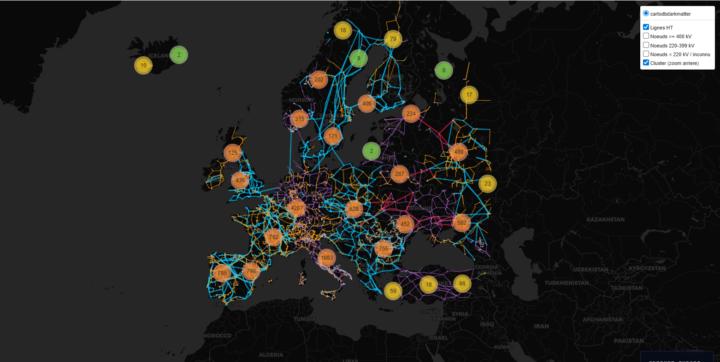
🗺️ Where it started To better understand energy networks and their geographic topology, I dove into open source data — specifically OpenStreetMap and GridKit — to map transmission nodes and lines across Europe and the UK. There are already plenty of courses on grids and storage. So instead of passively consuming content... I decided to build something. 🎯 Project Goals Technical side: - Sharpen my Python + mapping skills (Folium / GeoPandas) - Experiment with Vibe Coding (rapid iteration, AI-assisted prototyping) Knowledge side: - Understand the role of energy storage and load balancing in modern grids - Identify the critical materials and minerals behind storage technologies (lithium, cobalt, vanadium, manganese...) - Map out the key players in the sector — utilities, pure-play storage companies, and emerging startups 💡 Open questions — your ideas welcome! Some threads I'm already pulling on: - Where are the bottlenecks in European transmission networks? - How is the storage mix evolving — short-term (batteries) vs. long-term (hydrogen, pumped hydro)? - What business models are emerging around grid flexibility? What would you add to this project? 👇 Series in progress — more in the next post 🔄
2 likes • Mar 19
Hi Muriel! Really fascinating project, I'm curious about your vibe coding workflow which AI tools are you using for the prototyping? And how do you handle it when the energy domain gets technical does the AI keep up or do you find yourself having to guide it a lot?
Mar 13 •
Interview question
I share a recent interview question asked by Baringa (this is a consulting company focused strongly on energy, utilities, and the energy transition). From a student forum / database (for internship). The question was: 'Why do some renewable power plants continue generating electricity even when electricity prices turn negative? and when do prices become negative ? do you know any example? '
2 likes • Mar 13
Thank you for sharing your insights!
1-10 of 16

@jorge-torres-6866
I’m Jorge from 🇵🇦 Currently enrolled in a Masters degree in Big data, Data Science and Artificial Intelligence at Universidad Complutense de Madrid
Active 13h ago
Joined Nov 18, 2025
Panama