
Write something

3d •
New Report: Oil Price, Bonds & USD
Rising oil prices from Middle East conflict spread quickly through the global economy. They have: a) increase dinflation, b) pushed up short term bond yields, c) strengthened the US dollar, d) raised costs for oil importing countries. A new report on this topic has now been published in Classroom, at the very end under “Energy Industry Support”, a special section featuring reports that explain the current status and key trends in the energy sector. The report is written in simple language, includes illustrative graphs, and shares official sources from the Financial Times, Bloomberg, Wall Street Journal, The Economist, Forbes, and Investors Chronicle. It can be freely used in your projects, work, or studies. It may be especially useful for interviews, presentations, networking, and broader professional development. It is strongly recommended to read it and download it for your use. See the attached screenshots.
4d •
New report: Energy Security & Nuclear Power
A new report on this topic has now been published in Classroom, at the very end under “Energy Industry Support” ( a special section featuring reports that explain the current status and key trends in the energy sector). The report explains how energy crises and conflict, especially around the Strait of Hormuz, have renewed interest in nuclear power as a more secure long-term source of electricity. Dependence on imported oil and gas can quickly drive up prices and threaten electricity supply, while nuclear energy offers stable output and fuel that can be stored for years. There is therefore growing investment in nuclear fuel and advanced reactor technologies. But nuclear is a long-term solution rather than a quick fix. The report is written in simple language, includes illustrative graphs , and shares official sources ( Financial Times, Bloomberg, Wall Street Journal, The Economist, Forbes, and Investors Chronicle). This report can be freely used in your projects, work, or studies. It can be useful for interviews, presentations, networking, etc, so it is strongly recommended to read it & download it for your use. See the attached screenshots.
8d •
New Report: UK Power Market Structure (2026)
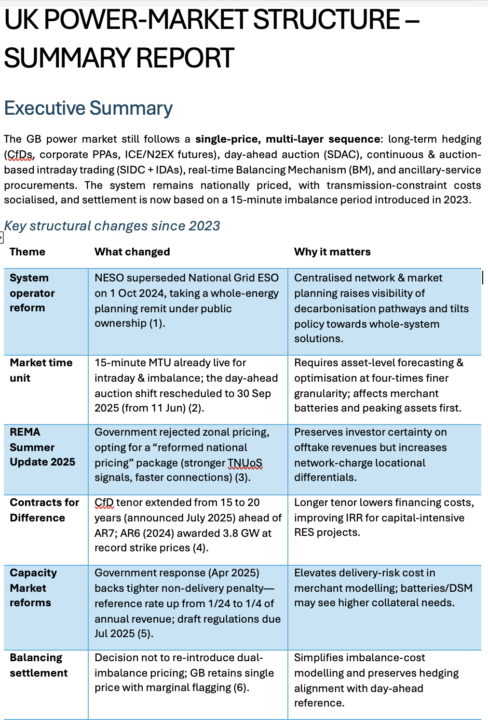
I’ve uploaded a new report on the UK Power Market. It gives a practical overview of how the market works across each layer, from long-term contracts and day-ahead trading to intraday markets, balancing, and ancillary services. It also highlights the most important recent reforms, pricing trends, and the structural features shaping the market today. It is like a cheat sheet, concisely giving an overview of a complex market . The UK market is often seen as a model market because it is one of the most mature, transparent, and actively reformed power markets in the world. So, understanding how it operates helps bring much more clarity to power markets globally. The UK markett is moving fast on market reform, which makes it a very useful case study for where global power markets may be heading. You can find and download the report in the Classroom, under Energy Industry Support ( a special section focused on analysing trends and key topics in the energy industry using simple language). Attached is a screenshot from the report.
12d •
New Report: Solar PV in space
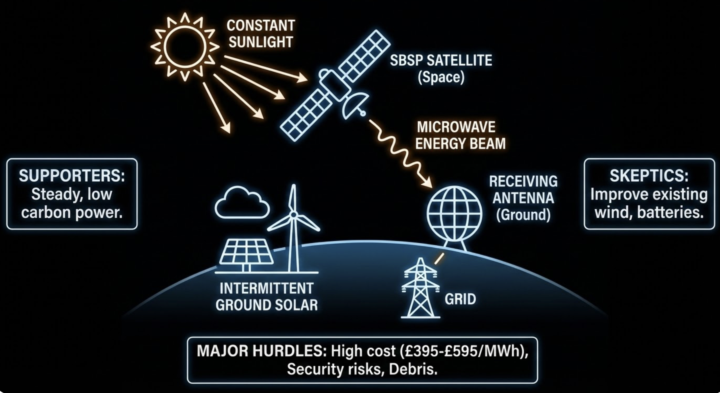
Space based solar power means to deploy large solar photovoltaics panels on satellites to collect sunlight and then beam the energy to Earth in the form of microwaves. On earth, huge ground receivers would convert it into electricity for the grid. It could help provide steady low carbon power and might become cost competitive by 2040, but early systems would be very expensive and face major technical, safety, and space security risks. See the attached screenshot for how it will work. A new report about this topic has been published in 'Classroom' , at the very end In the section "Energy Industry Support" (a special section with reports that explain the current status and trends in the energy sector). It is written in simple, easy-to-understand language with every terminology/jargon explained. It has been written by compiling data from official sources (Financial Times, Bloomberg, Wall Street Journal, the Economist, Forbes, Investors Chronicle etc). Feel free to use this report in your projects, work, or studies. Reading these reports can help with interviews, meetings, presentations, networking, and public speaking, so it is strongly recommended. “

16d •
Oil and Gas Geopolitics
Would like to hear your thoughts on the potential global economic consequences of the closure of the Strait of Hormuz? I have some takeaways about this situation: 1.The closure of the Strait of Hormuz and halted shipments could push Brent crude prices above USD 100/bbl if the blockade persists. 2.Geopolitical tensions and market uncertainty typically increase demand for safe-haven assets like gold. There are increasing doubts about the US dollar's safe-haven status from Central banks like the European Central Bank, this could suggest a potential shift in currency dynamics making other currencies (Swiss Franc) or commodities ( Gold or Silver) more appealing as a safe heaven. I believe we will see the same market drivers for 2026 specially that war is escalating very fast, we are seeing even more countries involved like many of the Gulf countries, . Dr.Spyros made a analysis of Gold rally in 2025 (It explains many of the market drivers we are seeing also in 2026, highly recommended!) 3. Energy Resilience The uncertainty surrounding the closure of the Strait of Hormuz raises important questions about the resilience of global energy systems. Given that there is no clear timeline for reopening, this disruption could act as a catalyst for countries to reassess their dependence on oil and gas. Several countries are already feeling the effects of supply constraints, and if the situation persists, we may see increased volatility in energy markets. In this context, the crisis could accelerate investment and policy shifts toward renewable energy sources, as nations seek to reduce exposure to geopolitical risks associated with fossil fuel supply routes. If the conflict evolves into a prolonged situation, repeated disruptions or closures over time could further reinforce the urgency of diversifying energy portfolios and strengthening energy security. Let me know your thoughts!
1-30 of 72
powered by

skool.com/software-school-for-energy-7177
A beginner-friendly program for a career that combines energy, economics/finance & data science. Regardless of your location/age/education/experience
Suggested communities
Powered by