
Pinned

👑
1h •
Public Software launching soon
If anyone's curious if the methods I'm teaching here will last long enough. Just know that y combinator is now asking for solutions we built years ago. https://www.ycombinator.com/rfs
Pinned
👑
Jul 1 •
Welcome to Clief Notes. Here's where to start.
1. Go check out 📚Navigating The Course to see how to get around and what's here. 2. Start with The Foundation. Concepts, folder architecture, prompting framework. Everything else builds on this. 3. Check in at the bottom of each lesson. Polls, discussion posts, other members working through the same stuff. Use them. 4. When you're ready to build real things join in on our Biweekly competitions and win some real cash. ⭐ Competitions Mega Thread 5. If you are wanting to dive into the masterminds, grab all the past templates, artifacts and resources. Upgrade and head into the The Vault for Premium and The Drawing Room (VIP) for VIP 6. Post your work. Ask questions. Help others when you can. What are you here to build?
Pinned

6d •
Community Guidelines
This community is large and it moves fast. That's the good part and it's also the problem: valuable posts get buried, the same questions get re-asked instead of found, and spammers show up wherever there's an audience. These guidelines are what keeps the room worth showing up to. Read them once. You won't need them again, because most of this is what you'd do anyway. New here? Start with Jake's welcome post and the Foundation course. This post is about how we behave, not where to begin. 1. Build in public. Post the thing while it's half working. A half-finished build is more useful to everyone else than the polished writeup you'll never get around to, and you'll get corrected before you've spent a week going the wrong way. 2. Teach what you learn. The day you figure something out is the day you're best at explaining it, because you still remember exactly what confused you. A month later you've forgotten the hard part and your explanation gets worse. If you cracked something this week, that's a post. Nobody has to earn the right to ask a question here, but this place only works because people come back and answer them once they can. 3. Ask good questions. Specific beats polite. "How should I structure this?" gets three vague answers. "I have a 40 file client folder, the model keeps loading the wrong context file, here's my CLAUDE.md" gets a real one. Say what you tried, what happened, and what you expected instead. A more in depth guide: https://dontasktoask.com The flip side of this: "Anyone here?", "Help please", and one line questions with no context may get removed. Not to be harsh, but because nobody can answer them. 4. Give credit. If you built on someone's skill, template, folder structure or comment, tag them. It costs you nothing and it's the reason people keep publishing their work here instead of keeping it. A lot of the best material in this community started as somebody's reply on somebody else's post.

17d •
What 1.5 days and about 5 billion AI tokens produced
I just shared the full walkthrough of the Vois website refresh on LinkedIn. I have attached it here too because the process is more useful than the screenshots alone. The headline is big: less than 1.5 days from idea to deployment, with about 5 billion text-agent tokens used along the way. That total excludes image and video generation. Before I posted it, I asked a friend who is a veteran UI/UX designer to review the work. His response: "I hate you. this is good... I hate you for making it" For context, I am the founder of Vois, and this is my own product and codebase. I ran the refresh like a coordinated AI product team. I stayed responsible for the product direction, visual taste, quality bar, and every ship or reject decision. The setup: • GPT-5.6-sol handled the main orchestration. It broke the work into plans, assigned specialist agents, integrated their output, and kept the release moving. • More than 300 specialist sub-agents using GPT-5.6-terra and Grok-4.5 worked in parallel and in sequence across planning, UX, choreography, visual design, asset creation, copy, frontend development, mobile QA, accessibility, browser testing, performance optimisation, and deployment. • Fable-5 acted as an independent advisor. It reviewed alternatives, challenged decisions, and sent weak work back through another pass. • GPT-image-2 generated the images and characters. Grok Imagine generated the video assets. Their generation usage is not included in the roughly 5 billion text-token total. The text-agent token split: Main agent: 13% Sub-agents: 51.3% Advisor agent: 35.7% What shipped: • a complete visual refresh for Vois • a cinematic, scroll-driven homepage • a consistent design system across the site • dedicated desktop and mobile behavior • generated visual and motion assets • accessibility, performance, browser, and deployment fixes The 5 billion total makes the trade visible. I used far more compute and coordination to compress a large design and engineering cycle into less than 1.5 days.

3h •
how to handle "function calls" ?
how does an agent keep track of where it is in the folder chain ? my architecture might not be fully linear , I may have process that I would want to invoke somewhere down a chain , get some result , then return to where I was . (like a classic function call with return) does it require setting up some kind of memory for the running agent ?
1-30 of 2,801
skool.com/cliefnotes
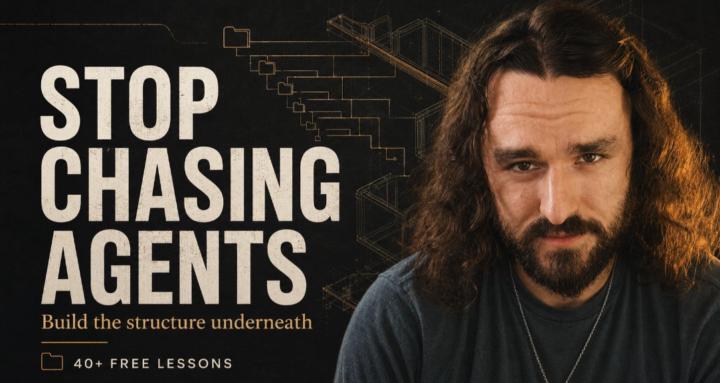
What we give away free beats most paid courses. Build durable AI systems with a Marine vet and Edinburgh researcher. 40+ lessons, growing.
Leaderboard (30-day)
1

+1374
2

+1152
3

+1088
4

+598
5

+587
Powered by