

12d •
Got my first paid client. :)
This is the website I created for them — pikolhaus.com. Small start, but officially my first real client project. More to come.

1d •
ICM is crazy for ML research
I’ve done a master’s thesis before: genetic algorithms, XGBoost, Monte Carlo simulations, graph optimization. Lots of ML, long before modern AI could meaningfully help me. Back then, the hard part wasn’t having ideas. It was turning those ideas into structured experiments, reliable evidence, useful visualizations and clear conclusions, without losing weeks to setup, documentation and context switching. ICM changed the game. In one week, I’ve done more research than I managed in six months of my master’s thesis. The difference is not just speed. It’s the number of ideas I can now explore, test and refine: - Turn a vague idea into a concrete research question. - Convert that question into an experiment or proof obligation. - Generate the code, tests and evaluation structure. - Produce visualizations and evidence automatically. - Inspect the results and use them to guide the next idea. - Keep the reasoning, context and decisions connected throughout. - Do all of the above concurrently. The ICM becomes a research operating system. It helps separate what the code proves, what the experiment observes, what the data supports and what still requires human interpretation. That distinction matters. A test can show that the implementation works. It cannot prove that the model is useful. A result can show that one approach performed better. It cannot automatically explain why. A paper can inspire an architecture. It cannot validate that architecture on your dataset. ICM gives each of these things a place—and connects them into a traceable research loop: question → hypothesis → experiment → evidence → interpretation → next question The most powerful part is that ICM does not replace the researcher. It amplifies the researcher’s ability to think. The human provides judgment, curiosity and scientific direction. The ICM provides structure, memory, continuity and execution. That is why it feels so transformative for ML research. It turns research from a sequence of disconnected tasks into a living system that can continuously generate, test and refine knowledge.

12h •
AI Driven ML Research
This is a follow-up to my previous post about using ICM for AI-driven machine learning research. In one week of ICM-assisted research, I've moved further than I managed in roughly six months of my master's thesis. This is what that looks like in practice: ICM/ ├── README.md ├── skills/ ├── agents/ │ ├── literature-intake.md │ ├── research-development.md │ ├── code-development.md │ ├── results-evidence.md │ ├── research-argument.md │ ├── thesis argument.md │ ├── self-review.md │ └── ... ├── research/ │ ├── context/ │ ├── literature/ │ ├── development/ │ ├── results/ │ └── reports/ ├── code/ │ ├── src/ │ ├── tests/ │ └── runs/ ├── thesis/ └── _system/ ├── rules/ ├── templates/ └── schema/ I can queue several research goals across different chats and let each one keep moving. The agents are not all doing the same job with different names. Each one has a bounded responsibility, its own context and a clear handoff to the next part of the work. - The literature-intake agent turns papers into usable research context. It extracts the claims, methods, datasets, assumptions and limitations that matter for my problem. It helps answer: what has already been tried, what can actually be reused and what still needs to be tested? - The research-development agent turns vague ideas into explicit questions, hypotheses and experiments. It forces the research to become testable before implementation begins. Instead of “try an LSTM”, the goal becomes something like: under these conditions, does recursive probabilistic prediction outperform a defined baseline? - The code-development agent owns the implementation. It builds the data pipeline, model interfaces and experiment code while respecting the assumptions defined by the research question. Its job is not to decide whether the research is meaningful. Its job is to make the proposed experiment executable and reproducible. - The testing agent checks whether the implementation behaves as intended. It verifies data shapes, transformations, edge cases, saved artifacts and the parts of the pipeline that can be checked mechanically. A passing test gives me confidence in the software. It does not give me scientific confidence in the conclusion.

21d •
Appreciation Post - Clief Notes Community 🙌💙
This was the first community I joined, and my first real go at AI beyond just talking to a chat window. I found it pretty much by chance, lurked for a few months, and High Tea 6 was my first call. I didn't realise at the time how much that would shape things. The picture I got here was a healthy one. Build the thing, watch how it actually behaves, be honest about the bits that don't work. I've spoken to enough people since who came in through paid courses to know that isn't the norm. Nobody here sold me a shortcut, and I got pretty lucky landing here first rather than somewhere else. Something happened recently that made me take a step back. I met someone at an open networking event who runs corporate training and is writing a textbook alongside it. What she needs is her course turned into per-module walkthrough videos - her own slides on screen, voiceover over the top, one video per module. I built it as ICM, because that's just how I build now. Numbered stage folders, one agent reading the right files at the right moment, markdown carrying the context, and local scripts doing all the mechanical work that never needed a model in the first place. Her voice cloned from a module she'd already recorded, the deck walked and exported as frames, one script and one audio file per slide. The durations of those audio files become the cue sheet that stitches the whole thing together, so there's no separate timing step to get wrong. One module's through it end to end. 21 slides, 21 scripts, 21 audio files, one finished MP4. And there's around ten hours of modules to put through the same pipeline. As an 18-year-old that's a really good opportunity, and it's going to generate me some serious income. I wouldn't have built any of it without what I picked up in here first, so thank you to everyone who's answered a question of mine along the way. Nothing's finished yet. I've still got a lot to come and plenty I haven't cracked. It just felt worth stopping on rather than quietly getting on with the next thing.

5d •
🏆 It’s a BIG WIN already if you are here 🏆
I remember the first time I saw Jake’s video. I was actually searching for a better approach to agentic AI. I knew something was off but I didn’t know what it was. As soon as I heard “folders and .md files” it clicked. That was an eureka moment for me and I’ve been a member of Clief Notes ever since. Because of ICM I now manage all the moving parts of the AI Clarity studio (4 different platforms) I run with ease and so much efficiency. Although I want to start building more, I’m more of an AI educator facilitating AI clarity to leaders and organizations. I’m not sure how things would have turned out if I didn’t have a structure like ICM that keeps all the moving parts in sync. Evergreen solutions and methodologies are very few in the AI ecosystem and sometimes I think about how privileged we are to be here to witness first hand, ICM in all its glory. If you are here, you already won. All you need do is put in the ICM reps. Learn, share, build, test, deploy, interact, connect and the rest will sort itself out in due time. 🏆 Congratulations to all the winners! 🏆
1-30 of 248
skool.com/cliefnotes
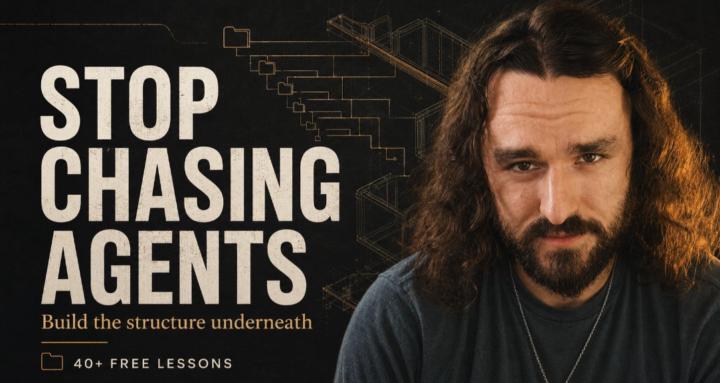
What we give away free beats most paid courses. Build durable AI systems with a Marine vet and Edinburgh researcher. 40+ lessons, growing.
Leaderboard (30-day)
1
+667
2

🔥
+633
3

+621
4
+515
5

+475
Powered by