Activity
Mon
Wed
Fri
Sun
Sep
Oct
Nov
Dec
Jan
Feb
Mar
Apr
May
Jun
Jul
What is this?
Less
More
Memberships
Rule-Based Trading
374 members • $19/month
Algo Trading
3.5k members • Free
Clief Notes
43.4k members • Free
AI Pathways
481 members • $149/m
5 contributions to Clief Notes

12h •
how to handle "function calls" ?
how does an agent keep track of where it is in the folder chain ? my architecture might not be fully linear , I may have process that I would want to invoke somewhere down a chain , get some result , then return to where I was . (like a classic function call with return) does it require setting up some kind of memory for the running agent ?
2d •
Google Introduces - Open Knowledge Format (OKF)
would love to hear what Jake has to say about that ! its basically the Karpathy llm wiki concept , but generalized to a simple folder setup . main use case is to set up a knowledge base that is both human and AI readable. I can see it could be integrated with ICM with no issue and it involves pointing the agent\skill to specific types and other metadata , that will be present as YAML front-matter in the files, as well as index file in each folder. one caveat to notice is that its completely open format so You have to think about the process of ingesting data into it , and ideally an agent should handle it .. or a single prompt if its not too complicated. its still somewhat of a personal system , I think that if you develop tools that will be used by an organization then migrating to a Standardised database is probably the way to go , if you want to maintain order .. but I'm uncertain about that.
3 likes • 2d
@Aaron Kruger yea I thought he had a reaction to it , I see it taking off with youtube "AInfluencers" and channels. but its not exactly the same as ICM as far as I understand , its more about the knowledge base , not how to set up the agentic workflows, correct me if I'm wrong ?

Jun 27 •
Poll: What's In Your Toolbox?
Edited: 100+ have voted Results to follow Thank You Please take ten seconds to respond to this poll — it helps everyone see the real meta! I’ll like every comment. BONUS: If I can twist @Jake Van Clief ’s arm, we’ll pick one random commenter for 1 month of premium access — for free once we hit 100+ votes! Vote and reply! Main method you use for interacting with AI agents right now? WHAT"S IN YOUR TOOLBOX RIGHT NOW?
Poll
169 members have voted

3 likes • 2d
VS code and Claude extension , but I'm contemplating setting up a mac studio for local llm to torture it with obscene amount of requests ( the type you would send to Haiku) that will also involve deterministic local code runs

Jul 2 •
Agents as Folders.
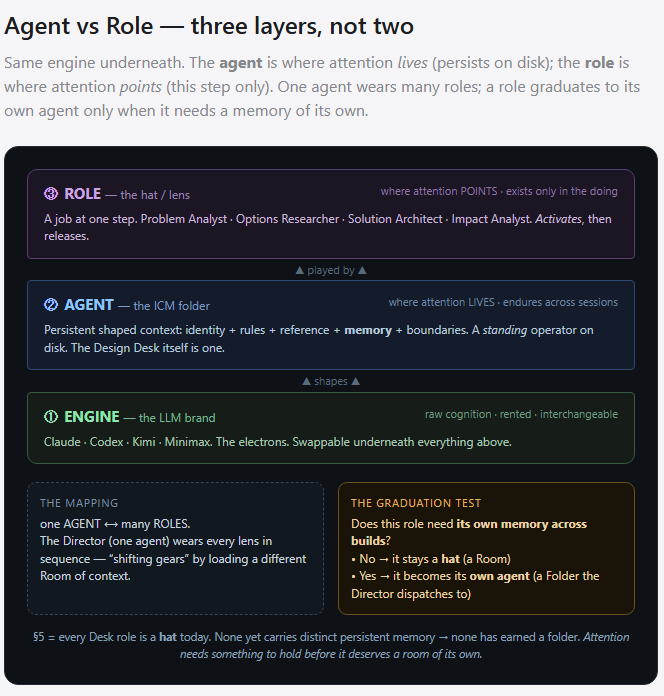
Recently a lot of excellent community discussion around how to ICM, largely because that’s the foundation but also refocused due to @Bas Rosario’s Post on ICM as building a Cake. Having experienced rapid growth in my past, one of the hardest things to do is keep language and definitions aligned. If I say the Agent did this, where does your brain go? Lines get crossed because you have so many levels of understanding and perspective. Some people are coming from non-technical backgrounds and have learned through corporate ai marketing. Others coming from corporate environments where language is defined for them by the management and designers building their infrastructure. Mini cultures with their own language. One of the brilliant aspects of ICM is it's commonality with almost anyone on a computer. It's just a folder, from that foundation we can all get on board. What's difficult is what happens next. I had this conversation with claude during a planning session. Claude asked me did I want agents or roles? I responded back by did he mean an agent like claude or codex, which is really an LLM, a purpose built agentic piece of software that the market tells me is an agent that does stuff? Or a folder acting as an agent with a specific role. I didn't know what the underlying meaning implied, how to answer? So I asked here was the response. 1. Engine — the LLM brand (Claude, Codex, Kimi, Minimax). Raw cognition, rented capacity, the electrons. Interchangeable. 2. Agent — the ICM folder. Persistent shaped context: identity + rules + reference + memory + boundaries. A standing operator that exists on disk and endures across sessions. This is your "folders hold attention" — an agent is where attention lives. 3. Role — a lens/hat: a function performed at one step of a process. It exists only in the doing. Where attention points right now.
1 like • 29d
@Jordan Shaw on the other side of what I mentioned is "Technical debt" where you start with something poorly engineered , that requires a lot of re-work afterwards and the complications of transferring to a new system. so practically , Its best to start simply with low 'Technical debt' something that you can scrap . what I'm going to do as a first project in this approach is gather up a few somewhat similar but still different prompts that I copy paste into the LLM chat every so often and structure them into subfolders with a markdown file containing the specific prompt and a sub-folder for the llm output , in the outer folder I will have the main "router" or floor-plan , that will help the llm know which prompt is relevant for the task entry point --> floor plan--> specific prompt and its related instrunctions-->output main folder -- main instructions.MD prompt A folder --prompt A.MD output folder prompt B folder --prompt B.MD output folder it will be designed so I will have to expend the least amount of mental energy when prompting it , and my instructions together with the intelligence of the LLM will figure out if prompt A or B is needed and since its all written in plain text I can always add Do's and Don't if I find that its doing something I don't like or waste too much tokens where a more specific instruction can cut useless over spending.
2 likes • 27d
@Jen Cortez-Walters as I see it , its just organization, of prompts without using any complicated stuff. I think its best to grow it organically based on your current use case , take a look at how you prompt the AI in your current use case , do you keep a document with useful prompts ? do you have a file where you save particular responses from the AI ? would you rather have some kind of "memory" for all your prompts and the responses , in case you would like to improve your prompts or have some pipeline beyond just ask-response ? would you rather automate that pipeline to save time ? there is no reason to over-complicate things if you don't need a memory system and more involved pipeline.

👑
Jul 1 •
Welcome to Clief Notes. Here's where to start.
1. Go check out 📚Navigating The Course to see how to get around and what's here. 2. Start with The Foundation. Concepts, folder architecture, prompting framework. Everything else builds on this. 3. Check in at the bottom of each lesson. Polls, discussion posts, other members working through the same stuff. Use them. 4. When you're ready to build real things join in on our Biweekly competitions and win some real cash. ⭐ Competitions Mega Thread 5. If you are wanting to dive into the masterminds, grab all the past templates, artifacts and resources. Upgrade and head into the The Vault for Premium and The Drawing Room (VIP) for VIP 6. Post your work. Ask questions. Help others when you can. What are you here to build?
2 likes • 29d
I have been trying the Obsidian style knowledge base, but I find that its mostly a graveyard for AI output , and that I don't really re-use it in any meaningful way and still has to do a lot of manual work , your approach seems more useful i.e structure my different workflows in a folder structure with clear map to navigate it , so I could just prompt via Claude code and it will do all that work for me of knowing what to use , then apply the workflows. I think I'd still like to use some database to organize some of that output , so AI will be able to query it , If l'd like to run comparisons between outputs , but definitely not for the workflow part.
1-5 of 5
