
Pinned

👑
⭐
9d •
Welcome to Clief Notes. Here's where to start.
1. Go check out 📚Navigating The Course to see how to get around and what's here. 2. Start with The Foundation. Concepts, folder architecture, prompting framework. Everything else builds on this. 3. Check in at the bottom of each lesson. Polls, discussion posts, other members working through the same stuff. Use them. 4. When you're ready to build real things join in on our Biweekly competitions and win some real cash. ⭐ Competitions Mega Thread 5. If you are wanting to dive into the masterminds, grab all the past templates, artifacts and resources. Upgrade and head into the The Vault for Premium and The Drawing Room (VIP) for VIP 6. Post your work. Ask questions. Help others when you can. What are you here to build?
Pinned
👑
⭐
17h •
🚨 New one in the NLP Logix series is live 🚨
Sat down with Katie Bakewell, a data scientist who's been building this since 2011, back when it was still just called "natural language processing" 🧮 She came up through math (DNA computing, time series on commodities) and thinks about problems like proofs, not recipes. What we get into: 🪨 The Indiana Jones "build me a chatbot" boulder she ran from in 2023 🚨 The 7 neural nets that "found" a signal that was completely fake 🏎️ A $5M Pagani vs a $100 Toyota, and why "best" is a trap 🤖 The first chatbot was built in 1966 (ELIZA)... these aren't new ideas 🐬 Meta's SAM3 turning hours of labeling dolphin fins into a single prompt 🧠 Why half the companies asking for AI are solving the wrong problem ▶️ Go watch 💬 Then drop a comment: What surprised you most, or what would you have asked her? Happy learning 🙌
Pinned
👑
⭐
2d •
🤝 NEW: The Connection Hub is live
👋 Welcome to the Connection Hub - The Vault · Clief Notes So I was on the onboarding call this today, and one thing kept coming up that I couldn't stop thinking about: The biggest value of this new age isn't just the tools. It's the people. 👥 Specifically — people who understand AI the way THIS community teaches it. Not "prompt hacks" and not "10x your output" nonsense, but actually building systems, thinking in workflows, and treating AI like a real part of how you work. That's a rare group. And a lot of you told me the same thing: 💬 "I'd love to work with someone who gets this." 💬 "I want to break into [industry] but don't know anyone in it." 💬 "Who else here does what I do?" So instead of letting those connections happen by accident... I built a place for them. 👇 🗂️👋 Welcome to the Connection Hub - The Vault · Clief Notes It's a simple set of pages, split by industry. You find your corner, drop a quick intro about what you actually do and what you're looking for, and connect with people who speak your language.

3d •
We aren't that far from removing Claude/Codex from our ICM. 3B Model beats 1 Trillion parameters.
This isn't exactly a new model but it deserves recognition. A 3B Model called VibeThinker, beats models like Opus 4.5 and Gemini 3 Pro. While these aren't the latest frontier models, it gives us an idea of how open source will catch up and then beat frontier models while also being able to run on consumer level hardware, maybe not now, not in the next year either, but within the next 5 years? Definitely possible. It was built on top of Qwen 2.5 3B (Not even the latest low parameter qwen model either), and focused directly on reasoning tasks. Now the use case this model provides is very specific, it's mainly meant for generating outputs that have a direct Yes/No as an answer. Now that brings up the question, for most of the ICM systems where you aren't directly creating new software or having AI do insane tasks such as editing videos from scratch with animations and such, how far are we from removing frontier models entirely from our ICM systems? I would say that setting up the ICM folder and workflows inside of it can be given to one of the top models, but if the ICM is set up properly, it's a step by step workflow that doesn't change, the results do, but the steps to make the results don't (assuming this under the average use case of the ICM). So if a model is able to achieve something like this, we aren't that far from having tiny hyper focused/fine-tuned models or a cluster of tiny models for a specific use case being implemented into our daily lives. A model for content writing, a model for deep research, a model for front end HTML visual explanation pages. That's exactly what I'm on a mission to build, let's see how it works out. Might be a cluster of fine tuned models, or just a really smart MoE model.

2d •
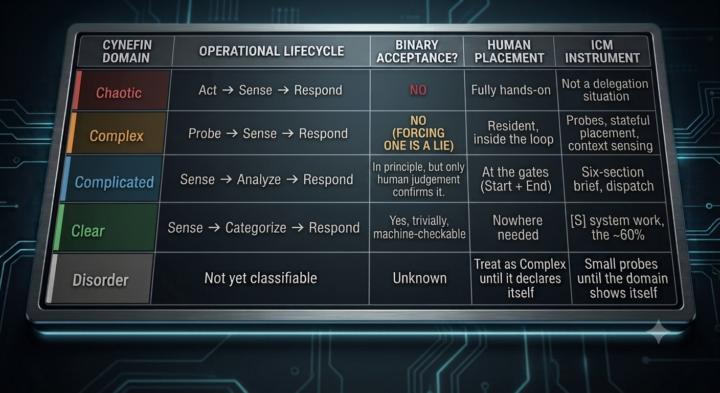
Where do you sit when the agent is working? Human placement is a property of the task, not a preference
Something clicked for me across two recent threads here with @Mads Skak and @Alex Brown, so I mapped it out as a table. I've been trying to work out where I actually need to sit when an agent is working through files. Turns out that's not a preference, it's a property of the task. Cynefin classifies problems by how predictable they are; ICM gives you the instrument for each type. Put them side by side and you can see where the human needs to sit. The row that matters most is **Complex**. When there's no pre-known right answer, forcing a pass/fail check into a markdown file is a lie. The pipeline will look gated and be nothing of the sort. For that work you don't review the final output, you live inside the loop and co-edit the intermediate files as they form. Every output is an edit surface. **Complicated** work is different. There is a right answer, binary in principle, but only human judgement can confirm it. So the worker never self-certifies. You sit at the gates, start and end, and stay out of the execution loop. **Clear** work is machine-checkable and needs no human at all. That's most of the background volume (Jake's 10/30/60 split). **Chaotic** is not a delegation situation. One-line advice at most, human hands on. And the one I nearly missed: **Disorder**. If you can't tell which domain you're in, treat it as Complex until it declares itself. Misclassification is where the damage happens. The long game is moving work down the table, Chaotic towards Clear, as probing stabilises it. But only what has genuinely stabilised. Force the move and you fall off the cliff. Table below. Tell me where this is wrong.
1-30 of 2,402
skool.com/cliefnotes
What we give away free beats most paid courses. Build durable AI systems with a Marine vet and Edinburgh researcher. 40+ lessons, growing.
Leaderboard (30-day)
1

🔥
+1712
2

🔥
+1536
3

🔥
+1438
4

+952
5

+865
Powered by