

Feb 10 •
Your TRT Clinic Should Not Be Prescribing IGF-1 for Optimization
If your TRT clinic has prescribed IGF-1 as part of an “optimization” protocol, it strongly suggests either a lack of understanding of the growth hormone axis or a financial incentive that does not align with patient physiology. This pattern is unfortunately common. Patients seek testosterone optimization and are quickly placed on multiple high-cost peptides and supplements, often without a clear explanation of what is being treated or why. Monthly costs escalate into the thousands, while the underlying biology is rarely explained. In many cases, the clinicians prescribing IGF-1 do not fully understand the growth hormone (GH) pathway or its regulatory feedback systems. IGF-1 is frequently promoted because it is one of the most expensive, high-margin compounds offered by clinics, not because it is physiologically appropriate for long-term optimization. Let’s clarify how the system actually works. How the Growth Hormone–IGF-1 Axis Works 1. The hypothalamus signals the pituitary gland 2. The pituitary releases growth hormone (GH) 3. GH travels to the liver 4. The liver converts GH into IGF-1 (Insulin-Like Growth Factor-1) IGF-1 is the molecule responsible for: - Muscle repair and hypertrophy - Fat metabolism - Collagen synthesis - Tissue repair and recovery In other words, your body already produces IGF-1—it simply requires the correct upstream signaling. Why Secretagogues Make Sense Peptides such as CJC-1295 (No DAC) and ipamorelin work upstream. They stimulate the pituitary to release more of your own growth hormone, which the liver then converts into IGF-1. This approach preserves: - Natural pulsatility - Hepatic conversion - Negative feedback control The system remains intact and self-regulated. What Happens When You Inject IGF-1 Directly ` Injecting IGF-1 bypasses the entire regulatory axis: - Hypothalamus - Pituitary - Liver The body interprets elevated IGF-1 the same way it interprets exogenous testosterone—as a signal to shut down endogenous production.


26d •
NAD oral verses injecting
What do you think is better. Here is Bio coach Bill answer! Oral NAD+ products have the advantage of being easy, convenient, and better suited for daily use, but NAD+ itself may be poorly absorbed orally, so products often use precursors like NR or NMN that the body converts into NAD+. Injected NAD+ bypasses the digestive tract and delivers NAD+ directly into the body, producing much higher immediate exposure, but it’s more expensive, invasive, and can cause injection-related side effects. The big catch is that while both approaches can affect NAD+ levels, we still don’t have strong human evidence proving that injections produce better long-term health or longevity outcomes than a consistent oral precursor strategy.
Jan 8 •
Blood Work After 35
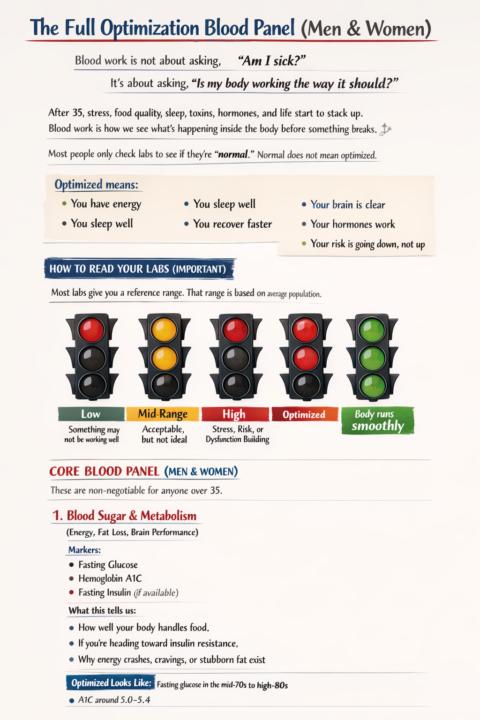
The Full Optimization Blood Panel (Men & Women) Blood work is not about asking, “Am I sick?” It’s about asking, “Is my body working the way it should?” After 35, stress, food quality, sleep, toxins, hormones, and life start to stack up. Blood work is how we see what’s happening inside the body before something breaks. Most people only check labs to see if they’re “normal.”Normal does not mean optimized. Optimized means: - You have energy - You sleep well - You recover faster - Your brain is clear - Your hormones work - Your body responds to training - Your risk is going down, not up Below is what a FULL OPTIMIZATION BLOOD PANEL looks like and what the markers actually mean. HOW TO READ YOUR LABS (IMPORTANT) Most laboratories provide a reference range. That range is based on the average population. Think of labs like traffic lights: - Low = something may not be working well - Mid-range (normal) = acceptable, but not ideal - High = stress, risk, or dysfunction building - Optimized = the body runs smoothly and efficiently CORE BLOOD PANEL (MEN & WOMEN) These are non-negotiable for anyone over 35. 1. Blood Sugar & Metabolism (Energy, fat loss, brain performance) Markers: - Fasting Glucose - Hemoglobin A1C - Fasting Insulin (if available) What this tells us: - How well your body handles food - If you’re heading toward insulin resistance - Why energy crashes, cravings, or stubborn fat exist Optimized looks like: - Fasting glucose in the mid-70s to high-80s - A1C around 5.0–5.4 If these drift high, people usually feel: - Tired - Hungry all the time - Foggy - Stuck with fat loss 2. Lipids & Cardiovascular Health (Heart, circulation, hormone signaling) Markers: - Total Cholesterol - HDL (good cholesterol) - LDL (bad cholesterol) - Triglycerides - ApoB - Lipoprotein(a) What this tells us: - How much stress your arteries are under - How many cholesterol particles are circulating - Long-term heart and brain risk
Nov '25 •
Welcome to Skool Games!
Hey everyone!! Welcome to the Skool Games community! We’ve officially moved from Facebook to Skool, creating a more focused, interactive space centered on learning, growth, and connection. Click the link below to watch a quick tutorial on this platform to learn how to use it most effectively. https://www.loom.com/share/dfeb21de2c544ad78753b267dff07f75 Here you’ll find everything you need to: ✅ Learn about peptides — what they do and how they work ✅ Build confidence in applying and understanding protocols ✅ Connect with others who are committed to optimization and performance ✅ Ask questions, share results, and grow together Take a moment to explore the modules, introduce yourself in the comments, and start earning XP by engaging and sharing your journey. If you're looking for a trusted source to purchase peptides, you can create an account with: https://ascensionaminos.com All members in this community get 20% off each order. Use code: bioopt20% Let’s build something powerful together.

Aug 23 •
KLOW question
Hey guys, quick question. I reconstituted all my KLOW vials on July 3rd and kept them refrigerated. They’ve been reconstituted for about 7 weeks now. Would you guys still use them, or would you toss them? Just want to make sure I’m being safe.
1-30 of 259
skool.com/bioopt
For adults 35+ ready to build muscle, burn fat, and optimize hormones. Aging is inevitable. Decline isn’t. Train smarter. Optimize everything.
Leaderboard (30-day)
1

+4
2

+3
3

+3
4

+2
5

+1
Powered by