Activity
Mon
Wed
Fri
Sun
Oct
Nov
Dec
Jan
Feb
Mar
Apr
May
Jun
Jul
Aug
Sep
What is this?
Less
More
Peptides & Pump Pro
574 members • $10/m
Peptide Researchers
7.9k members • Free
Hacksmith's Free Peptalk Group
2.5k members • Free
3 contributions to BioOptimization Collective

Feb 24 •
Blood work!
Most people don’t die suddenly. They ignore warning signs for years. Heart disease. Diabetes. Hormone collapse. It’s building right now — and you don’t feel it. Not getting blood work isn’t brave. It’s blind. Your labs tell you the truth your body whispers before it screams. If you actually care about your health — Test. Don’t guess.”

2 likes • Feb 26
I just did function health as my dr didn't order anything but standard and omg explains a lot now that I know.

Feb 4 •
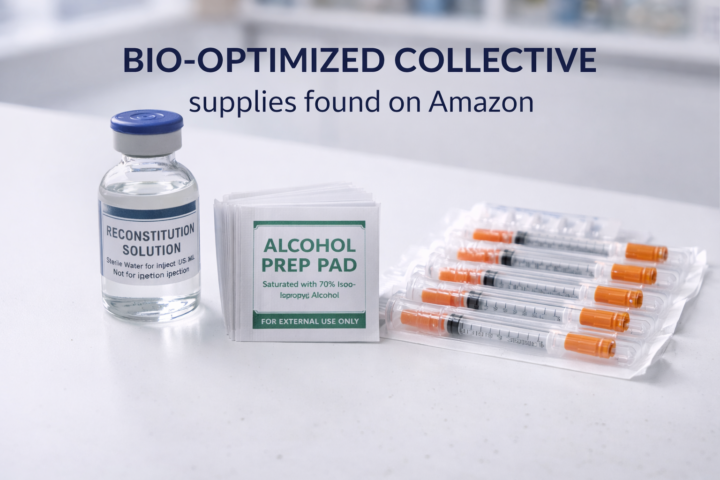
Trusted Research Supplies — Available on Amazon
We get this question a lot, which is exactly why we put together a simple list of the research supplies we actually use and trust, instead of having people guess. When it comes to needles and syringes, the goal is accuracy, consistency, and reliable delivery — not what’s smallest or trendiest. That’s why: - Smaller syringes = better accuracy for small doses - And why I generally prefer a ½” 29g needle over a 5/16” 31g The slightly longer length gives more margin for consistent subQ delivery across different body types and injection sites. The shorter 31g needles can work, especially if someone is very lean, but they’re more technique-dependent and easier to be too shallow with. Comfort-wise, most people don’t notice a meaningful difference. All of the supplies we recommend are basic, no-nonsense tools we personally purchase through Amazon because they’re easy to source, consistently available, and clearly spec’d. Nothing fancy. Nothing gimmicky. Just reliable equipment that supports clean, precise research practices. Everything shared is for research and educational purposes only. The goal is to remove confusion, save time, and help people follow best practices. Start simple. Stay organized. Be precise. That’s how real research is done. Link for Reconstitution Solution: https://www.farrislabs.com/products/bacteriostatic-watersrsltid=AfmBOopVGmTgV6LKthnyROyxp8jKSuU6UliOCjoIw1koPGvNWMv3E3hn Link for Alcohol Prep Pads: https://a.co/d/0fX2kyaL Link for 1mL, 29 Gauge, 1/2 inch Syringes: Note you can also find a purchase different size syringes depending on your application: https://a.co/d/0c8tbJvb
2 likes • Feb 26
YAY Avaiailbe in California - so far!
Feb 6 •
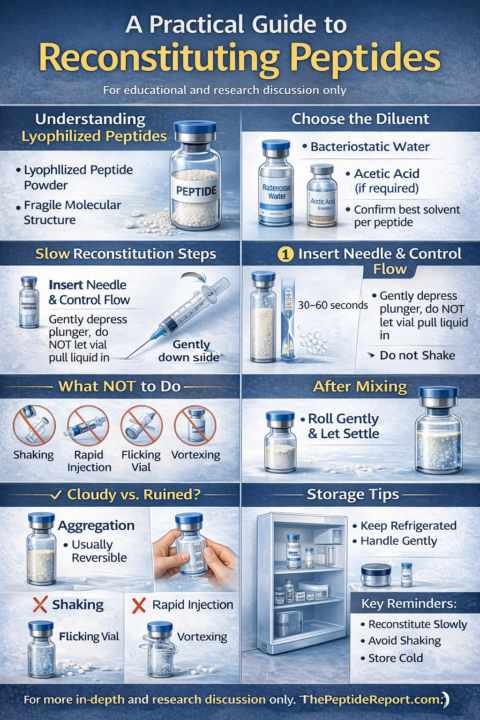
A Practical Guide to Reconstituting Peptides/Calculator (Educational Use Only)
Proper peptide reconstitution is one of the most overlooked—and most important—steps in peptide research handling. Many issues people encounter (cloudiness, clumping, reduced effectiveness) are not product defects, but reconstitution errors related to speed, agitation, or solvent choice. Bio-Opt Tracking Calculator: https://peak-bio-path.base44.app This article outlines best-practice principles for reconstituting lyophilized peptides for educational and research discussion only. 1. Understanding Lyophilized Peptides Most peptides are supplied as a lyophilized (freeze-dried) powder. This form improves stability during storage and transport but makes the peptide mechanically sensitive once liquid is introduced. Key point: Peptides are fragile molecular chains, not resilient compounds. How liquid is introduced matters. 2. Choosing the Correct Diluent The most commonly used diluent for research peptides is: - Bacteriostatic water (contains 0.9% benzyl alcohol) In specific cases (e.g., certain fat-loss or acidic peptides), acetic acid may be used in combination, but this depends on peptide characteristics. General educational guidance: - Most peptides tolerate bacteriostatic water well - Always confirm compatibility for the specific peptide being studied 3. Step-by-Step Reconstitution Technique Step 1: Prepare the vial - Allow the peptide vial to reach room temperature briefly if stored cold - Swab the stopper with alcohol Step 2: Control the vacuum - Many vials have a strong vacuum seal - Do not allow the vial to pull liquid in rapidly Instead: - Insert the needle - Gently depress the plunger to control the flow Step 3: Introduce liquid slowly - Aim the needle toward the inside wall of the vial - Let the liquid run down the side - Take 30–60 seconds if needed Rapid force = turbulence = aggregation risk. 4. What Not to Do Avoid the most common mistakes: - ❌ Shaking the vial - ❌ Rapid injection of diluent - ❌ Flicking or vertexing - ❌ Repeated aggressive handling
1 like • Feb 26
I feel that while it may have been debunked, why push it if it dissolves ok with a swill?
1-3 of 3

@connie-marshall-3405
Wife, Mom, Dogs,Tripod Cats, Sony 📷 '66 ElCamino, Harley, Subie, Mini, Fuji road bike. Hormones, detox, energy. MCS, Penz10 at Peptipen.com
Active 5h ago
Joined Feb 25, 2026
Powered by