Activity
Mon
Wed
Fri
Sun
Dec
Jan
Feb
Mar
Apr
May
Jun
Jul
Aug
Sep
Oct
What is this?
Less
More
Powerhouse Fitness for Women
29.2k
5.0
Free
BioOptimization Collective
372
Free
Photography
534
Free
Peptide Association Community
1.1k
Free
The Menopause Lab
65.8k
Free
16 contributions to BioOptimization Collective

Sep 24 •
Your Metabolism Has an Age… What’s Yours? 👀
You know your age… but how old is your metabolism? Take the quiz here 👇 https://biocoachbill.com You might be 40, 45, 50 or 60 on paper. But that doesn’t necessarily mean your body is functioning at that same age. We put together a quick Metabolic Age Quiz that helps give you a better look at where you currently stand based on factors that can influence your metabolic health. The interesting part? Your metabolic age could come back younger than you are… or older than you are. And if it comes back older, the point isn’t just to give you a number. It’s to help you start identifying the areas you can actually work on to improve your health, body composition, energy, and longevity. Take the quiz here 👇 https://biocoachbill.com It only takes a few minutes. Then come back to this post and tell us: What’s your actual age vs. your metabolic age? Let’s see who in this group is aging backward. 🔥

1 like • 25d
So this is our recovery score, right? Actual age-58 Recovery score-52.2 The reason I even scored this high is not due to activity it’s because I have very low stress in my life right now. A year ago this number would be very different.
Jul 28 •
30 Day Bio-Opt Challenge
Why Are You Here? Let's Start With Your Goal. Welcome to the Challenge! If you're here, chances are you're looking to improve something about your health. Maybe it's fat loss. Maybe it's muscle. Maybe you're recovering from an injury. Maybe you just want more energy. No matter where you're starting from, you're in the right place. One thing I want everyone to understand from Day 1... There isn't a magic peptide. Peptides don't replace hard work. They don't replace good nutrition. They don't replace sleep. They don't replace consistency. They're simply one tool that may support the work you're already putting in. That's what this community is about. We're here to learn from the research, share experiences respectfully, and help each other become healthier, not chase shortcuts. If you could improve ONE thing over the next 90 days, what would it be? - Lose body fat - Build muscle - Heal an injury - More energy - Better sleep - Better hormones - Healthy aging - Better focus - Something else? Tell us below.
2 likes • Jul 29
More energy

May 21 •
Reta
Any advice on reta? Got a 30mg vial, how to recon, and how much to use, going up amounts etc, any advice is greatly appreciated
2 likes • Jun 2
I was at 3mg every 6 days. Titrating down a bit for a while so i can stack Ss-31 and/or mots-c. Took me a quite while to get up to 3mg. I chose the slow route, but where I finally found the food noise go away. I haven’t lost all the weight I want, but enough for now to start something new. I am down to 2.25mg now and i am definitely hungrier.
May 20 •
Peptide Stacking Guide
Your body is sending signals. Peptides restore them. We just dropped the Ascension Aminos Peptide Stacking Guide — a full 14-slide education resource built on Dr. William Seeds' Cellular Medicine Framework. This is not a list of compounds. This is a system. Every protocol in this guide answers the same question Dr. Seeds asks before building any stack: What cellular pathway is disrupted? What signal is missing? Which peptide restores it? Inside the guide you will find optimal stacking protocols for Retatrutide, KLOW, BPC-157, TB-500, PT-141, GHK-Cu, Sermorelin, Semax, MOTS-c, KPV, CJC-1295 with Ipamorelin, FTPP, the Glow Stack, and DSIP. Every compound mapped to its goal. Every add explained mechanistically. No guessing. The difference between results and exceptional results is not the compound you choose. It is what you build around it. Fat loss without lean muscle preservation is just weight loss. Recovery without collagen restoration is partial healing. GH optimization without tissue protection is borrowed time. Cognitive enhancement without nervous system regulation burns out fast. The guide shows you how to close every one of those gaps.
1 like • May 28
This is so helpful
Apr 3 •
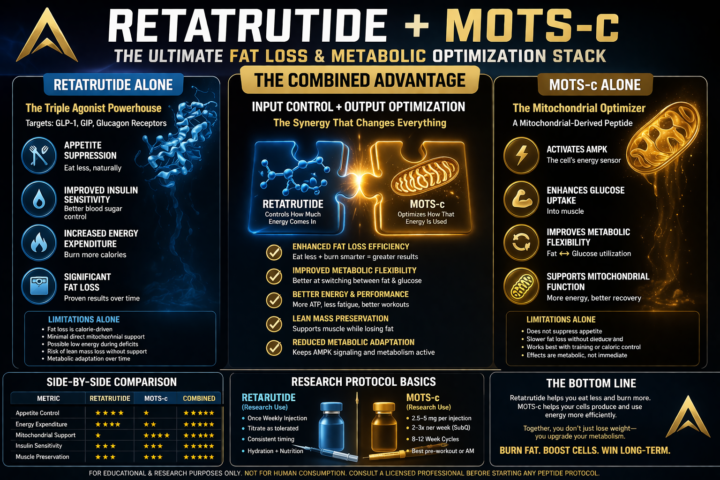
This Stack Burns Fat AND Boosts Your Cells (Way Beyond Retatrutide Alone)
Here’s a simple way to understand the difference between using retatrutide alone vs combining it with MOTS-c Retatrutide on its own is extremely effective for fat loss because it works primarily by reducing appetite and improving insulin sensitivity. You eat less, your body burns more, and weight comes down. But most of that effect is driven by caloric restriction and hormonal signaling, not necessarily by improving how your cells produce and use energy. That’s where MOTS-c changes the equation. MOTS-c works at the mitochondrial level, helping your cells become more efficient at using fuel. It activates AMPK, improves glucose uptake into muscle, and enhances metabolic flexibility — meaning your body gets better at switching between burning carbs and fat. So when you combine the two: - Retatrutide controls how much energy comes in - MOTS-c improves how efficiently that energy is used This creates a more optimized fat loss environment. Instead of just losing weight from eating less, you’re also: - Improving cellular energy production - Supporting better workout performance - Encouraging nutrient partitioning toward muscle - Reducing the “low energy” feeling that can come with aggressive calorie deficits Another important point — retatrutide alone can sometimes lead to metabolic slowdown over time (as the body adapts to lower calories). MOTS-c helps counter this by keeping metabolic signaling active through AMPK. So the real difference looks like this: Retatrutide alone = strong appetite suppression + weight loss Retatrutide + MOTS-c = appetite control + mitochondrial optimization + better overall metabolic function It’s essentially the difference between: - “Losing weight" vs “Improving how your body produces and uses energy while losing fat” For those focused on performance, body composition, and long-term metabolic health, that distinction matters.
1 like • Apr 4
Very timely post as I get ready to take the leap with a reta stack. Thank you!
1 like • Apr 19
Is anyone on mots-c feeling the “hangover” after a few weeks? Been reading up on this
1-10 of 16

@michelle-heaton-9927
Looking to learn and get community support
Active 8h ago
Joined Dec 17, 2025
Powered by