Activity
Mon
Wed
Fri
Sun
Jun
Jul
Aug
Sep
Oct
Nov
Dec
Jan
Feb
Mar
Apr
What is this?
Less
More
Memberships
Engineers in Business
1.1k members • Free
Mechanical Engineering Mastery
316 members • Free
Engineering Entrepreneurs
118 members • Free
Chemistry Physics Engineering
98 members • Free
Abundance Engineering
121 members • Free
Data Innovators Exchange
738 members • Free
Skool of Finance
600 members • Free
Data Analysis with R
469 members • Free
Data Alchemy
37.7k members • Free
27 contributions to The Energy Data Scientist

10d •
Lithium mining - France
To decarbonise the electricity sector, France is mining lithium for energy storage, transport and decarbonisation! Source: https://www.lesechos.fr/industrie-services/energie-environnement/imerys-se-lance-dans-la-course-au-lithium-avec-un-projet-a-1-milliard-deuros-en-france-1872166

1 like • 9d
This is a strong example of industrial policy meeting energy policy. The project is designed to produce about 34,000 tonnes of lithium hydroxide per year, enough for around 700,000 EVs, and it now has backing from both the French state and the EU strategic raw materials framework. By the way latest IEA data show that EVs still dominate lithium-ion battery deployment, while battery energy storage is growing and already represents more than 15% of deployment.

10d •
Report
Dear colleagues, I would like to share the second part of the report I wrote some time ago. This time I have focused on a more niche topic. Also, as of June 20th, I will be participating in a short-term program in Poland. Therefore, I will be in Europe. If you are interested in working together or have any opportunities you can direct me to, I would be happy to be in touch. You can send a message through this application or contact me at mstafakaramn@gmail.com so we can discuss this in more detail.
1 like • 9d
Thankyou for the report. I like the balance between data and policy analysis in your paper. The 2030 and 2053 targets give a good long term view and practical, especially on motors, waste heat, and digital monitoring. You highlight buildings as a major efficiency opportunity. Which building measure should be prioritized first: insulation, HVAC upgrades, automation, or district heating? And how realistic do you think the electrolyser targets of 2 GW by 2030 and 5 GW by 2035 are?
Mar 7 •
Job Market Firings & Energy: my discussions
Just wanted to share that from my recent talks in board meetings and with executives globally, the consensus is that companies are indeed laying off, and these numbers are accurate that I share below and maybe you have seen also around . You can verify them yourself. While they largely represent cumulative cuts and aggressive restructuring from 2023 through early 2026, the direct job eliminations are very real. I checked some of the biggest tech and legacy players: - Amazon: 30,000 (Cumulative cuts across corporate and managerial roles) - Intel: 25,000 (Aggressive restructuring to pivot toward the AI market) - Microsoft: 15,000 (Accumulated over several rounds of tech-sector corrections) - Dell: 12,000 (Massive sales team reorganization) - Salesforce: 4,000 (Role eliminations to reallocate funds toward AI development) - GM (General Motors): 3,300 (Cuts across autonomous vehicle divisions, software, and factory shifts) In the energy industry, we are going through the exact same ruthless transition, and the ones losing their jobs are the ones who have completely failed to adapt to new technologies and who rely on an old mindset. The industry is rapidly pivoting into professionals who understand / explain/ can storytell machine learning models, AI integration, optimization etc. The professionals who are aggressively upskilling and learning how to integrate data science into traditional energy workflows are the ones keeping their seats . If you think that energy is "safe" and all I have to do is "just go to meetings, and do coffee breaks" this is not the truth! "Oh I studied 5 years. I am now going to have a relaxed professional life". No! Constantly improve your skills. Never settle. Those who think 'energy is just writing reports and go to meetings" may get anytime a phone call "My friend, I love you. But I am sorry to say, you are among those who are going to be laid off. I am truly sorry. You know how much I care but I am sorry. It is a company policy". And that's it.

Mar 5 •
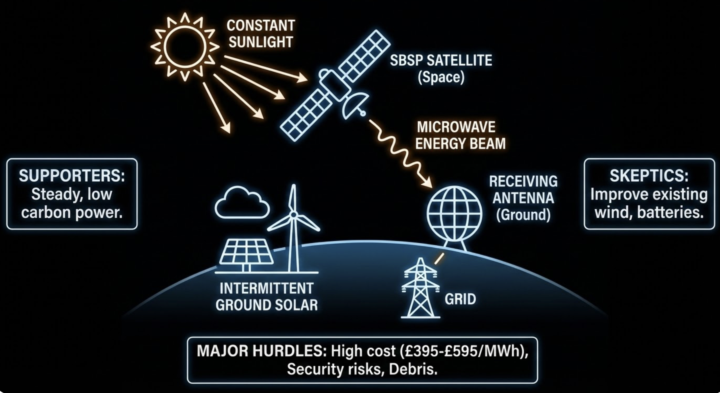
New Report: Solar PV in space
Space based solar power means to deploy large solar photovoltaics panels on satellites to collect sunlight and then beam the energy to Earth in the form of microwaves. On earth, huge ground receivers would convert it into electricity for the grid. It could help provide steady low carbon power and might become cost competitive by 2040, but early systems would be very expensive and face major technical, safety, and space security risks. See the attached screenshot for how it will work. A new report about this topic has been published in 'Classroom' , at the very end In the section "Energy Industry Support" (a special section with reports that explain the current status and trends in the energy sector). It is written in simple, easy-to-understand language with every terminology/jargon explained. It has been written by compiling data from official sources (Financial Times, Bloomberg, Wall Street Journal, the Economist, Forbes, Investors Chronicle etc). Feel free to use this report in your projects, work, or studies. Reading these reports can help with interviews, meetings, presentations, networking, and public speaking, so it is strongly recommended. “
1 like • Mar 5
The pathway would feel stronger with explicit milestones. Start with an end-to-end demo: beam, receive, convert, and feed a grid. The UK published a new small-scale SBSP feasibility report in February 2026, which supports staged development. Tie your conclusion to that staged logic. It will feel more practical.
0 likes • Mar 5
@Aless Romano Indeed.

Jan 13 •
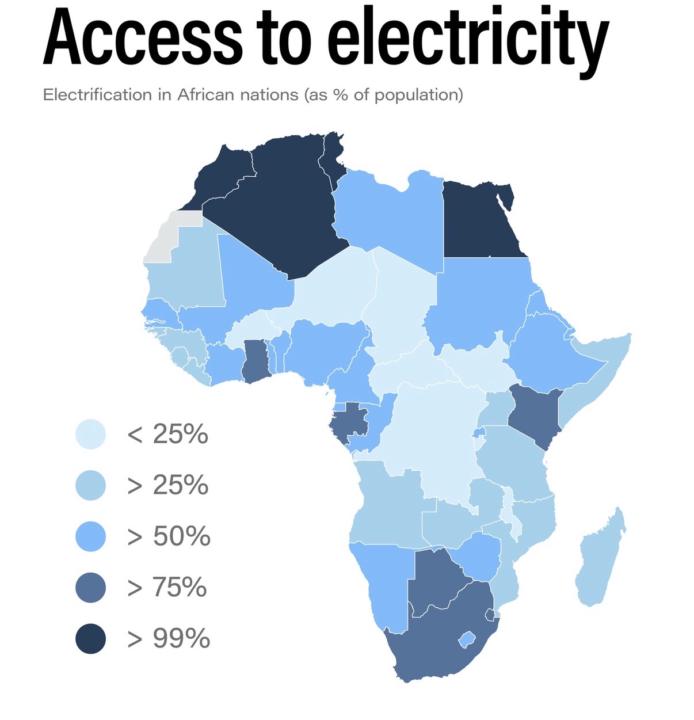
Access to Electricity in Africa
The attached plot shows the level of electricity in Africa. How best can it increase? using smart grids? micrograms?
0 likes • Jan 13
@Kim Min-jun exactly
1-10 of 27

Active 9d ago
Joined Sep 23, 2025
AZE