Activity
Mon
Wed
Fri
Sun
Jun
Jul
Aug
Sep
Oct
Nov
Dec
Jan
Feb
Mar
Apr
What is this?
Less
More
Memberships
Spanish Learning
80 members • Free
English Language Coach Kerry
27 members • Free
Free Greek Course
1.8k members • Free
Linguists Society
91 members • Free
Leadership Skool
1.4k members • Free
Elektrikal Skool
41 members • Free
Off Grid Academy
50 members • Free
The Electricity Lab
199 members • Free
Solar Operations Excellence
295 members • Free
24 contributions to The Energy Data Scientist

6d •
PDF on China-Australia energy cooperation
I was at a conference, and this is a presentation by a China Analyst, Climate Energy Finance at a conference on Australia–China green economy cooperation. Key points are: - China dominates global clean energy and clean tech manufacturing, holds ~40% of global solar, leads global EV sales (2.4 million in Q1 2025, +36% YoY), and controls over 80% of global manufacturing capacity across 11 clean-tech supply chain segments (solar, batteries, critical minerals processing). - China is Australia's #1 trade partner and offers the world's lowest-cost, most advanced clean tech. - Government needs to build an enabling environment through a future-oriented national China strategy, bilateral decarbonisation agreements, clearer foreign investment rules
2 likes • 5d
@A Khan ‘a long-term vision’: that is exactly what a mindset of abundance is all about, and thank you for those clear explanations
1 like • 4d
@Luis G The question of whether the nuclear sector in France is economically viable is a difficult one; however, there are government sources and non-governmental organisations that provide an insight into the current situation and future prospects. Sources: https://www.entreprises.gouv.fr/secteurs-dactivite/le-secteur-de-lindustrie-en-france/les-comites-strategiques-de-filiere/la-0 Les echos https://www.lesechos.fr/industrie-services/energie-environnement/nucleaire The shift project https://theshiftproject.org/publications/reussir-la-transition-dans-lincertitude/ That is why the scenario-based approach developed in Course 120 is so interesting.
10d •
Lithium mining - France
To decarbonise the electricity sector, France is mining lithium for energy storage, transport and decarbonisation! Source: https://www.lesechos.fr/industrie-services/energie-environnement/imerys-se-lance-dans-la-course-au-lithium-avec-un-projet-a-1-milliard-deuros-en-france-1872166

18d •
New Course: Fundamentals of Energy Economics for Electricity Grid Planning
Just released a new course on energy economics, covering important economic concepts behind investment decisions in electricity distribution networks. You'll learn about - decision frameworks (deterministic, stochastic, least-worst regret), - scenario trees, - stranded assets, - option value of smart technologies, - investment delay. All concepts are illustrated through a practical example. No prerequisites. Ideal if you're preparing for energy economics or power system economics roles, or doing research. It is course 120 at the very end of the Classroom. Briefly here are the definitions of fundamental economic concepts in power systems: - Decision frameworks: these are approaches that network planners use to decide where and when to invest in power systems. These frameworks are: deterministic (ignores uncertainty), stochastic (accounts for uncertainty and probabilities), and least-worst regret (accounts for uncertainty but not probabilities). - Scenario trees: A way to map out possible scenarios. Demand might grow a lot, a little, or not at all. The tree captures these paths and their probabilities. - Investment delay: Some investments take longer to build than others. Upgrading a cable might take years; deploying smart chargers can happen faster. This difference matters hugely for planning. - Stranded assets: You invest in upgrading a line expecting electricity demand to grow, but it doesn't. Now you've paid for capacity nobody uses. That's a stranded asset. - Option value of smart technologies: Smart technologies like smart chargers can be deployed quickly, letting planners wait and see how uncertainty plays out before committing to expensive upgrades. The cost savings from having this flexibility is the option value. - Capitalisation factor: Converts a one-off investment cost into an equivalent annual cost, accounting for the asset's lifetime and the discount rate. Attached is a summary slide, and a slide on the concept of option value and stranded assets. No need to fully understand these screenshots . Just to get an idea of what the course teaches.
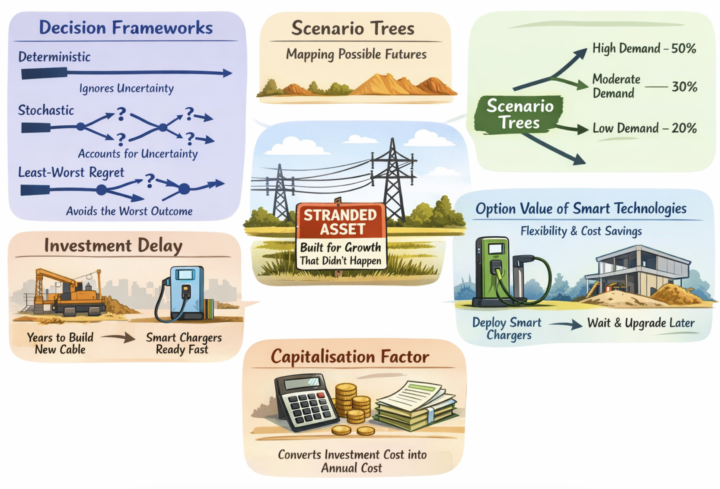
5 likes • 17d
The scenario-based approach covered in this course provides a clear framework for understanding uncertainty and projecting into the 2030s

Mar 25 •
How to learn Coding in the era of AI
I am sharing a summary from an HR/Careers conference in Applied Software Engineering. People are complaining of forgetting the code they learnt at uni, or on online courses. They learnt it, and now it's' gone. So the fastest way to learn coding today is not to sit through dozens of online courses on Udemy, Coursera, or edX and hope the knowledge sticks. If you have tried that route, ask yourself honestly: how much of it do you remember three months later? Most of it is gone. That approach feels productive in the moment only. Instead, the smartest path is to start with Python and study code that already exists inside industry case studies. You see exactly how it is applied in real-world cases. Then Open GitHub, and upload a full project. First, actually work with the code e.g. maybe you need to combine the code of 5-10 courses together . Change the data slightly,. Then upload your version to GitHub with a clean, nicely written README file and well-presented code (comments etc). Do not panic about volume. You only need to upload 1 machine learning project and 1 optimisation project over the course of 8 -12 months. Takes time if you are absolute beginner. That is enough to make you extremely attractive to employers : internships and junior jobs. This is better than MSc degrees because they are filled with exams and homework , whose solutions circulate around and you copy-paste and employers know it. Every time you upload a project, write a LinkedIn post about it if you aren't shy . So, take ten or twenty courses from the Classroom, as many as you need, and combine what you learn from them into a single coherent project or more. If you are ambitious, try to publish your work as a paper. Even better. Shows prestige. Nobody does these simple things and everyone goes to do MSc , which is fine ofcourse if you have the money. That is the whole strategy. HR managers almost never see this level of discipline from candidates. Most CVs simply list "I completed 5 courses on Udemy" or "I finished 10 courses on edX," but they never remember what they did there. They have the certificate but in the interview they say they forgot.
4 likes • Mar 26
@Dr J Fid You're spot on! 1/ The question I ask myself when learning the language (beyond the basics) is: what problem am I trying to solve (technical, business, etc.)? For example, are there enough charging stations in a certain neighborhood? Or how much will an hour of energy cost? Etc. 2/ That's why I find this comment so relevant “Don’t panic about volume. You only need to upload 1 machine learning project and 1 optimization project over the course of 8–12 months. It takes time if you’re an absolute beginner.” However, it does take time and energy, indeed...
Mar 19 •
⚡ Networks grids & Storage — Part 1/...
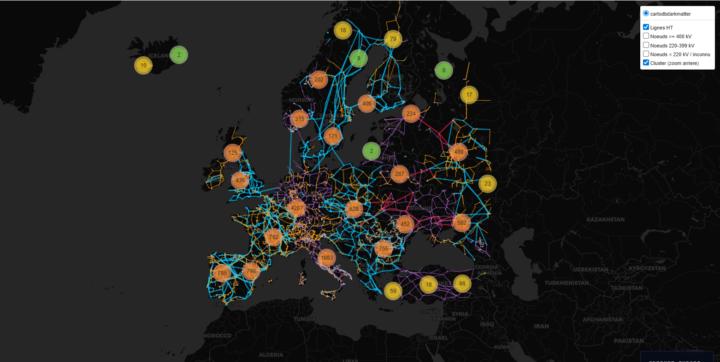
🗺️ Where it started To better understand energy networks and their geographic topology, I dove into open source data — specifically OpenStreetMap and GridKit — to map transmission nodes and lines across Europe and the UK. There are already plenty of courses on grids and storage. So instead of passively consuming content... I decided to build something. 🎯 Project Goals Technical side: - Sharpen my Python + mapping skills (Folium / GeoPandas) - Experiment with Vibe Coding (rapid iteration, AI-assisted prototyping) Knowledge side: - Understand the role of energy storage and load balancing in modern grids - Identify the critical materials and minerals behind storage technologies (lithium, cobalt, vanadium, manganese...) - Map out the key players in the sector — utilities, pure-play storage companies, and emerging startups 💡 Open questions — your ideas welcome! Some threads I'm already pulling on: - Where are the bottlenecks in European transmission networks? - How is the storage mix evolving — short-term (batteries) vs. long-term (hydrogen, pumped hydro)? - What business models are emerging around grid flexibility? What would you add to this project? 👇 Series in progress — more in the next post 🔄
3 likes • Mar 21
@Jorge Torres MSc. The idea behind this project, as I was taking the courses, was that I wanted to put what I’d learned into practice! I noticed that the ENTSOE map at https://www.entsoe.eu/data/map/ wasn’t interactive. So I set myself a challenge to see if I could put the following to good use: - the Python course - the Leaflet/Geopandas and geomatics course - a way to query CLAUDE for the coding vibe, guided by my intermediate coding skills I know I’m not a developer, but I enjoy it I use Colab or PyCharm
3 likes • Mar 21
@Mateo Flores, Msc This map is an interactive map I created using Python + Folium and CLAUDE I've just included a screenshot, but if anyone is interested once I've finished it—taking the above comments into account—I can post a link to view it) (I read in a post here that HR folks don’t like the coding vibe, but I use it to give myself more room to work on projects) As for the open-source datasets, everything is available as open source and free - https://geopandas.org/en/stable/gallery/plotting_with_folium.html - https://leafletjs.com/ Thanks to the courses I’m taking, I’m able to carry out my first project: understanding the network and storage
1-10 of 24
Active 3h ago
Joined Sep 19, 2025
France