Activity
Mon
Wed
Fri
Sun
Jun
Jul
Aug
Sep
Oct
Nov
Dec
Jan
Feb
Mar
Apr
What is this?
Less
More
Memberships
ETQAN Engineering Academy
19 members • Free
Engineers in Business
1.1k members • Free
Career Professionals Network
95 members • Free
Scholar Career Network
380 members • Free
Data and Ai Automations
1.6k members • Free
Dissertation Help Community
3.6k members • Free
Let's Master English
5.5k members • Free
Study Smarts
122 members • Free
Studicata
17.9k members • Free
46 contributions to The Energy Data Scientist

15d •
Energy Report
I'd like to share a short report I wrote some time ago. It's a brief overview of the Turkish energy market and its key players. I'd be happy to hear your thoughts and comments.

0 likes • 7d
@Mustafa kemal Karaman What have you decided?

9d •
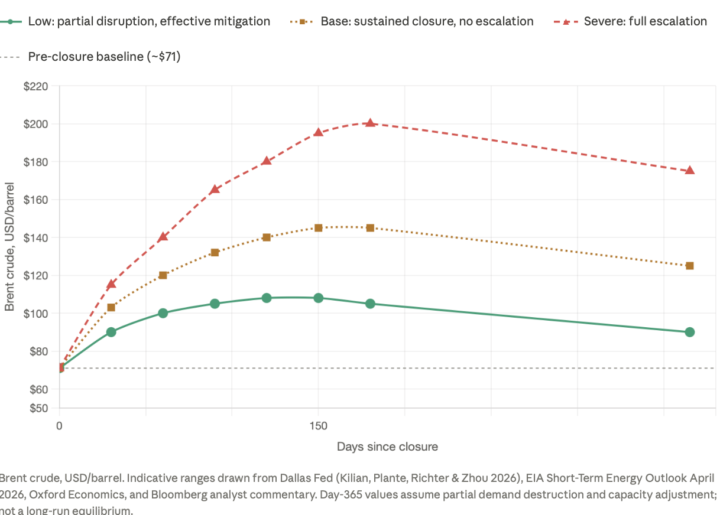
Oil Price Dynamics (Interview Question)
S&P Global Commodity Insights (Platts): commodity strategist, Interviewer: Explain the plot. It shows the oil price 0, 30, 60 , 90, 120, 150 , 180 days after a potential closure of the Straight of Hormuz. Why does the price not increase monotonously? explain the lines Can you try answer it ?
0 likes • 7d
Useful interview prep !

23d •
Interactive Map with Energy Projects
Found and sharing an interactive energy infrastructure map hosted by GlobalGrid2050. It maps renewable energy and storage projects for the United Kingdom only. It is including solar PV, onshore and offshore wind, and battery storage . It is getting them from the UK's Renewable Energy Planning Database (REPD). You can filter projects by technology type, planning status (from "in planning" through to "operational"), and capacity range in MW. It also overlays grid infrastructure like substation density and water utility locations. It is a useful tool for visualising the spatial relationship between generation, storage, and network assets. https://globalgrid2050.com/repd_atlas_grid_model/
0 likes • 22d
Thanks. Maps all the projects on a map so we know the geographical and other details.

23d •
Battery Arbitrage Project
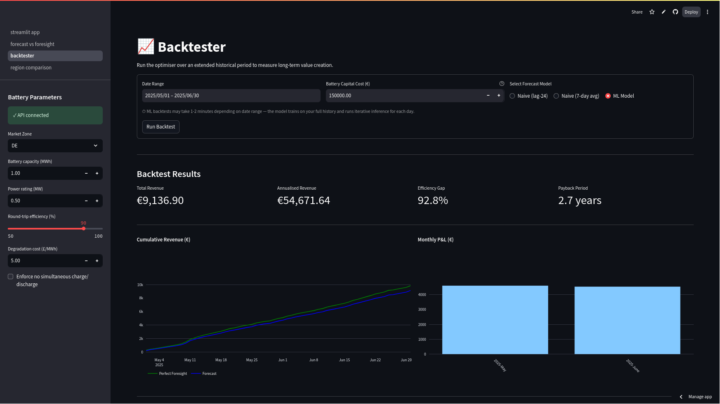
Hi everyone! I've been exploring the battery arbitrage space for the past few months and wanted to share my most recent project: I built a battery arbitrage backtester that finds the optimal charging schedule using LP, and tests it against three forecasting approaches(two rolling averages, one ML) and measures how much of the theoretically available market value was captured. I pooled data from different EU market zones to train a LightGBM model and trained a separate one for Britain, which is why the rolling average model overtook the ML model in Germany's results, for example, which was an interesting result. Article and Streamlit dashboard to play around with here if anyone's curious: https://kilowatthours.substack.com/p/building-a-battery-arbitrage-backtester https://bessarbitragedemo.streamlit.app/ I'm currently working on multi-battery coordination and whether batteries "knowing" more about the grid's topology can improve dispatch results, and using a neural network for the congestion signal. Curious to hear your feedback, and if anyone's working on battery optimization or grid ML, would love to connect.
1 like • 22d
Quite impressive . I like that you benchmarked against the theoretical market value instead of just reporting raw profits. That makes the results much easier to interpret. The Germany result is especially interesting because it shows where a simpler model can still win when transferability is limited. Have you looked at whether zone-specific feature engineering could close that gap for the ML model?

30d •
Energy Security and Batteries
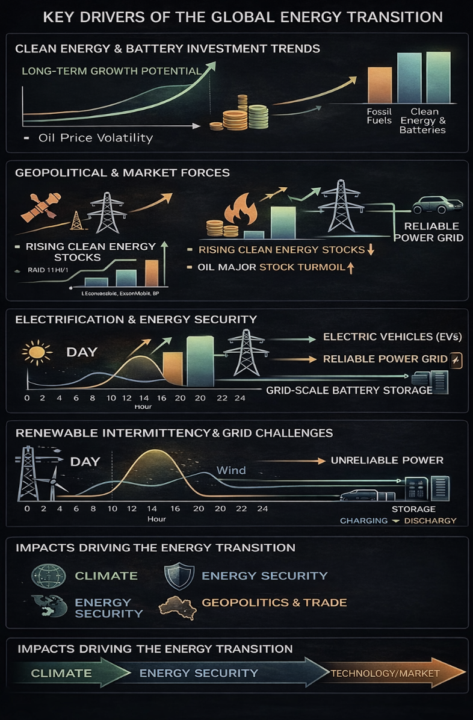
Rising conflict and growing energy insecurity have made batteries, clean energy, and electrification more attractive as long-term investments than fossil fuels alone. Companies such as CATL, BYD, and Sungrow have benefited strongly, as battery and energy storage technologies support electric vehicles, renewable power, and grid reliability. The energy transition is increasingly being shaped not only by climate goals, but also by war, trade risks, and the need for stronger domestic energy security. A new report on this topic has now been published in Classroom, at the very end under “Energy Industry Support” , a special section featuring reports that explain the current status and key trends in the energy sector. The report explains these developments in clear, simple language, includes illustrative graphs, and shares official sources such as the Financial Times, Bloomberg, Wall Street Journal, The Economist, Forbes, and Investors Chronicle. This report can be downloaded for your use. See the attached screenshot.
0 likes • 30d
This is a strong argument for why batteries matter now. They help countries rely less on unstable fossil-fuel imports. That gives them both strategic and economic value.
1-10 of 46

@kahu-ngata-5552
Renewables Researcher, Univ. of Auckland alumni - wind energy consultant for 10+ years
Active 7d ago
Joined Sep 20, 2025
Auckland, New Zealand