Activity
Mon
Wed
Fri
Sun
Oct
Nov
Dec
Jan
Feb
Mar
Apr
May
Jun
Jul
Aug
Sep
What is this?
Less
More
InnerDevelopment@Work
519 members • Free
55 contributions to InnerDevelopment@Work

Mar 6 •
Soil Health, Human Health & Planetary Well-Being: Pathways for Regenerative Economies
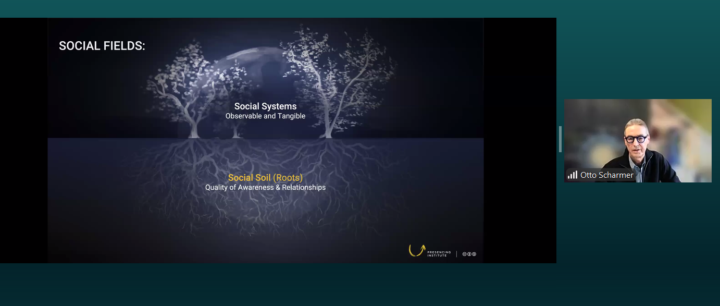
Being a part of the Presencing Institute community since it's very beginning, and have used TheoryU in the design of many gatherings that I have hosted and facilitated. I joined the first of five global gatherings yesterday. They hosted a 90-minute session with over 700 participants weaving together stories, music, breakout conversations, and collective reflection to explore the living connections between regenerative agriculture, human health, and new economic possibilities. I'm sharing a few of the images and phrases that stuck with me: Planting new seeds for new ways From extraction to regeneration Agriculture is culture Native bees are almost extinct Fall in love with the problem Both special guests were touched by a calling and curiosity to do something different with their lives. Despite their fear they allowed themselves to feel into it, to take risks because they had a strong belief in the importance of their ideas, and the impact they could have on people and the planet. They decided to experiment with what they were curious about and each took small steps with purpose, being brave enough to take the next step without having the answers. Christa was activated by soil, farming and community. Zuzanna by creating caring farmer communities. Christa went on to say that she surrendered to the process. Special Guests: Christa Barfield, Zuzanna Zielińska

3 likes • Mar 7
Hello! I was there as well. Very glad for the bridge between regenerative practices and theory U (so far not concerned with regeneration, at least from my vintage point). I was shocked by the similarity between my process of ecological conversion and Zuzanna's: both started during Covid pandemic, both centering on the humble art of composting your coffee grounds, at the beginning. Both continuing by "following in love with the problem" and wanting to spread the good news: falling in love with the problem means to feel the world as lover and the world as Self (Joanna Macy).
Dec '25 •
Alignment over Comfort
Comfort looks innocent. It feels deserved. Yet it may be one of the most powerful forces quietly undermining our values, our leadership, and our ability to build regenerative systems. Most of us don’t walk away from what we believe in because we stop caring. We walk away when living those values starts to cost us time, effort, patience or ease. Comfort rarely shows up as a conscious choice. It hides behind words like efficiency, convenience, and making things easier. It often sounds reasonable: - “We don’t have time for this right now.” - “The market isn’t ready.” - “Let’s not overcomplicate things.” - “We need quick wins.” None of these are wrong on their own. But together, over time, they form an invisible operating system. It subtly prioritises ease over alignment, and short-term relief over long-term value. The uncomfortable truth is this: many decisions that keep organisations stuck are not driven by bad intent, but by an unexamined preference for comfort. I believe most leaders genuinely care about sustainability, wellbeing, fairness, or long-term impact. The issue is that those values often become conditional. We support them as long as they: - don’t slow us down, - don’t disrupt existing models, - don’t introduce friction, - don’t require us to sit with uncertainty or resistance. The moment they do, we postpone, soften, or reframe them into something more manageable. Not because we don’t believe, but because full alignment asks more of us than we are willing to face. Building regenerative food systems inevitably introduces friction. It asks leaders to: - hold complexity instead of simplifying it away, - resist short-term incentives, - stay present when outcomes are uncertain, - engage with interests that don’t neatly align. This is where comfort quietly becomes a liability, because meaningful change rarely happens in its presence. What we often call “resistance to change” is, at its core, resistance to discomfort. And that is where inner development quietly becomes a business capability:

0 likes • Jan 2
I was reading this and I think "alignment" is what I call "congruence" following Carl Rogers. You rightly point to the existence of the good feeling, which I call the feeling of truth, coming from language and world meeting each other, closeby.
Dec '25 •
Happy New Year Everyone 💫🤩
It’s been an amazing year in community 🚀 Next year we kick off with weekly skill builder sessions, check the calendar and join us. We know inner development is one of the keys to positive change, in 2026 we’ve created 2 new services to provide you with deeper support with your work. We’ll discuss this in our last (roundup) hang out call on January 6th. Hope to see you then! Until then, we send each of you sparkles and showers of positive energy from all the colors of the universe 💫 Big love and appreciation Nadene & Sarah

5 likes • Jan 1
I have not been very active here in 2025, as "less screen, more life" has been my motto. But best wishes on all our endeavours! May we begin 2026 with a handful of soil in our hands and hope in our eyes!
Dec '25 •
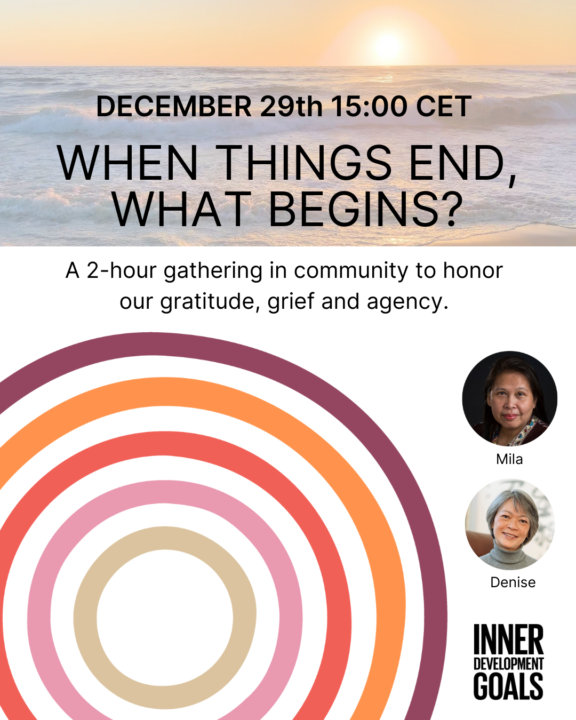
You are invited! 29 Dec, 15:00 - 17:00 CET
As the year closes and IDG moves through a time of transition, many of us are carrying both gratitude and grief, and an appreciation for what has been possible, what may be ending, and the unanswered questions that remain. This two-hour gathering is an invitation to slow down together, honour what has been and what has been lost, and reconnect with the deeper sources of creative agency that carry us forward. Drawing on Joanna Macy’s Work That Reconnects, we will make space for reflection and shared presence - not to fix or plan - but to meet the New Year with care and a sense of what wants to emerge. Participation is always by choice. Nothing is asked of you except presence. Gently held and guided by @`Mila Aliana and @Denise Pang Register here https://us02web.zoom.us/meeting/register/cnhDRC80Q8qE9NsIMMG3xg
0 likes • Dec '25
Registered!
Dec '25 •
Why the SDGs Are Stuck — and Why the IDGs Might Be the Missing Structural Lever
I don’t know about you but whenever I talk about IDGs, I often get « why focus on individuals when it’s corporations and government who holds the real power to bring change? ». It inspired me to write the following article. Let me know if you think it will help you in future discussions and/or whether you think an important argument is missing! https://nathalievenis.substack.com/p/why-the-sdgs-are-stuck-and-why-the?r=54pxeh
0 likes • Dec '25
@Nathalie Venis-Randabel Thank you for not assuming that people who do not lead need to shift their mindset!
1-10 of 55

@maria-emanuela-galanti-1988
I am a Focusing Trainer based in Rome, Italy, 67 years old, almost ready to become a grandma. I like to #walkthetalk of sustainability.
Active 160d ago
Joined Oct 13, 2024
Rome, Italy
Powered by