Activity
Mon
Wed
Fri
Sun
Aug
Sep
Oct
Nov
Dec
Jan
Feb
Mar
Apr
May
Jun
What is this?
Less
More
Memberships
The Consciousness Path
585 members • Free
24 contributions to The Consciousness Path

3d •
Are emotions a form of thought?
There is an insight I'd like to discuss with you guys! I've been contemplating Emotion recently. Not individual emotions, but the entire domain: What is Emotion? What is the stuff it is made of? Does it have a connection with the body? I was influenced by this idea from somatic psychology that emotions show up in the body, and so, I took them to be more real than thoughts. I took this idea literally. I thought: "Hmm, the body is an object, and if emotions show up in the body, then they must be as real as the objects. Maybe that's how the movement of the hormones feels!" Suddenly, it occurred to me that emotions are a type of thought! They are nowhere - not in the walls of the room, nor does my stomach suddenly change colour when I get angry or happy. They seem to influence the body, but so do verbal thoughts. Just like verbal thoughts are viewed as happening in the head, emotions are viewed as happening in different areas of the body. That connection is a belief! So, there are different types of thought: inner voice, remembering, staging a scene, creating images, knowing how a door works, and... emotion! I'm curious about your feedback on my contemplation. Is there anything I'm not seeing?
0 likes • 1d
Just to add, your comment helped me better formulate my insight: Emotions are a form of concept (not a form of thought, which is also a form of concept, but with a different flavour).
1 like • 22h
@Guido Sleddens Got it, thanks for clarifying!
3d •
Aligning with what's true
Hey folks! I want to share a recent insight. I was listening to the latest episode of The Consciousness Podcast when it struck me what alignment with what's true really entails. 1. Simply being - not being a self. 2. Living knowing, that the past and the future don't exist. 3. Calling a belief a belief when it comes up. 4. Saying "I don't know" when I don't know. Living from these discoveries is such a shift! I find that in my experience, 3 and 4 are relatively easy to act from, but 1 and 2 take practice. But I'm making progress! Regarding 1, I didn't get upset today when my husband blamed me for something. There was no suppression - simply no upset. It was so easy to move on. I joked he might as well take revenge on me someday, and we laughed together. That story didn't get to stay with me as a 'psychological episode', unlike before, when I believed I was a person, and my feelings mattered! 😅 Regarding 2, I noticed I tend to feel quite tense if an important meeting is planned in the future. So now, when there's a meeting, I notice how I create 'tense' by imagining the context of future and reacting to my thoughts in a way that produces tension. So nice to see all of this is happening in the now. Just need a bit more experience with this, and then I'll get settled in it. Thanks to everyone who read this. Are there any truths you are learning to align with? Hope to see everyone someday soon! (future ah!.. 😋 Unescapable!)
0 likes • 3d
@Diego Arzola Thank you for sharing your experience!
0 likes • 1d
@Guido Sleddens Beautiful, thanks for sharing!

5d •
Insight on communication
Hey guys, Lately I've stumbled across a realization on the nature of what has limited me in my communications with others, and now I feel I can start to drop them and live life from a different self or social context. In a nutshell, I've seen that a lot of the ways I interact with others comes down to feeling like I have to hide a true expression of myself. This was NOT something I consciously thought of, in fact, I can often say the opposite! I'm one of the types of guys who can yap on and on about honesty and authenticity and things like that, coming from a sort of Cheng Hsin influence. Yet, I've noticed in my patterns a sense that I can't fully open up to others for fear of... Something happening? Like I always have to be the nice, cheery, upbeat "love you" type guy. And I have that, to a degree, yet a big part of how I interact with others can come from this, and I'm now starting to see it as limiting, or unnecessary. When I am busy being "that person," I feel I am one step removed from that other person, as well as them being one step removed from me, so to speak. I feel that that's a powerful realization in my communications, because I feel it really opens me up to communucating in a whole new way, that i haven't really done in a while. Even more importantly, I feel I can become more authentic and honest with myself, and begin to orient my perceptions and actions toward the truth instead of whatever I'm simply trying to chase after. As a side note, isn't that interesting? What we WANT can steer us towards any direction. If I only stick with what I "want", I could've just as easily kept pursuing being this charming guy and not made any breakthrough on real communication. It's starting to seem better to pursue what's true instead. From "within us" or "without." Might take some courage, but I feel I'm starting to walk the path. Thank you guyz
0 likes • 4d
I read your post, and it moved something in me. I have also noticed that I often try to micromanage another's experience of me, and it drains me over time. I think in my case, it boils down to the distrust I feel of other people's ability to love and/or respect me if I communicate my real feelings and thoughts to them. Somehow, I have recently discovered that many people in the world welcome open expression and do it themselves. None of them have heard of Cheng Hsin. They just see it as common wisdom: share what's on your mind, or you'll be seen as pretentious. In my corner of the world, people look down on pretentious people; that's why, I guess, public shame plays a positive role here 😅
17d •
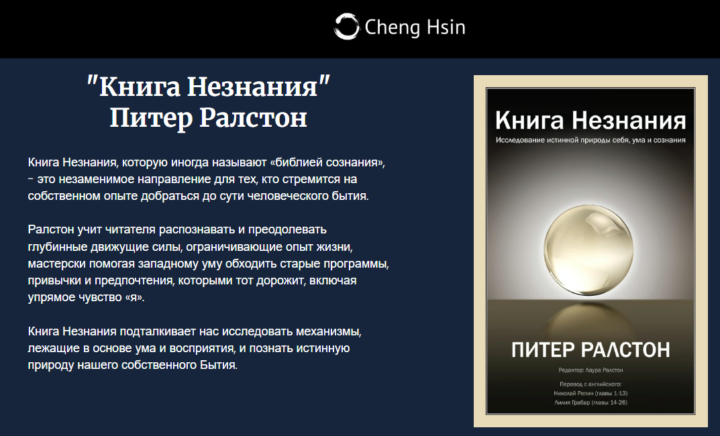
The Book of Not Knowing Now in Russian!
Excited to share the big news for all Russian speakers in the Cheng Hsin community: The Book of Not Knowing is now available in Russian (digital edition)! You can get it here: https://offers.chenghsin.com/book-of-not-knowing-ru Another language edition joins the BNK family. 😊

May 13 •
Donating the income from previous workshop
Hey all, I have facilitated a great Being Complete online workshop a few weeks ago and made some income on it but during the current phase of my life I'm not in need of it. For this reason I have decided to donate this amount to people that are interested in doing this work and are in genuine need of funds to finance their efforts. There is a limited amount at this point but if you wish to attend a workshop, please write an honest message to me about your situation, describing your geinuine interest and which workshop you'd like to attend. (please at this poing only consider one of the smaller ones). Best! V
2 likes • May 13
My admiration and respect, @Viktor Balogh. 👍👍👍
1-10 of 24

Active 1h ago
Joined May 16, 2025
Powered by