Activity
Mon
Wed
Fri
Sun
Jul
Aug
Sep
Oct
Nov
Dec
Jan
Feb
Mar
Apr
May
Jun
What is this?
Less
More
Owned by Leanna
Free wellness community for faith based living, functional health and real connection - off social media, rooted in purpose - learn, grow and heal.
Memberships
Skoolers
174.4k members • Free
216 contributions to Bedrock Nation

5h •
Why You Can’t Sleep:
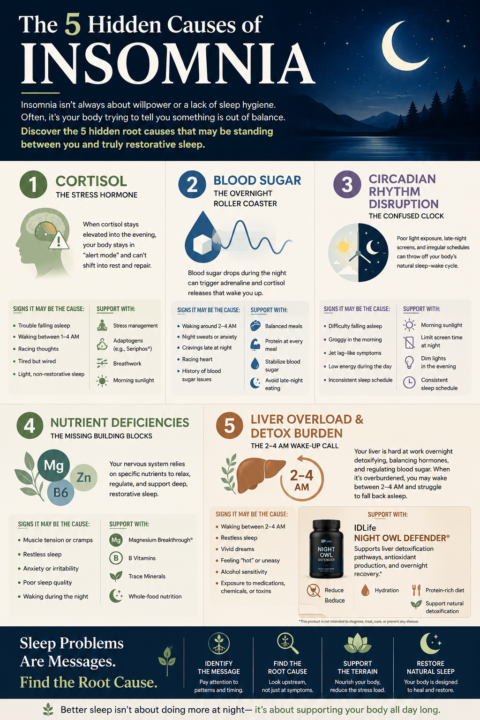
A Terrain-Based Approach to Insomnia and Sleep Disturbances Most people think insomnia is a sleep problem. I don’t. Insomnia is often a symptom of an underlying imbalance. The inability to fall asleep, stay asleep, or wake feeling restored is rarely caused by a deficiency of sleeping pills. More often, it is the result of dysfunction somewhere upstream. The body is designed to sleep. When it doesn’t, something is interfering with that design. Instead of asking: “What can I take to make me sleep?” A better question is: “Why does my body no longer feel safe enough to sleep?” Sleep Is Not Passive Many people think of sleep as a period when the body shuts down. In reality, sleep is one of the most active healing states in human physiology. During sleep, your body: - Repairs tissues - Produces growth hormone - Consolidates memories - Regulates blood sugar - Balances hormones - Clears metabolic waste from the brain - Supports immune function - Repairs cellular damage Sleep is not a luxury. It’s a biological requirement. When sleep becomes disrupted, every system in the body eventually suffers. The Four Most Common Root Causes of Insomnia 1. Stress and Elevated Cortisol This is by far the most common cause I see. Your body cannot simultaneously prepare for survival and prepare for sleep. When cortisol remains elevated into the evening, the brain receives a message: “Stay alert. We may need to deal with a threat.” The result: - Difficulty falling asleep - Racing thoughts - Waking between 1–4 AM - Light, non-restorative sleep - Feeling tired but wired Many people assume they have a sleep problem when what they actually have is a stress regulation problem. Research consistently shows that people with insomnia often exhibit higher nighttime cortisol levels and a state of physiologic hyperarousal. 2. Blood Sugar Dysregulation This is another commonly overlooked cause. Blood sugar instability during the night can trigger: - Adrenaline release - Cortisol release - Night sweats - Racing heart - Sudden awakening around 2–4 AM
1
0
1d •
The Real Reason We Can't Stop Scrolling
Hint: It's Not Dopamine. If you've spent any time on social media lately, you've probably heard people talk about "dopamine addiction." Dopamine detoxes. Dopamine overload. Dopamine fasting. Dopamine being the reason we can't put our phones down. But what if dopamine isn't the problem? What if we're blaming one of the body's most important systems for a problem it never created? Dopamine isn't bad. In fact, dopamine is one of the most remarkable systems God designed into the human body. Without dopamine: • You wouldn't pursue goals. • You wouldn't feel motivated. • You wouldn't experience anticipation. • You wouldn't enjoy learning. • You wouldn't strive for improvement. • You wouldn't seek meaningful connection. Dopamine is part of the system that helps move us forward. It was designed to reward behaviors that help us survive, grow, learn, connect, and fulfill our purpose. So if dopamine isn't the problem... Why can't we stop scrolling? Because modern life has learned how to trigger the reward without requiring the growth. For most of human history, dopamine was tied to effort. You learned a skill. You built something. You solved a problem. You worked toward a goal. You spent time with people you loved. You served others. You deepened your faith. You accomplished something meaningful. And dopamine reinforced those behaviors. Today, we can access the reward without the process. A notification. A like. A comment. A reel. A short video. A purchase. A swipe. A scroll. The brain receives a reward signal, but often without the growth, purpose, or fulfillment that was originally meant to accompany it. Over time, that disconnect can create imbalance. But I think there's an even deeper question worth asking. Why do some people scroll for ten minutes and put the phone down... While others lose three hours? Why can one person enjoy social media without becoming dependent... While another feels compelled to check every notification? The answer is usually much bigger than dopamine.

1d •
Why Our Approach Is Different
Why Our Approach Is Different One of the biggest challenges in health today is that most people are looking for a quick fix. A magic pill. A miracle supplement. A new protocol. A trendy gadget. A shortcut. And honestly, I understand why. When you're exhausted, in pain, struggling with your weight, dealing with digestive issues, autoimmune symptoms, hormone problems, brain fog, poor sleep, or simply feeling frustrated by a body that isn't cooperating, relief can't come fast enough. That's exactly why the health industry continues to market products as if they're the holy grail. Every week there's a new supplement. A new superfood. A new biohack. A new promise. And while many of these products may have value, most are presented without context. Without purpose. Without intentionality. Without customization. Without evidence that they're the right fit for the individual using them. The truth is that no supplement works in isolation. No product is one-size-fits-all. And no health solution has the exact same answer for every person. That's why so many people spend years chasing promises. They buy another supplement. Try another diet. Follow another influencer. Purchase another program. And eventually find themselves more tired. More frustrated. More confused. More hopeless. Not because they're failing. But because they've never been taught how the body actually works. That's where our approach is different. At Bedrock, we aren't looking for the fastest solution. We're looking for the most sustainable solution. We're not interested in temporary symptom relief if the underlying problem remains untouched. We're interested in helping people create permanent change. That means we focus on: ✓ Purpose ✓ Intentionality ✓ Customization ✓ Evidence ✓ Education ✓ Long-term sustainability We help people understand why they're taking something. What it's supporting. How it works with other nutrients. How it fits into the bigger picture. And most importantly... How to adapt as their body's needs change over time.
0
0
1d •
How We Build a Supplement Plan at Bedrock
After reading the first three parts of this series, some people might be wondering: "If vitamins don't work alone, nutrients work in teams, and more supplements aren't always better... then how do I know what I should take?" It's a fair question. And the answer is probably not what most supplement companies want you to hear. We don't start with supplements. We start with foundations. Because no supplement can consistently overcome poor foundations. If someone is sleeping 4-5 hours per night, eating ultra-processed food, dehydrated, sedentary, stressed, and disconnected from sunlight, the solution is rarely another capsule. The body is asking for something much deeper. At Bedrock, we focus on what I call the terrain. T he environment in which every cell, hormone, nutrient, enzyme, and organ system must function. When the terrain improves, health often improves. When the terrain deteriorates, symptoms begin to appear. That's why we focus on our Seven Pillars: ✓ Food ✓ Supplements ✓ Hydration ✓ Sunlight ✓ Sleep ✓ Movement ✓ Stress & Spiritual Health Most people want to jump straight to supplements. But supplements are only one pillar. Not the foundation. Not the entire structure. Just one tool. Once the foundations are in place, we begin asking better questions. What is the body actually communicating? What symptoms are present? What systems appear stressed? What nutrient relationships may be struggling? Where are the bottlenecks? This is why we often recommend testing before guessing. A symptom doesn't automatically tell us what nutrient is missing. Fatigue isn't always iron. Brain fog isn't always B12. Poor sleep isn't always melatonin. Low energy isn't always caffeine. The body speaks in patterns. Our job is to learn the language. When we do recommend supplements, we look for leverage. We aren't trying to create the largest supplement stack possible. We're looking for the smallest intervention that produces the greatest improvement. We focus on:
0
0

1d •
Why More Supplements Can Make Things Worse
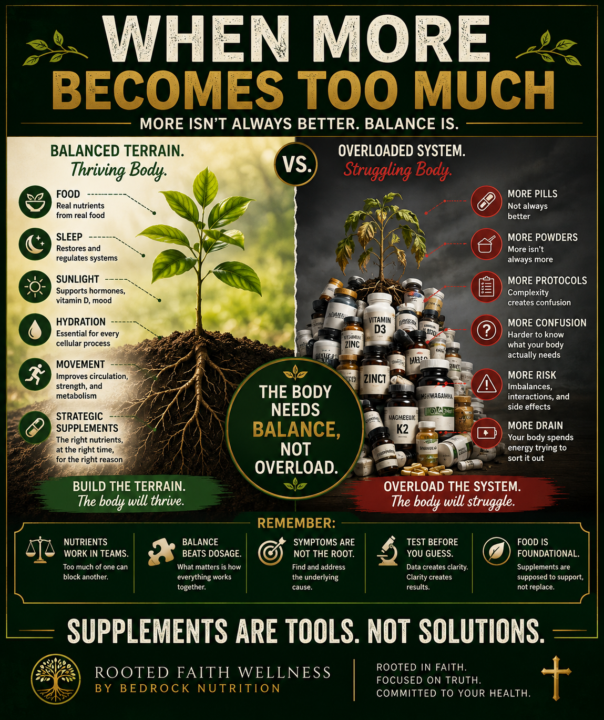
In Part 1, we talked about the biggest lie about vitamins: Nutrients don't work alone. In Part 2, we talked about why nutrients work in teams. Today, let's talk about one of the most common mistakes I see in health and wellness: The belief that more supplements automatically create better health. Unfortunately, that's not how biology works. In fact, sometimes the exact opposite is true. Most people approach supplements like they're trying to fill a bucket. Low energy? Add B vitamins. Trouble sleeping? Add melatonin. Low Vitamin D? Take more D. Hair loss? Add biotin. Joint pain? Add collagen. Then they add another supplement. And another. And another. Before long, they have a cabinet full of products and no real understanding of what their body actually needs. The problem is that the body isn't a bucket. It's an ecosystem. And ecosystems depend on balance. Take Vitamin D as an example. Many people know they need Vitamin D. So they start taking 5,000, 10,000, or even 20,000 IU per day. But Vitamin D requires magnesium for activation. It works alongside Vitamin K2. It influences calcium metabolism. It affects multiple hormone pathways. When you push one nutrient aggressively without supporting the others, you can create new imbalances. The same thing happens with calcium. For years, people were told: "Take calcium for strong bones." So they did. Millions of people added calcium supplements without addressing: • Vitamin D3 • Vitamin K2 • Magnesium • Stomach acid • Hormonal health The result? More calcium wasn't necessarily building stronger bones. In many cases it was simply increasing the amount of calcium circulating in the body. Leading to kidney stones, gallstones, joint pain, arterial calcification... but not "stronger bones." As a matter of fact, with the underlying problem not addressed, bone loss can even get worse... Iron is another example. People feel tired. They assume they're low in iron. They start supplementing. But excess iron can increase oxidative stress and inflammation.
0
0
1-10 of 216

@leanna-cappucci-3527
Functional Nutritionist, Mother, Free Thinker, Christian, Writer/Educator
Active 2h ago
Joined Nov 4, 2025
INTJ
Florida, USA