Activity
Mon
Wed
Fri
Sun
Jun
Jul
Aug
Sep
Oct
Nov
Dec
Jan
Feb
Mar
Apr
What is this?
Less
More
Memberships
Career Operating System
91 members • Free
Career Professionals Network
95 members • Free
Career Boost
55 members • Free
Future Social Club⚡️🔋🦾
32 members • Free
Electric Bike Academy
101 members • Free
GoGreen
6 members • Free
The Off Grid Collective
459 members • Free
Off Grid Academy
50 members • Free
Solar Operations Excellence
295 members • Free
45 contributions to The Energy Data Scientist

Mar 10 •
Uncomfortable truths for Workplace
I see many students who want to stay home and so they ask for remote work all the time. Also I see many who go to work and do not dress well. Here is the truth for the job: Truth1: Go 3-4 times every week to the office so others see you. Your presence is very important. Smile and be professional. This plays a role for your promotion. If you stay home most of the time, you will not be promoted and people will forget you. Truth2: Do not use AI a lot at workplace because every computer has trackers and gives your managers a distribution of time (with plots) of how much you used AI and for how long. There is a software (hidden) that summarises your activity on the computer at work. So be careful : if they see that you cannot write code, and all you do is copy-paste from Chat GPT the code, they will fire you sooner or later. Silently one day they will fire you and they will not tell you why most likely. Be careful. Also you can use it on your phone, but it is time consuming.. Ofcourse they have AI tools but you must write code yourself. Truth3: If you go to non-code positions, it is more stressful and more competitive than code positions. Often, you get lower salary also. Because people in energy are scared of coding, and do not like it. So you get an advantage if you can code , understand code etc. Not super . Just basic things. Eg understand Python . Understand ML. etc Truth4: Do not share personal stories with co-workers. They are competing with you for promotion so they want you to fail ... Be careful. Do not share sensitive things. Truth5: Becareful of your social media presence. Managers spy on you e.g. they have fake profiles and are your friends. They will find your second, third etc profiles. They can find your anonymous X profile where you troll people . They have the ability to find you because they have software tools that you do not know . Truth6: yes the online courses here are all you need. But please fix your CV. Align it with energy companies. Do not just design your CV yourself. Get feedback here. Most CVs look rubbish. Try work on your CV carefully.

0 likes • 9d
@Jack Burgemeister You allow AI in the company ?

Mar 25 •
How to learn Coding in the era of AI
I am sharing a summary from an HR/Careers conference in Applied Software Engineering. People are complaining of forgetting the code they learnt at uni, or on online courses. They learnt it, and now it's' gone. So the fastest way to learn coding today is not to sit through dozens of online courses on Udemy, Coursera, or edX and hope the knowledge sticks. If you have tried that route, ask yourself honestly: how much of it do you remember three months later? Most of it is gone. That approach feels productive in the moment only. Instead, the smartest path is to start with Python and study code that already exists inside industry case studies. You see exactly how it is applied in real-world cases. Then Open GitHub, and upload a full project. First, actually work with the code e.g. maybe you need to combine the code of 5-10 courses together . Change the data slightly,. Then upload your version to GitHub with a clean, nicely written README file and well-presented code (comments etc). Do not panic about volume. You only need to upload 1 machine learning project and 1 optimisation project over the course of 8 -12 months. Takes time if you are absolute beginner. That is enough to make you extremely attractive to employers : internships and junior jobs. This is better than MSc degrees because they are filled with exams and homework , whose solutions circulate around and you copy-paste and employers know it. Every time you upload a project, write a LinkedIn post about it if you aren't shy . So, take ten or twenty courses from the Classroom, as many as you need, and combine what you learn from them into a single coherent project or more. If you are ambitious, try to publish your work as a paper. Even better. Shows prestige. Nobody does these simple things and everyone goes to do MSc , which is fine ofcourse if you have the money. That is the whole strategy. HR managers almost never see this level of discipline from candidates. Most CVs simply list "I completed 5 courses on Udemy" or "I finished 10 courses on edX," but they never remember what they did there. They have the certificate but in the interview they say they forgot.
0 likes • 9d
@Jack Burgemeister You do consulting independently or employed in a consultancy in Australia market?

24d •
New Career Intelligence Report: The Energy Consulting Landscape (12-Page Breakdown)
I have just uploaded a new 12-page career intelligence brief detailing the specific consultancies in the energy sector currently offering analyst roles. Building advanced computational models is only half the equation. The other half is knowing exactly which top firms are actively looking to hire these quantitative skills in the market. This report is designed to bridge that gap. For every firm listed, the report outlines their specific energy focus, the exact graduate opportunities available, and the regions they hire in. - It is available to download. Where to find it: The PDF is now live in the Classroom (Page 5). Navigate to: Career Strategy & Interviews --> 2. Company Profiles & Intelligence --> 2.4. Consultancies in the Energy Sector.
0 likes • 9d
@Jack Burgemeister Is Australia attracting employment globally in the energy sector ? Reports are conflicting . On one hand New Zealanders go to Australia. Then we hear that Australians leave ?
9d •
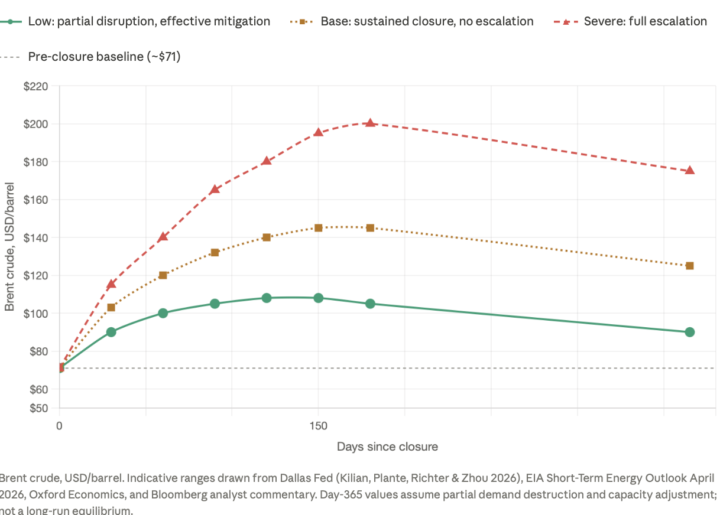
Oil Price Dynamics (Interview Question)
S&P Global Commodity Insights (Platts): commodity strategist, Interviewer: Explain the plot. It shows the oil price 0, 30, 60 , 90, 120, 150 , 180 days after a potential closure of the Straight of Hormuz. Why does the price not increase monotonously? explain the lines Can you try answer it ?
1 like • 9d
Tip: the hump in this plot is the key.

15d •
Energy Report
I'd like to share a short report I wrote some time ago. It's a brief overview of the Turkish energy market and its key players. I'd be happy to hear your thoughts and comments.
0 likes • 9d
Thank you for the report . It paints the picture of the market. You have additional ones ?
1-10 of 45

@tak-sato-7948
Student - Energy & Economics & Management
Active 9d ago
Joined Sep 17, 2025
Japan