Activity
Mon
Wed
Fri
Sun
Jun
Jul
Aug
Sep
Oct
Nov
Dec
Jan
Feb
Mar
Apr
What is this?
Less
More
Memberships
The Energy Data Scientist
674 members • Free
2 contributions to The Energy Data Scientist

23d •
Battery Arbitrage Project
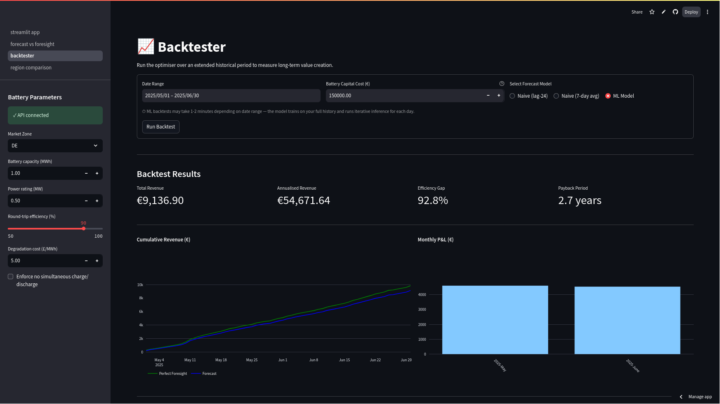
Hi everyone! I've been exploring the battery arbitrage space for the past few months and wanted to share my most recent project: I built a battery arbitrage backtester that finds the optimal charging schedule using LP, and tests it against three forecasting approaches(two rolling averages, one ML) and measures how much of the theoretically available market value was captured. I pooled data from different EU market zones to train a LightGBM model and trained a separate one for Britain, which is why the rolling average model overtook the ML model in Germany's results, for example, which was an interesting result. Article and Streamlit dashboard to play around with here if anyone's curious: https://kilowatthours.substack.com/p/building-a-battery-arbitrage-backtester https://bessarbitragedemo.streamlit.app/ I'm currently working on multi-battery coordination and whether batteries "knowing" more about the grid's topology can improve dispatch results, and using a neural network for the congestion signal. Curious to hear your feedback, and if anyone's working on battery optimization or grid ML, would love to connect.
3 likes • 22d
@Dauemi Burutolu @Manuel S Thank you! I'm not sure if I could write an in-depth tutorial aside from the walkthrough article I already have because exams are coming up, but I'd be happy to answer any questions you have if you're looking to build it? Here's the Github repo as well if you'd like to take a look: https://github.com/sakeenahaderinto/bess_arbitrage
2 likes • 22d
@Dr. Spyros Giannelos Thank you! The plan is to use the neural network weights to sanity check on whether the model actually learned relationships between buses rather than leaving it as a black box, so hopefully the results are promising!

Jan 16 •
New Online Course: How Big data from Smart Meters are processed efficiently
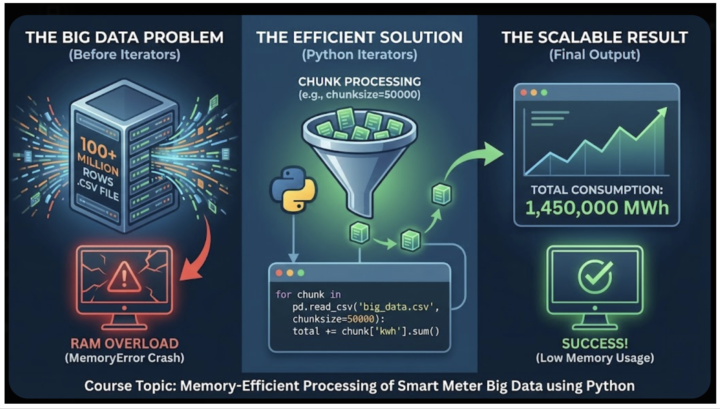
I’ve just published a new online course about Memory-Efficient Processing of Big Data. This course teaches real-world skills as they are used in practice. Smart meters measure the electricity-consumption data every hour, and store the information in CSV files. These files eventually become very large (big data). The new online course is called "Smart Meter Big Data Efficient Processing" and it is in the Classroom in 1.36. This online course teaches a Python methodology that is used by energy companies in practice to read extremely large datasets (Big Data). Without this technique such files cannot be read because they cause a memory (RAM) error. Companies that sell electricity to consumers are known as 'Retailers' or 'Suppliers'. Such companies have CSV files with hundreds of millions of rows, where each row is the hourly kWh electricity consumption. If they try to load these CSV files, their computers will run out of RAM and crash. So these companies process these files using Python iterators, which enable a memory-efficient and fast processing method. In this course, I show you the industry-standard solution: using Python Iterators to process Big Data in "chunks". See the attached image; this is analysed in detail in the course.
1 like • Jan 17
This is great, thank you!
1-2 of 2

Active 1d ago
Joined Dec 4, 2025