Activity
Mon
Wed
Fri
Sun
May
Jun
Jul
Aug
Sep
Oct
Nov
Dec
Jan
Feb
Mar
Apr
What is this?
Less
More
Memberships
PricingSaaS
1k members • Free
13 contributions to PricingSaaS

10d •
Fair Use Policies - what are you seeing?
@Farhan Manjiyani Farhan Manjiyani guest-wrote last week's newsletter, and I loved his insights on fair use policies as a way to protect margins while creating a true AI story. The big idea: "unlimited" is dead, hard caps churn customers, and the companies winning right now are landing in the middle with fair use policies. A few examples he shared: 1️⃣ Grafana Cloud Logs lets you query up to 100x your ingested log volume for free. Go beyond that and billing kicks in on a formula. It protects margin without putting a scary number on the pricing page. 2️⃣ ChatGPT doesn't cut you off when you hit your GPT-5 cap — it silently drops you to a lighter model until your window resets. No overage, no upgrade wall, just graceful degradation. It's one of the most underrated pricing moves in AI and almost nobody's talking about it. 3️⃣ Atlassian bundles Rovo AI into paid Jira and Confluence subscriptions with a credit-based quota pooled across the organization. Right now, they’re not enforcing the limits. But they’ve published the quotas, committed to 90 days notice before enforcement begins, and will include dashboards for monitoring usage. Curious what others are seeing — are you using fair use policies, or seeing anything cool in the wild?

2 likes • 9d
Fair use works well when you're overt and consistent. At one of the places where I worked, we used soft caps meaning that instead of making it a usage event, it increase the next year's contract in a formulaic way. That said, one of our biggest priorities was consistent, predictable revenue so were less in need of collecting as it happened. What I'm watching is if B2C starts that movement. Metered internet, phone, pay-per-view with the streamers
0 likes • 9d
@Kareem El Muslemany Is a interesting take but I do think it applies to the scenario I laid out. We offered unlimited based on an uptick on price when customer paid transactional. The 3x wasn't a limit. You could keep going. But at renewal, we were going to factor that in to the renewal price as our "expected usage given your history". No shut downs and purely monetization play. I do like the different view. Had we not been constrained by being a public company, I would banged you over the head with usage fees. WE did have a hard limit item on dollar value of credits reports on companies OUS. Our relationships with our partners in those markets were "Pay me". We actually wound up having the nine majors sign the type of agreement we gave our customers. We could sell their data unlimited but if we sold 3x what we paid, next year's contract was automatically readjusted.

Feb 24 •
Optimizing Pricing Plans with a Revenue Simulator
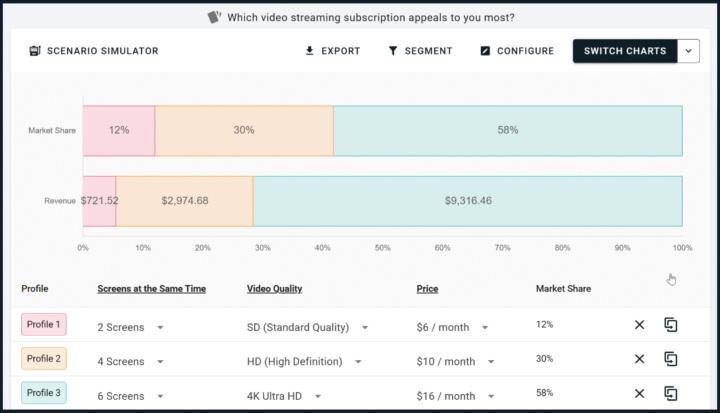
I feel like revenue simulators are the most underrated pricing research method -- you get insights similar to A/B testing but without needing deep pockets and a huge customer base to test against. More of the teams I work with have been asking to run simulator projects recently, for stuff like introducing a new pricing plan, optimizing their recommendation engine, launching optional add-ons, etc. Especially with so much pricing experimentation going on around AI feature releases, it feels like revenue simulators are kinda having their moment right now. I put together a detailed example (with plenty of GIFs and screenshots) showing how a revenue simulator works, how you set up a study like this, and what kind of outcomes you can expect to get it: https://fullstackresearcher.substack.com/p/how-not-to-price-your-new-ai-feature
1 like • Mar 2
Very helpful, particularly if its like a pure Monte Carlo sim and you can give ranges for most likely to buy

Feb 11 •
New member
Hi all, I'm a technical product manager for Usage Cloud at DigitalRoute, based in Sweden. Been working with real-time prepaid credits and batch-based pricing, charging and billing since 2004 at scale - also deep knowledge of usage data mediation (the stuff that happens to get the messy real-life operational system events data in shape so it _can_ be priced). I have a fairly solid grasp of the entire quote-to-cash process. I co-host DigitalRoute's invite-only Usage Unlocked roundtable every month or so, where we discuss all things related to usage and pricing. I'm also a Wardley mapping nerd building the collaborative mapping SaaS https://mapaware.io (feel free to try it out), and I co-founded the Blockchain Sweden industry association. And overall tech nerd.
0 likes • Feb 18
@Jonas Wallenius I've done work on Comp Plams before and it can be amazing when you think you have a perfect plan created, everyone then shows you just how wrong you are :-)
0 likes • Feb 19
This is an area where Pricers rarely go but it has a huge impact on success and results. SaaS was easy. Forecastable, stable. AI Credit models aren't smooth and will typically follow a U-curve once they've reached higher maturity. The challenge with Comp is that with SaaS, you "knew" exactly what you were going to get so I saw many comp plans move to straight ACV. With credits (like phone company minutes), I can see comp plans incorporating credit revenue (if the customer doesn't use the credit, you got paid but did not deliver. ASC-606 would say "don't take revenue on unused credits". If you absolutely don't allow rollover credits, you can get the revenue in the contract term. If you allow rollover, that defers the revenue. ** Note: I'm not in Rev Rec or Finance but have done several enterprise transformations with usage/subscription flips and have many years running Deal Desks where we would work to find ways to keep the customer happy while structuring the deal so i get more in year revenue
Feb 12 •
Where does your product catalog live?
One of the hardest things to sort out in pricing seems to be wrangling the product catalog. Sales need it in CRM/CPQ systems. Finance need it in Billing/ERP systems. Product/Pricing need it in ... where? When products have usage-based pricing or entitlements, many ERPs can't handle it, and the product catalog spreads into a third system that handles usage, credits, entitlements, etc. We see how this crosses organization boundaries, lacking a single clear owner, and keeping everything in sync becomes super important - and very difficult to keep 100% correct over time. And most likely, someone in your organization is using Excel in some part of this process. Curious to hear how others split the product catalog, both horror stories and success stories.
1 like • Feb 15
I’ve definitely been there. At best, I’ve put it in a 3rd party database with the specific fields as well as owners from systems it feeds to. A modern CPQ should be able to handle it and pass the appropriate billing codes into the rev rec system. I haven’t deal with it in a full ERP without system help and they typically ensure it goes into the other systems. Houston

Nov '25 •
MedTech / HealthTech Benchmarks?
Does anyone have any benchmarks on what hospitals are willing-to-pay for SaaS Medtech / HealthTech products? This SaaS product provides analytical and predictive support across five hospital domains - Patients, ER, Beds/Wards, Surgery/Theatre and Outpatients. I'm particularly interested in "cost-per-head-of-population" or "cost-per-hospital-bed" metrics, which would provide alignment with activity-based funding models in public hospitals. There may be others...? Also interested in metrics for private hospitals (if / where different). DM's welcome if you prefer. Thanks in advance.
0 likes • Nov '25
@Ulrik Lehrskov-Schmidt You're doing net, right? You know all the insurance, etc knockdowns.....
1-10 of 13

@houston-itzen-2156
Accidentally fell into a pricing. More than fifteen years later, I'm still doing both strategy and deal desk work.
Active 9d ago
Joined Oct 16, 2025
Chatham, NJ
Powered by