Activity
Mon
Wed
Fri
Sun
Nov
Dec
Jan
Feb
Mar
Apr
May
Jun
Jul
Aug
Sep
Oct
What is this?
Less
More
PricingSaaS
1.2k
Free
8 contributions to PricingSaaS

Apr 9 •
How is everyone incorporating AI into their workflows?
Curious to hear how other pricing strategists and operators are using AI in their workflows. Are you just getting started, or do you have a full flow built? What tools do you like vs. which tools are causing you the most trouble? I'm especially curious if anyone has developed a way to leverage AI to refine ICPs?? Or if anyone has found any good Claude skill files specific to pricing? I'll kick off! Some context: We're refining our sales-led pricing model at the moment and need to move quickly, so I don't have the support to run formal research. I'm also a team of one at a Series A company that just underwent a massive change in how we deliver our product 😅 I've been using Claude to refine new pricing structures and develop HTML pricing calculators for sales-led deals. I've been funneling context to Claude using our product's MCP server, knowledge files, and more, which have allowed me to develop and pressure-test various pricing strategies that I have then vetted with cross-functional leadership and sales as viable to test. My sales team now has a self-service hub they can rely on to run with these new models for certain deals. The hub provides guidance on choosing a model, the value story for the chosen model, pricing, and ROI calculations. Would love to hear what everyone else is doing!

1 like • Apr 10
I built a "night shift" worker with Claude auto mode that researches pricing across our ICP segments and generates heat maps and other stats on their actual pricing, so I have that ready in the morning when I login. Very helpful to cut through the LinkedIn hype and see what companies are _actually_ doing at the moment. Gives a great landscape of unit of measure definitions, price models used etc. Running it periodically I can get trend lines over time for changes per segment. PricingSaaS has a as-of-yet free service for this kind of research that they recently published via MCP that I plan to play with soon. I'm going to enhance it with an ICP roaster soon that takes our current ICPs and compare them to how the ICPs actually present themselves publicly and see how well those match up. It's ofc not very indicative of their internal pain, but still helpful as aggregates/weak signals. Ofc also doing simulations of revenue impact of hypothetical pricing changes, needed when usage-based. We're going to make those much deeper soon. The "where does your product catalog live?" pain is still ongoing though (I wonder if it will ever be solved well tbh). It's so easy to build a self-service thing for Sales but the hard work is keeping it all synchronized with all other systems and specific deal negotiations etc...
1 like • Jun 3
@Kareem El Muslemany Yep, did the same thing

May 11 •
The reliability guarantee your billing platform won't provide
I talked to an engineering manager today about monitoring issues in production. He mentioned an open-source platform his company uses to increase reliability: Temporal. I went to check it out and realised how hugely popular it's become. Long story short, it lets you define workflows that automatically survive crashes, restarts, and network failures: without you writing retry or recovery logic yourself. It made me realise how easy it is to take reliability for granted when dealing with pricing / billing complexities. Every major billing platform - Stripe, Chargebee, Metronome, Polar etc. is reliable on its own. None of them, however, owns the layer between your CRM, your usage events, invoices, and your warehouse in a way that survives failed event delivery, events arriving out of order, and missed reconciliations. That layer is yours to build. If you or your team have never explicitly built this layer, it's most likely not there. This is most likely quietly costing you money in ways your dashboard won't show. PS: You don't have to use Temporal. Inngest, Restate, AWS Step Functions, Kafka, or even a well-behaved queue with idempotency keys can get you there. The pattern matters more than the tool. PPS: This is the work I do. Happy to nerd out in the comments or DMs.
1 like • May 12
DigitalRoute does that pretty well since year 2000. :) Concepts like enrichment, usage data management, mediation, de-duplication, transaction safety, re-tries, idempotency, exactly-once delivery, for very large data volumes (millions per second in extreme cases). Few appreciate the complexity of building this solid data layer until they try home-grown, then scale, and suffer the maintenance burden. And yet it enhances every layer built on top.
0 likes • May 13
Usage-based pricing in some shape or form (currently credits are popular, everyone talks about outcome-based but few are doing it in the wild) will be happening for a while now as long as AI is 1) expensive enough and 2) widely used to build services. The AI feature token costs eat into margins and the only way to handle that mismatch right now is moving from seats/subscriptions to some form of usage-based pricing. And usage-based pricing requires all the things you posted about.

Apr 21 •
Office Hours Recap: AI Pricing Strategies for Legacy SaaS
Howdy pricing people! Wrapped a great Office Hours session last week with David Reid and Sam Little from Teneo on AI pricing strategies. David's been doing software monetization for 17 years and said the quiet part out loud — "you've had to relearn everything you thought you'd learned over the last 18 months." That pretty much framed the whole hour. A few things that stuck with me: 1️⃣ The disconnect is real. David's team asks enterprise buyers if they want value-based pricing. They say yes, absolutely. Then Teneo comes back with a consumption model and the same buyers say "no chance, never getting this past the CFO." He pointed at Twilio and Snowflake as examples of companies that had to rebalance toward hybrid after going too hard on consumption. The "buyers say one thing, buy another" gap is just louder than ever with AI. 2️⃣ The gentle on-ramp he keeps using with $1B companies Embed a meaningful chunk of AI credits into the base license, and design the allowance so most customers don't exceed it in year one. Only the real power users blow through it. Removes friction, drives adoption, buys you a year of usage data to set the real bands on. This seems like an increasingly popular approach. Clay's recent remodel and introduction of "actions" comes to mind. 3️⃣ You earn the right to monetize AI by proving value first. David's been running a pattern with clients: three-month free trial, translate credits into value during the trial, then start charging in month four. And the business case doesn't have to come from new AI revenue — one billion-dollar client of his saw GRR go 5% higher on AI users vs. non-AI users. So $50M of their "AI revenue line" came from retention lift, not new ARR. I hadn't thought about AI ROI that way before. 4️⃣ The hub-and-spoke GTM model. For big portfolios launching a bunch of AI features at once, Sam's push is a small central "control tower" (product, pricing, product marketing, sales, revops) that sets the value metric, pricing architecture, and commercial guardrails — then the product teams run as spokes inside those rails. The alternative is either siloed chaos or one giant bureaucratic committee. Both lose.
1 like • Apr 22
The CFO tension is very real, anything usage-based is harder to forecast because it breaks a bunch of existing subscription-based Excel models. Don't wait too long to align there...
Feb 12 •
Where does your product catalog live?
One of the hardest things to sort out in pricing seems to be wrangling the product catalog. Sales need it in CRM/CPQ systems. Finance need it in Billing/ERP systems. Product/Pricing need it in ... where? When products have usage-based pricing or entitlements, many ERPs can't handle it, and the product catalog spreads into a third system that handles usage, credits, entitlements, etc. We see how this crosses organization boundaries, lacking a single clear owner, and keeping everything in sync becomes super important - and very difficult to keep 100% correct over time. And most likely, someone in your organization is using Excel in some part of this process. Curious to hear how others split the product catalog, both horror stories and success stories.
0 likes • Mar 24
Stripe is easy enough to add, there are many options. Depends on how complex pricing you need to support. If you do plain seats/fixed subs, you can probably run it in your accounting software (ERP)? If you do anything usage-based, need to think a bit more carefully.
1 like • Apr 2
@Mark Miller You're not wrong, though that's only one (very important) part of the wider "where's the product catalog" conundrum :)

Feb 24 •
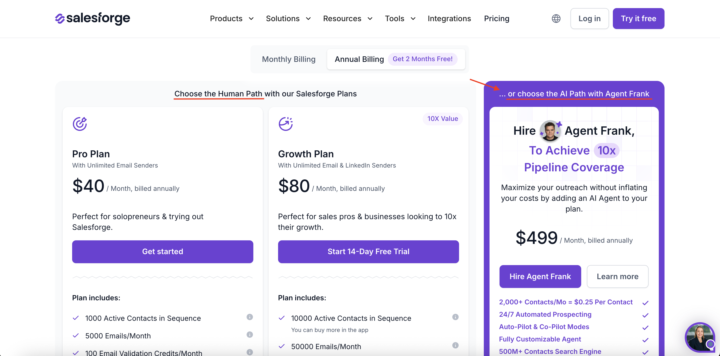
We aren't talking about AI optics in the buying decision
Salesforge is the only company I have seen do this ⬇️ On their pricing page, they clearly delineate the “human path” and the “AI path” and have pricing packages for each. They charge a premium for the AI agent. $499/m vs. $80/m for their top “human” package. Part of this is a growing trend we see in the data around high WTP (Willingness to Pay) for AI capabilities that solve for specific jobs. But it's not just about the functionality. It's also about the optics. Venture-backed brands looking towards their next series not only want the functionality but they want to tell a story of how they are using agentic software as part of their scalable growth playbook. Enterprise organizations don’t want to be left behind. Pressure from the top is high to deploy more agents to solve different organizational pain points. The teams that best adopt and execute agentic software into the organization's processes are rewarded and given more resourcing. Even if many of the agentic tools require meaningful human oversight today, the idea that the tech can learn and evolve with your team, and ultimately be highly scalable, is an investment many software leaders are eager to make. What do you think? https://www.linkedin.com/posts/caseyhill_salesforge-is-the-only-company-i-have-seen-activity-7432076873213419520-QXfY?utm_source=share&utm_medium=member_desktop&rcm=ACoAAAULZvkBJhmWcLLU-35ban2YYnjvvzf_6Mc
2 likes • Feb 27
I'm a bit curious how AI capabilities in vs on systems will evolve. Last year everyone built an AI assistant and AI capabilities. This year it seems more and more people just connect Claude/ChatGPT and use it as their command cockpit across tons of other systems. The AI capabilities of the systems will still be built-in and valuable ofc, but I think they will increasingly be consumed via APIs and not UIs. Sort of like: API for humans = MCP for LLMs SDK for humans = Skills for LLMs The value of doing it with an external LLM is that it can do something no single system can do no matter how capable, which is cross-correlate across tons of systems and reason about them all as a coherent whole as opposed to just in that single system. Of course they can have integrations with other systems, but it's not the same fluid/dynamic way, as I think anyone who's doing it can attest to. And this kind of shifts the value even more from human to agent users, perhaps?
1-8 of 8

@jonas-wallenius-9662
Technical Product Manager Pricing at DigitalRoute. I run https://mapaware.io for strategic Wardley mapping. I co-founded https://blockchainsweden.se.
Active 30d ago
Joined Feb 11, 2026
Powered by