Activity
Mon
Wed
Fri
Sun
May
Jun
Jul
Aug
Sep
Oct
Nov
Dec
Jan
Feb
Mar
Apr
What is this?
Less
More
Memberships
ADHD Harmony™
6.7k members • Free
59 contributions to ADHD Harmony™

28d •
New Label, Same Concept — Anyone Else Exhausted From All The Jargon?
Does anyone else feel like they're drowning in new labels for old ideas? I'm a life coach with a master's in counseling and I've been noticing something for a while that honestly frustrates me. It feels like every other week there's a new term for something humans have understood for a long time: "Nervous system regulation" is learning how to calm down and breathe; "Dopamine detox" is taking a break from overstimulation; "Shadow work" is looking at the parts of yourself you'd rather not look at.These things have been known for a long time some of it is common sense and learning how to take care of yourself. So why do I think this keep happening? Because there's a whole industry built on making old wisdom sound new. Brand identity folks and marketing folks tell you that if you're a coach, therapist, author, etc. trying to stand out, you need a "thing”, something that sounds original, something you can put on a book cover or build a program around. The problem is that many of these “new” ideas have been around a long time. So what do they do? They repackage it. Give it a catchy name. Build a brand around it. Write a book. Launch a course. And suddenly they’re the person who "discovered" something that poets and philosophers and elders have been saying for centuries. Look at Mel Robbins and the whole "Let Them" phenomenon. She and her daughter wrote a book around this idea of letting go of trying to control what other people do, which is a useful concept, except a poet, Cassie Phillips https://www.cassie-phillips.com , wrote about the concept years before they did, and as far as I know, they gave her no credit for her idea. Although, the concept didn't originate with Mel Robbins, now it's "her" thing because she had the platform and the marketing machine to claim it. And that's the pattern. The person who packages it/renames it gets the credit, not the person who came up with the idea first. Stolen ideas are being rewarded rather than wisdom and originality. The marketing sends a message to people that they need to keep buying the next book, the next course, the next framework, because surely THIS one has the answer that all the others were missing.

3 likes • 28d
It’s been happening since the beginning of time. Freud re-wrapping Buddhist technology immediately comes to mind (Psychogist here too). It’s just that life is ten million times faster now…so we are collecting them faster!
30d •
Anyone else doing Blueprint the pdf way?
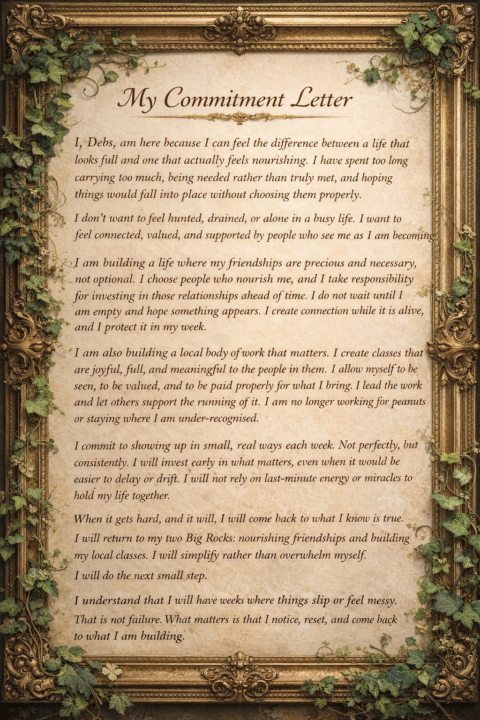
Here is my commitment Letter to myself! I'm working through this on my own and with you all hopefully listening out there.... It's very valuable to have done this exercise. Here is the ADHD friendly summary: 1. I'm choosing nourishing friendships to support my big dreams coming to fruition 2. I'm choosing to prioritize in real life offerings, even though they don't make much financial sense but they do light me (and everyone else) up so I make no apologies for being big in local community. The key philosophy: I am choosing a life that feeds me as much as I give. The full version if you have time to read it: I, Debs, am here because I can feel the difference between a life that looks full and one that actually feels nourishing. I have spent too long carrying too much, being needed rather than truly met, and hoping things would fall into place without choosing them properly. I don’t want to feel hunted, drained, or alone in a busy life. I want to feel connected, valued, and supported by people who see me as I am becoming. I am building a life where my friendships are precious and necessary, not optional. I choose people who nourish me, and I take responsibility for investing in those relationships ahead of time. I do not wait until I am empty and hope something appears. I create connection while it is alive, and I protect it in my week. I am also building a local body of work that matters. I create classes that are joyful, full, and meaningful to the people in them. I allow myself to be seen, to be valued, and to be paid properly for what I bring. I lead the work and let others support the running of it. I am no longer working for peanuts or staying where I am under-recognised. I commit to showing up in small, real ways each week. Not perfectly, but consistently. I will invest early in what matters, even when it would be easier to delay or drift. I will not rely on last-minute energy or miracles to hold my life together. When it gets hard, and it will, I will come back to what I know is true. I will return to my two Big Rocks: nourishing friendships and building my local classes. I will simplify rather than overwhelm myself. I will do the next small step.
1 like • 30d
@Judy Hamilton Awww, thank you Judy xxx
1 like • 30d
@Deb Brouwer Thanks for helping me fly my busy bee friend xxx

Mar 18 •
Staying connected - Suggestion
I know we have all been commenting on each other's posts, giving insight s. Sharing humor etc. I am unable to join the 6 week program and mentally fell into a bit of a rut and I started telling myself some negative stories. I was feeling a but sorry for myself and was just going to drop off the radar as everyone was going ahead and leaving me. I reflected on how I felt during the challenge and connecting with this community. and it felt so good to have a space where I felt seen & understood and that I was not alone. I know a connected with a few other people that I communicated with via posts etc Suggestion: Maybe we can start a message thread to stay connected in the community, check in etc. Hoping to make some lasting connections.
4 likes • 30d
I'm in the same boat - financially I have been ruined by a Cowboy Builder who took my life's savings so I couldn't afford the 6 week program and I am well motivated to use what we have in the Blueprint but don't want to go it alone as this is my usual failing (trying too hard and being isolated) so it would be great if we could fine a way to be together...

⭐
Mar 21 •
⭐ Woke up to this little star this morning
Recently, I’ve shared LOTS of free value, and in return, I asked you to actively engage, support one another, and take your check-ins seriously. And many of you have actually done just that. And... as a result, we’ve moved up from 34th to 29th place in the “self-improvement” category on Skool. The top 30. That means I’m now among the top 1% of community builders on the platform, what a huge dopamine hit this morning when I woke up to see the star emoji. But let's be real... that badge is just as much yours as it is mine. Every like, comment, check-in pushes us up. Which means more people with ADHD can now find this place and get the help they need. You're all incredible. Thank you. 🙏
7 likes • 30d
You truly deserve this. Thank you Jim xxx
Mar 14 •
Where does the time go?!? #timeblindness
Yesterday I decided to go out and work on my land for an hour…4 1/2 hrs later I walked back into the house shocked that I’d been out there that long! I did get a lot done. Do you get time blindness? I get it when I’m outside in nature and when I’m creating with my hands.
2 likes • Mar 16
@Lois Hamilton 100%!!!!
3 likes • Mar 16
@Tracy Weiss oooh...lovely!
1-10 of 59

@debs-molwuka-3469
Dance Instructor and Cardiac Rehab Specialist. Somatic Yoga Teacher. Rescue Dog Lover. Psychologist. Ex Nurse. Choir Member. Married 36 years.
Active 28d ago
Joined Feb 11, 2026
Bingley, West Yorkshire
Powered by