

Nov '25 •
Supersets for Efficiency
Not my personal favorite template, but it is always a good recipe to go to when you don't want to think too hard. Adjust sets/reps to your time constraints and capabilities. Warm Up: 5-8min {Stretch, BW exercises, prioritize dynamic movements} Power: Upper Plyometric- 3x5-10 {med-ball slams/tosses/throws, dynamic cable exercises} Lower Plyometric- 3x5-10 {jumps, bounds, skips, KB Swings} Strength 1: Priority leg exercise- 3x5-8 {squats, deadlifts, lunges} Ab exercise- 3x8-15(:20-:60) {cable work, crawls, carries, plank variations} Strength 2: Priority upper exercise- 3x5-8 {bench press, incline Press, OH press} Ab exercise- 3x8-15(:20-:60) {cable work, crawls, carries, plank variations} Strength 3: Secondary leg exercise- 3x6-12 {lunges, step-ups, hip lifts, 1-leg squats} Secondary upper exercise- 3x6-12 {rows, chin-ups, pull-ups, pulldowns} Cardio: Interval Training- :10work/:20rest x8 {biking, running, sled pushing, med-ball/body weight circuits}
Oct '25 •
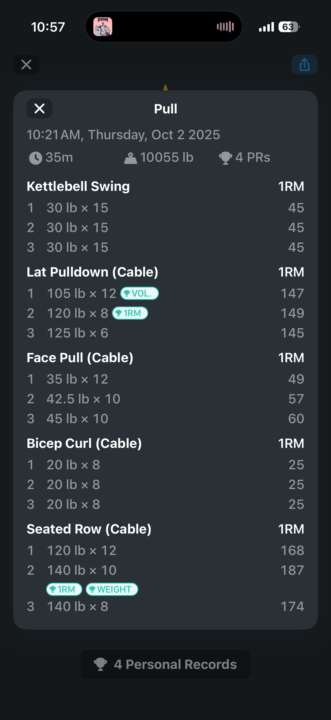
Morning! What routine do you prefer?
I’ve had a lot of success with the push, pull, leg routine. This is what I did yesterday

🔥
Oct '25 •
🧘♀️ Why Flexibility Training Matters--okay a bit more on this....
Okay...decided to nerd it out a little bit more on the importance of stretching so I'm gonna share some nuggets here...Maybe it'll help persuade a little bit! :) (The material below is a short summary based on a lesson on the National Academy of Sports Medicine (NASM)'s site about the Scientific Rationale for Flexibility Training). Most people think stretching is just about feeling looser or improving posture, but flexibility training goes beyond that It helps protect your body from two key issues that can lead to pain and injury: pattern overload and the cumulative injury cycle. 💡 Pattern overload happens when you repeat the same movements every day. It might be pitching a baseball, running long distances, lifting boxes at work, or sitting at your desk for hours (really, any movements that are repetitive in nature). Over time, these repetitive motions create muscular imbalances and abnormal strain on your joints and connective tissues. 🔥 The cumulative injury cycle begins when repetitive stress or poor posture causes tissue irritation and inflammation. Your body responds with muscle tension and small protective spasms (it's trying to compensate...). Over time, these microspasms can lead to adhesions forming in the fascia, creating a web of tightness that limits movement. 🧬 According to Davis’s law, soft tissue remodels itself along the lines of stress placed upon it. If muscles stay tight or inactive, the body lays down collagen in random directions. This then causes stiffness, limited mobility, and altered movement patterns. The longer this goes on, the more the body adapts to these restrictions. 💪**** This is where flexibility training becomes essential. Stretching and myofascial release techniques help restore proper movement, break up adhesions, and encourage tissues to remodel in healthy ways. ****Flexibility training improves joint range of motion, muscle balance, and neuromuscular efficiency, allowing the body to move the way it was designed to.*******
Poll
3 members have voted
1
0
🔥
Oct '25 •
🧘♀️ Flexibility and Mobility: Moving with Freedom and Ease
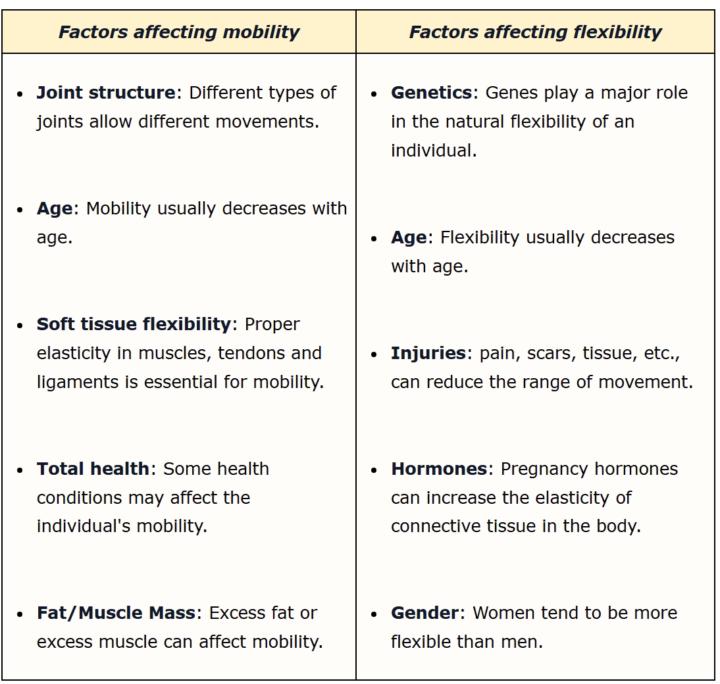
I got to the gym today and it felt like everything was so stiff maybe even a little bit painful (a bit different than soreness)... that got me thinking that I probably don't spend enough time on helping my flexibility and mobility.... Our bodies are meant to move, stretch and twist... But for most of us, current life often consists of us sitting, rushing, or disconnected from how our body feels and what it actually needs. Improving flexibility and mobility is not about touching your toes or doing splits though it may lead to that. It’s about feeling free and comfortable in your own body. It's about allowing our bodies to be functional and move with more ease. 💪 Flexibility vs. Mobility While I thought that these were interchangeable, they're actually not quite the same. -Flexibility is about how far your muscles can lengthen. -Mobility is about how well your joints move through their full range of motion. You can be flexible but still have poor mobility, and the goal is to build both together for a body that feels balanced and resilient and functional. :) 🌸 Benefits of Flexibility and Mobility Work -Less muscle tension and stiffness (this is what prompted this post today!) -Better posture and alignment - Reduced risk of injury - Improved balance and coordination (guilty of needing help in this area too!) -Easier everyday movements-from getting up off the floor to reaching high shelves, we want functioning bodies. :) 🔑 Ways to Improve Both 1. Move Daily: Even gentle movement counts. Walking, stretching, and mindful mobility work all keep joints healthy. 2.Warm Up Before Stretching: Stretching cold muscles can cause strain. Start with light movement to increase blood flow. 3. Incorporate Dynamic Stretching: Try controlled, flowing movements like leg swings or arm circles before workouts. 4.Add Static Stretching: AFTER Exercise hold stretches for 20 to 60 seconds when your body is warm. Focus on breathing slowly. (studies are showing that static stretching before workouts/competition actually decrease muscle strength and power)
Oct '25 •
30 Min Full Body
I was short on time today and had to go off program. I work off a 3-day full body program, so my goal was easy: hit the big target muscles, be efficient with time/space, and to keep my heart rate going up with high intensity, then giving it time to recover in-between. I'll write out my exact workout, and I'll write out a simplified version that's lower impact for those that need work arounds. For time and cardio purposes the workout is organized into a few circuits. Do all the exercises in a given block, in order, in a row. When they are all done, REST the full time. When you finish a block, give yourself a few minutes to reset before moving forward. This up and down effect on the heart rate better conditions your heart to kick in and chill out on demand. A 5 min warmup is non-negotiable for either option ("Rule 18: Limber Up" -Zombieland). Standard Version Simplified Version Block 1: Block 1: -Barbell Front Squat 4x8 -DB Goblet or Body Weight Squat 3x12 -Split Stance Cable Chop 4x8ea -Side Plank Hold 3x30s ea -Rest 60s between -Rest 60s between Block 2: Block 2: -2DB Walking Lunges 3x8-10ea -Goblet or Body Weight Split Squat 3x8 -Alternating DB Bench Press 3x6-8ea -DB Floor Press 3x10 -Farmer Carry 2x25s -Rest 60s between -Rest 90s between Block 3: Block 3: -Glute Bridge w/ 3s Squeeze (at the top) 4x10 -Cable Single Leg RDL 3x8ea -Rest 30s between -Rest 60s between If there's issues, questions, movement limitations, additions, let me know in the comments!
1-9 of 9

skool.com/reclaim-your-health-2797
Get fit, lose weight, all while improving self-esteem and drive within a group of likeminded people.
Leaderboard (30-day)
1
🔥
+6
2
+3
3

+2
4

+2
5

+2
Powered by