
Write something
Pinned
🍀
⭐
1d •
next steps to shift your identity PERMANENTLY (plus announcements)
If you can see this, I just want to say thank you so much for being a part of this. It's been magical! You will have access to Aaron AI, the pattern worksheets and the replays until Monday at 11:59 p.m! I explain more in the video! how was your experience? also in case you didn't hear... I am looking for people who want to go deeper in a 6 week cohort! In the mentorship we are about to start, we do two things together: 1. We let go of the old identity – the stored emotion, stories and roles that kept you safe as a kid but are now keeping you stuck 2. We repattern a new identity – the version of you that feels safe in your body, can say no without guilt, and is actually chosen instead of chasing If you want to stop repeating the same patterns in love and feel safe, chosen, and yourself again, this is exactly what the SHIFT Mentorship is for Starting August 18th we are going to spend 6 weeks together: - Live calls each week where we go into your specific patterns - Practices and meditations to wire in the Magnetic You - AI tools to support you between calls when your pattern pops on a Tuesday afternoon And then, we repattern it in your body over 3 days in Sedona Tomorrow is the last day to join and get the VIP calls plus 90 days of Aaron AI so if you're feeling the call, here you go! https://www.skool.com/the-shift-mentorship/about
Pinned
🍀
⭐
1d •
Day 3 HW for the Magnetic Identity Shift Challenge + replay UP!
hi everyone! today’s call was AMAZING! the replay is is UP and you can watch it here: https://www.skool.com/highvibetribe/classroom/5bac406c?md=79862cc890344fbbac0232d2246c0459 transformation isn't about becoming someone else, it's about recognizing that the old version of you was conditioned but not who you truly are the challenge is that many of us keep trying to create a new life while operating from an old identity but identity doesn't change because you think differently… every new level of your life requires a new level of values because your values create your identity AND that’s where the SHIFT happens! HW for Day 3: 🧲choose two photos of you to add in your share - photo #1: an old version of yourself that represents your old identity or patterns. photo #2: a current photo that represents the most magnetic version of you 🧲describe your Identity Shift from on identity to the other + from doing the work in this challenge: write from the perspective of your new identity, and include your commitment to this new identity 🧲choose one small action you will commit to doing every day that reinforces your new identity 🧲what was your favorite part of this challenge? and what was your BIGGEST breakthrough? share it here in the group as a post or in the comments below! BTW, my new 6-week CoHort called the SHift Mentorship is open for enrollment. It starts on August 18th and when you join you get a ticket to a LIVE 3-day event in Sedona! https://www.skool.com/the-shift-mentorship/about 🧲AND these exclusive bonuses: Bonus #1: AaronAI extended to 90 days Bonus #2: A VIP Week‑1 implementation call Bonus #3: A VIP pre‑Sedona integration call Bonus #4: The LOVE SHIFT Track
Pinned
🍀
⭐
Jan '24 •
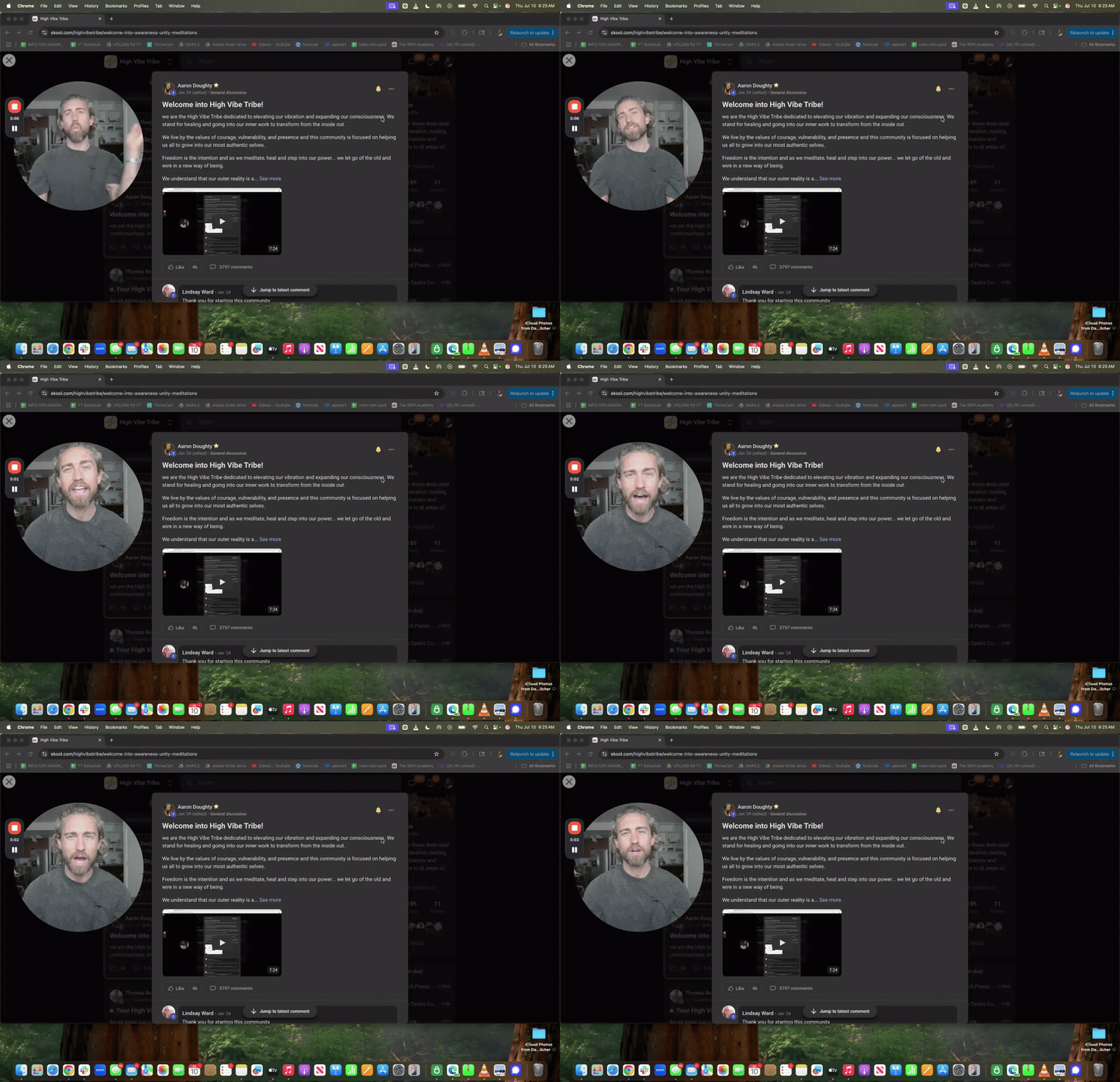
Welcome into High Vibe Tribe!
we are the High Vibe Tribe dedicated to elevating our vibration and expanding our consciousness. We stand for healing and going into our inner work to transform from the inside out. We live by the values of courage, vulnerability, and presence and this community is focused on helping us all to grow into our most authentic selves. Freedom is the intention and as we meditate, heal and step into our power... we let go of the old and wire in a new way of being. We understand that our outer reality is a refection of our inner reality and rather than blame the outside or try to fix it, we look at ourselves and let go of parts of ourselves attached to the beliefs, patterns and past "familiar" energies keeping us locked in the past. When you go through a spiritual awakening many feel like the lone wolves in their family. This community is a way to connect with other people like you… dedicated to healing the past, spiritual growth, and creating their dream life. This is not about surface level change or thinking better thoughts… it’s about doing the inner work, looking at subconscious parts most people avoid (the shadow) and creating inside out transformation. There are some Rules for this community to keep it a safe space… 1. Absolutely no selling or promoting other groups/events. This includes directing messaging other members. Members who break this rule will be banned from the group. 2. Posts should either add value and be well thought out. Lets create a high vibe, supportive community section 3. No posting “who else lives in New York?” Etc these will be deleted as if everyone posted them the group will be flooded with it. if you want to learn how to see who lives in your city I share in the video below 4. Be supportive and accepting of other people. Like posts, support other people and encourage them.
5m •
Toxic Relationships (Social Groups and Individual)
I was in a relationship with somebody (and her social group) this woman was - from the beginning (childhood) more-so the type to be narcissistic. She was always mean when we were younger, her and her siblings. Eventually she did seem to help me out tremendously in my late 20s. Then when she did help me to a point, she began - essentially humiliating me in front of a bunch of people at parties (parties of many of my friends, I saw immediately by their reactions, but wasn’t in the right state of mind at the time (she comes from a peer group of religious narcissists) Fast forward to more recent, I found out she got an entire group of people (behavior techs and such) to take my life with drugs, cigarettes, slowly into heart failure. (Previous to this I had 7 or so major cardiac events that made my left side of my body not work well) They were all into many addictive things and she got with a few of the guys there and decided to ask them to do that deed - in an institutional setting, with these behavioral techs and therapists that played along with this. I hit a point of complete heart failure and my heart stopped in an ER. I then received an Ativan shot because I woke back up somehow and then woke up 5 days later with a severely hurt neck. By these behavioural techs. Then she used this law to keep these guys around me constantly (a law to release me to them without me knowing at all) they then tortured me and everyone around to keep me decided from everyone around. Just recently, I understood (and heard her ask the few guys there to attempt my life) Countless hours and childhood, we spent together most of our waking and sleeping hours in the last 2 years or so) And she threw all of that away for those same people that ended up doing her the worst I have ever seen anyone because she got them arrested or something. The absolute worst things I have seen done to a woman and me not able to do anything because of this state of mind I was in more so than her (but her narcissistic group ways - that she showed them to do, I figured out) kept her and me from being able to stop this entire year and a half from happening.
0
0
11m •
Why Science Keeps Missing The Mark On Psychic Phenomena
Have you ever experienced something psychic or supernatural that you know was real, even though you cannot explain or reproduce it? You are not alone. Psychic phenomena and supernatural experiences are often dismissed by science because they cannot always be reproduced on demand under controlled laboratory conditions. From this, skeptics commonly conclude that these phenomena do not exist. But the problem with psychic research is not as simple as “there is no conclusive evidence.” There is evidence. A lot of it, actually. Those of us who work in this field as both practitioners and researchers, know where the real problem usually lies: in the way psychic perception is tested and measured. Conventional research has largely tried to study psychic perception using methods designed for physical, repeatable, cause-and-effect processes. But psychic perception is not a simple mechanical or linear process. It cannot be isolated and reproduced like a chemical reaction or treated as though the same conditions must always produce the same result. This is not merely a matter of opinion. Research increasingly supports it. 🔬 A 2009 paper argued that standard psychic tests and tools often fail to capture genuine psychic phenomena. “Prove it on demand” may be the wrong testing model entirely. Psychic awareness tends to expand in calm, open states, not through pressure, force, or control. 🔬 A more recent study published in March 2026 examined 874 psychic research studies across 10 research protocols spanning several decades. In 7 of the 10 protocols, the researchers found a clear and measurable decline in effect size over time. The more controlled, restrictive, and repetitive the experiments became, the weaker the measured results tended to be. This supports what experienced practitioners have long understood: psychic ability cannot simply be switched on and off under clinical pressure and skeptical observation. A psychic experience does not automatically become imaginary simply because it cannot be reproduced like a chemistry experiment. We may simply need better ways of studying the expanded capacities of human consciousness.
0
0
1-30 of 37,175

skool.com/highvibetribe
a community for those dedicated to raising their vibration, healing, letting go of limitations and creating freedom in all areas of life
Leaderboard (30-day)
1
🔥
+2617
2

🔥
+1129
3

+827
4
+518
5
+431
Powered by