

22h •
3Blue1Brown on Divergence and Curl of Vector Fields
A few of our members are asking for more content that relates to studying fields in space, with special emphasis on Electromagnetism. So, to start that journey, here's an even better tutorial about vector fields and vector functions than the one I posted last week. As time goes on, I'll be posting tutorials that build on this information and that collectively explain all of electricity and magnetism that you'd get in a good undergraduate curriculum. Enjoy!
1
0
23h •
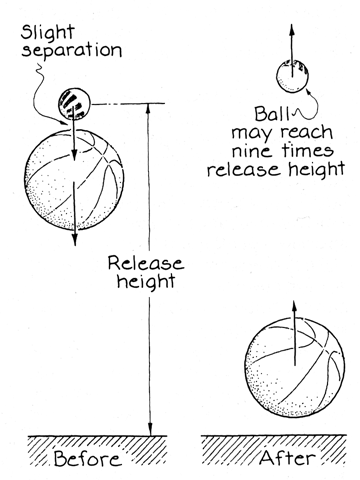
Drop Two Stacked Balls From Waist Height; the Top Ball May Strike the Ceiling
When I was a freshman taking my first college-level physics course my professor performed a delightful demonstration that absolutely stunned me. Drop a baseball on a basketball and it doesn't just bounce — it launches toward the ceiling. At first it seems quite surprising, but the physics behind it is quite simple. When a stack of elastic balls hits the floor, each collision passes energy up the chain, and the lighter the top ball, the more violently it gets flung. Two balls can send the top one nine times higher than its drop height; stack three, and the math says 49 times — enough that safety goggles are a genuinely good idea. This delightful article by the great Jearl Walker is from The Amateur Scientist. In it Walker explains exactly why using nothing more than momentum, kinetic energy, and a coefficient of restitution. It covers the pendulum experiments that mapped out ideal mass ratios, the surprising finding that transferring all the energy isn't what produces the highest bounce, and real recipes (baseball on basketball, Wiffle ball on Super Ball, a deodorant-cap ball on a steel ball) anyone can replicate at home. It even ends with open questions nobody's solved yet — the kind of thing a curious backyard experimenter could actually crack. A challenge to our members... How many balls does one have to stake to achieve escape velocity? And can you see any way to use this effect to replace the first stage of a rocket, or as a way for an underdog nation to achieve an asymmetrically advantage over a larger foe?
1
0

1d •
Applied Magnetics
Here's an interesting article about the application of strong magnets. https://www.schneier.com/blog/archives/2026/06/robot-police-officers.html
0
0
3d •
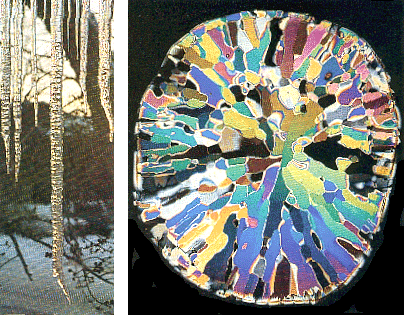
On the mysteries of icicles
Icicles Ensheathe a Number of Puzzles: Just How Does the Water Freeze? by Jearl Walker, May, 1988 issue of The Amateur Scientist Icicles look like simple frozen drips, but they hide a surprising amount of unsolved physics. Why does every icicle taper to a tip just a few millimeters wide? Why is there a liquid-filled tube running up the center that you can probe with a toothpick? What causes the white line down the middle, the evenly spaced ribs along the sides, the spots where the ice turns spongy enough to push a knife into, or the twists and spikes that some icicles develop? Researchers like Maeno and Takahashi, Hatakeyama and Nemoto, Makkonen, and Knight have traced answers to some of these questions, tying icicle shape to the freezing physics of pendent drops, supercooled water sheaths, dendritic ice growth, and even the crystal orientation revealed by slicing icicles under crossed polarizing filters. But plenty of open questions remain: what sets the length of the internal ice tube, what determines rib spacing, how do wind, impurities, or ambient humidity reshape growth, and how does an icicle's structure depend on temperature and water supply. That's what makes this a genuine citizen-science opportunity: no lab required, just icicles, a toothpick, a camera, and curiosity. Anyone with icicles hanging from their own roof this winter can run a real experiment, add colored water or salt, photograph growth every few minutes, or slice a specimen for polarized light and contribute observations to questions professional researchers haven't fully answered yet.
3d •
Grad, Divergence and Curl -- Brief summary
Vector calculus is absolutely foundational to understanding the fundamental principles upon which the universe operates. If you want to learn physics, you need to understand how to think about scalers, vectors, and how to describe how scaler and vector fields that track how physical things are changing, like temperature or flow inside a volume. Here's a very straightforward visual introduction to these ideas that I wish had been available back when I was first learning these concepts. Enjoy!
1-30 of 107
powered by
skool.com/fellowship-of-mad-scientists-3928
Mad Scientists Unite! Find community amongst the atom smashers and X-ray tubes. Over 1000 high-level STEM projects. Find your minions!
Suggested communities
Powered by