
Pinned

👑
⭐
7d •
Welcome to Clief Notes. Here's where to start.
1. Go check out 📚Navigating The Course to see how to get around and what's here. 2. Start with The Foundation. Concepts, folder architecture, prompting framework. Everything else builds on this. 3. Check in at the bottom of each lesson. Polls, discussion posts, other members working through the same stuff. Use them. 4. When you're ready to build real things join in on our Biweekly competitions and win some real cash. ⭐ Competitions Mega Thread 5. If you are wanting to dive into the masterminds, grab all the past templates, artifacts and resources. Upgrade and head into the The Vault for Premium and The Drawing Room (VIP) for VIP 6. Post your work. Ask questions. Help others when you can. What are you here to build?
Pinned
👑
⭐
24h •
📢 Recordings of Tea Masterminds are live: The Second Brain
🧠 This round was about what a second brain actually is: a context layer you and your AI both read, not a notes app. The Afternoon Tea is the teaching. The High Tea is the room putting it to work on scale, memory, trust, and security. Here is what I want you to understand about these drops, because it is the whole point of being in here. While the videos are valuable and being able to sit and answer your questions is a big reason for them that's not the only value they hold. 📄 Every drop is a set of working files. Markdown built to be used and reused. Each one ends with the exact data to give your AI for your own situation. This round also ships a starter folder you can open, run the self-audit on, and walk away with the skeleton of your own second brain in a sitting. 🤖 I build them expecting you to feed them to your AI. That is the design. Hand a whole round to Claude in a few minutes, whether or not you made it live. The room's thinking is in the files, so you lose almost nothing by catching it later. 🔄 They adapt. A prompt pack is frozen. These are meant to be reshaped: update the context, swap in your own work, bend the templates to your process. And they grow on my side too, as we learn together in these calls. The call is dialogue. The package is that dialogue, crystallized into something you can run. Next round builds on this one. ☕ Afternoon Tea 6 →Afternoon Tea 6 (Second Brain Chat) 🫖 High Tea 10 → High Tea 10 (Second Brain Deep Dive) 🧭 How you should use these: 🔹 Show up live when you can. Your questions shape the next drop. 🔹 When you can't, rewatch, or drop the files into your AI and run the prompt at the bottom. 🔹 Open the starter folder and build your own version. Rename it to your work. It is yours to keep. 📚 A mastermind ends when the call ends. What you get here keeps working after: a structured version of your own thinking (and some of my own thinking!) that improves every round. In my opinion that is worth more than the hour in the room. (or three as some of you stick around in these calls to chat)
Pinned
👑
⭐
2d •
Ai before ChatGPT: The Interview.
In this interview I sit down with Matt from NLP Logix. He's been working in the AI space longer than most people have been working in general. We dive into what changed and what is it going to be important about the future. This is a three part series, I will be posting another two videos from another two experts in mathematics and Engineering! Please like and comment on YouTube if you have time as well!

2d •
An ICM Workspace Auditor
How my workspace audit works (and what's deliberately left out here) I run an ICM-structured workspace for my own work, and built a structural audit for it that came up in a conversation elsewhere. Starting this as its own thread so it stands on its own for anyone interested, not just the people already in that one. One thing worth saying up front: what follows is a stripped-down version of the real thing. My actual setup has a fair bit more wired into it (a decision log that learns from repeated corrections, a long list of specific maintenance triggers, and more). I've left all of that out here on purpose, so this stays focused on the part that's genuinely reusable and widely applicable, rather than tied to my own specific workspace. The core idea: an audit only ever diagnoses and proposes. It never changes anything on its own. Even if the session is set up to act autonomously, the audit overrides that and waits for my sign-off on every finding. That one rule is what makes it safe to run regularly without worrying it'll go off and "fix" something I never asked it to touch. Three principles sit underneath it: 1. Diagnostic, not corrective. It finds drift and proposes fixes. I decide, one finding at a time. Nothing gets edited during the scan itself. 2. Mechanical checks before judgement. A small set of deterministic checks runs first (broken links, orphaned index entries, count drift) so I'm not relying on the model's judgement for anything a script can verify outright. 3. One shared quality bar. The same rubric governs creating, editing, and auditing. Not three different standards for three different moments. It runs in four phases: a full read-only scan of everything, findings presented in priority order, collaborative decisions with nothing implemented yet, then implementation only once I trigger it. Anything deferred or declined gets logged so it isn't lost. The rubric scores against ten dimensions: things like right altitude (specific enough to guide, not so rigid it breaks), token discipline, separation of concerns, currency, proportionality, and evidence over invention, each scored against a clear pass mark.

9d •
Film/Advertisement Generation Workflow 🎬
👋For the last 2 months, I've been heads-down exploring ai image & video generation as my new personal project. I was shock by the capabilities of current ai image/video space. But every ai creators face a common pain point.. this sh*t is hard. Haha. Thats why all youre seeing are ai slops. Then about 1 month ago, I sent the kids to my relative for few weeks and lock myself in a room and went nerd out to build a tool that lets me take an idea and turn it into a profession cinematic video. I recorded it working on a real project and wanted to share what it actually does — and why I'm pouring everything into it. The idea in a nutshell: Instead of guessing what makes a video great, my tool studies one: → I give it an original video as a study case (here's the one I used: [youtube]) → It analyzes that video and pulls out its DNA — the small details in every component that make it work: the shots, the pacing, the sound, the transitions, the feel. → Then it reverse-engineers that DNA into something completely new and my own — and carries it all the way through, even into the editing, mostly automatically. The Unfolded short film bellow received the same DNA treatment, as you will see, the context is similar ..however, it produced a very unique animation perspective using origami. Every user who analyzes a film makes the library richer for the next one. That's a network effect — the rare thing that actually compounds. GitHub for film DNA: fork a look, make it yours, push it back. I have tried to use it to branch off ideas from Game of Thrones series. It is very complex to keep track of all the different kingdoms, characters, props, and story development. But i think i got it figured out. Theres no one size fit all approach for different type of contents. Horror dna cant get mix up with cartoon 😂. But this is the closest thing to a “reusable” end to end video generation. Correct me if im wrong but there isnt a product out there that can solve this yet. This is a foundation to a full content creation pipeline - you re using a proven video as a reference for your own video. Once you figured out your winning format, automate it to create video daily/weekly is the easy part.
1-30 of 2,348
skool.com/cliefnotes
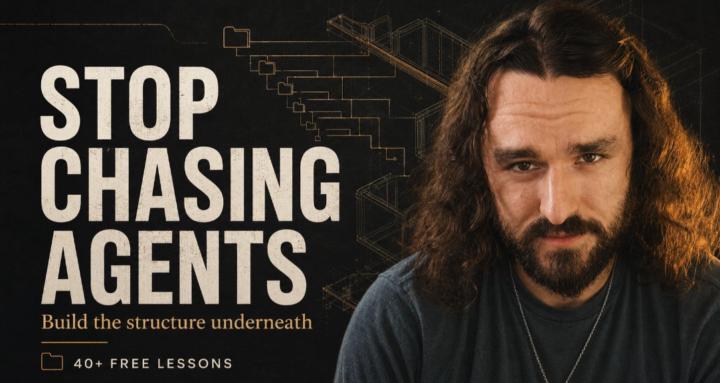
What we give away free beats most paid courses. Build durable AI systems with a Marine vet and Edinburgh researcher. 40+ lessons, growing.
Leaderboard (30-day)
1

+1593
2

🔥
+1559
3

🔥
+1538
4

+889
5

+789
Powered by