Activity
Mon
Wed
Fri
Sun
Aug
Sep
Oct
Nov
Dec
Jan
Feb
Mar
Apr
May
Jun
Jul
What is this?
Less
More
Owned by Shawn
Mad Scientists Unite! Find community amongst the atom smashers and X-ray tubes. Over 1000 high-level STEM projects. Find your minions!
Memberships
Home Lab Explorers
1.6k members • Free
Community Launch
15k members • Free
Science Nerd 🤓 🧫🧬🔬⚗️🔭
148 members • Free
Diva Network
478 members • Free
Skoolers
165.3k members • Free
371 contributions to Fellowship of Mad Scientists

22h •
How NASA Literally Reinvented the Wheel
Tech that gladden the heart of every mad scientist who sees it. How might you be able to apply this in your own projects? Enjoy!
1
0
22h •
Grad, Divergence and Curl -- Brief summary
Vector calculus is absolutely foundational to understanding the fundamental principles upon which the universe operates. If you want to learn physics, you need to understand how to think about scalers, vectors, and how to describe how scaler and vector fields that track how physical things are changing, like temperature or flow inside a volume. Here's a very straightforward visual introduction to these ideas that I was had been available back when I was first learning these concepts. Enjoy!
1
0
22h •
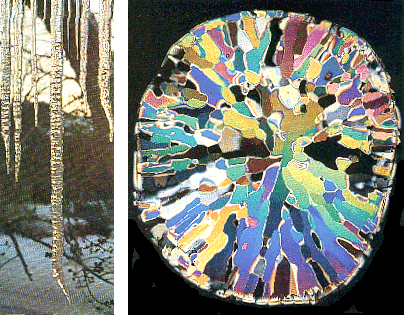
On the mysteries of icicles
Icicles Ensheathe a Number of Puzzles: Just How Does the Water Freeze? by Jearl Walker, May, 1988 issue of The Amateur Scientist Icicles look like simple frozen drips, but they hide a surprising amount of unsolved physics. Why does every icicle taper to a tip just a few millimeters wide? Why is there a liquid-filled tube running up the center that you can probe with a toothpick? What causes the white line down the middle, the evenly spaced ribs along the sides, the spots where the ice turns spongy enough to push a knife into, or the twists and spikes that some icicles develop? Researchers like Maeno and Takahashi, Hatakeyama and Nemoto, Makkonen, and Knight have traced answers to some of these questions, tying icicle shape to the freezing physics of pendent drops, supercooled water sheaths, dendritic ice growth, and even the crystal orientation revealed by slicing icicles under crossed polarizing filters. But plenty of open questions remain: what sets the length of the internal ice tube, what determines rib spacing, how do wind, impurities, or ambient humidity reshape growth, and how does an icicle's structure depend on temperature and water supply. That's what makes this a genuine citizen-science opportunity: no lab required, just icicles, a toothpick, a camera, and curiosity. Anyone with icicles hanging from their own roof this winter can run a real experiment, add colored water or salt, photograph growth every few minutes, or slice a specimen for polarized light and contribute observations to questions professional researchers haven't fully answered yet.
Apr '25 •
Welcome to the Fellowship of Mad Scientists
Welcome. Please complete the following tasks Download Skool • iPhone • Android Introduce yourself in the comments of this post: • Who are you? Tell us a little about yourself. • What are you hoping to get out of your membership? Then, check out the START HERE course in our Community Classroom.
1 like • Feb 9
Hey Randall, welcome. I hope you check out our weekly chats on Wednesdays, Noon Eastern. Many of our members are older folks who are looking for fellowship with like minded people. Most have deep expertise and love doing all sorts of interesting science projects on their own. We’re quite an eclectic group. I see you dm’ed me on another matter. Check your dm’s for me reply. Take care and tallyho!
0 likes • 4d
@Rick Cunningham — we are definitely nerdy enough to do that!

5d •
INTRO>>>
Hello, my name is Jerry, and I’m from North London. I wouldn’t describe myself as a science nerd, but I am deeply fascinated by how the human body works and how science and technology can help us better understand ourselves. I’m especially interested in the future of mental health, human development, and the possibility of creating tools that help people build greater self-awareness, resilience, and mastery over their own lives. I’m currently exploring several ideas that combine emerging technology with human wellbeing. They’re still in the experimental stage, but I’m passionate about turning these concepts into something that could make a meaningful difference. I’m always open to connecting with scientists, researchers, engineers, entrepreneurs, and curious minds who enjoy discussing bold ideas. If there’s an opportunity to collaborate, share knowledge, or help bring these visions closer to reality, I’d be delighted to connect and see where the conversation leads.
1 like • 4d
Hello and welcome Jerry! I'd love to learn more about what you're doing and find out how I and other mad scientists in this group might be able to support you. I have some experience in teaching resilience, grit, and growth mindsets to students, so I hope to be able to make a useful connection with you on your interests, through I suspect you've thought more about these topics that I have. I hope you can make it to the next LabChat (they happen every Wednesday at 2:00PM Eastern -- I think that's 7:00PM GMT) so I can meet you in person and introduce you to some of our most active members. I have family visiting all next week so my time will be quite limited for the immediate future. Take care!
1-10 of 371

@shawn-carlson-8472
Mad Scientist Extraordinaire, Physicist and Educator, Scientific American Columnist, Founder-Society for Amateur Scientists, MacArthur Fellow
Active 22h ago
Joined Mar 30, 2025