
Write something

Apr 25 •
Written rules
Yesterday I wrote a post about unwritten rules that strengthen groups. That post got... 10 likes and 5 people to comment, in a group of 483 members. Maybe it was a particularly bad or irrelevant post. In any case it seems like a good time to talk about written rules. I recently joined a Facebook group. The group is about the same size as Daily Email House, but it's much more engaged. People are enthusiastically introducing themselves in the group as soon as they join (as did I)... ... spontaneously writing up new posts and starting new discussions all the time... ... commenting on others' posts all the time. How? Simple. The group has written rules stating that you have to introduce yourself when you join, and participate once you're inside, or you will get kicked out. And the moderators follow through on these rules. What do you think about that? Please comment below. Or don't. But I've decided to start doing the same: Periodically and randomly and brutally removing people who don't participate inside Daily Email House. Your choice.

May 2 •
3-4 person accountability Mini Pods?
In a thread from last week, @Neil Sutton wrote: === I’ve been in some accountability groups that were very successful. It’s not an “all of us” getting together kinda thing, but those created an opportunity to bond with and become friends with people I might never had met otherwise. The best one was when I was in Brian Kurtz’s Titans group. He assigned the groups of 3 or 4 then we went off on our own and met monthly. We came up with 3 questions we took turns answering in each call and the others would offer feedback and support if needed. It was definitely optional. You put your name in to be assigned to a group if interested. Then you'd be grouped with a few others. I had to look back, and there were just four groups of 3 each. (I was teamed up with the amazing Kira Hug & Shannon McCaffrey.) === Are you interested in this? More importantly, will you actually participate? I'm happy to put the pods together. But ultimately, this is about you, and having a regular little mini-mastermind with two or three other folks in this group, and helping each other out, and socializing, and keeping each other on track. It won't work unless you participate, and regularly. So do you want this? Let me know below.
Poll
17 members have voted

Apr 26 •
Enforcement is key
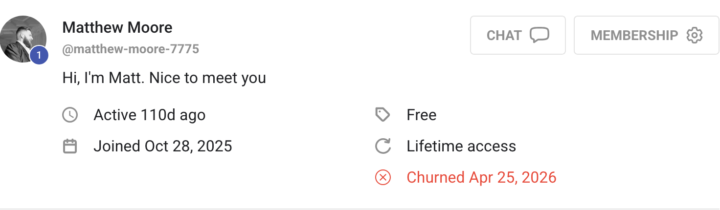
Yesterday this group had 483 members. Today it has 474*. Over the past 24 hours, I've removed 10 people from this group, following up on this discussion on written rules. As proof, I am attaching 10 "churned" profiles of former House members, with yesterday's churn date. I'm not holding up these removed ex-members to shame them. I have nothing against them personally. But rules are rules, and Daily Email House has its rules. As a few people commented in the discussion I linked to above: Enforcement is key. No sense in having rules if you're not going to enforce them. I'd also add, not only is enforcement key... but public enforcement is key. Yeah, maybe somehow you project a different vibe if you have rules and you stick to them in private, behind the curtain, where only you and the person you're dealing with are privy to what went down. But it helps the objective of the rules massively if you make a public showing of enforcing rules. That way, the rules don't just punish the transgressors, but are a reminder and an encouragement and even a reward for everyone else who did not transgress. This doesn't apply to just kicking people out of communities for not engaging: - It's the same thing with deadlines for your promos to your email list - It's the same when dealing with disrespectful readers or clients or partners - It's the same for turning someone away from your offers, because he or she is not going to get value out of those offers, and you've set a policy for yourself to not sell to people like that In each case, enforcement is key... and public enforcement is the Golden Key. (*) Daily Email House yesterday had 483 members... minus the 10 members I removed makes 473... and yet the group now has 474 members? A few days ago, I finally filled out the necessary fields to make this group discoverable via the Skool discovery network. Today a dude found Daily Email House via Skool, and asked to join.
Apr 24 •
Unwritten rules
This morning I watched a video about unwritten rules in baseball. (Bear with me if you know nothing about baseball or care nothing for baseball.) I had no idea, but baseball has had, for 100+ years, dozens of unwritten rules about player conduct, for example: - You cannot flip your bat after you hit a home run - You cannot have a beard (all teams, once upon a time, New York Yankees still today) - You cannot score from second base on a single if your team if the game is a blowout and your team is winning Now here's what got me: These unwritten rules are enforced BY THE PLAYERS THEMSELVES ON THE PLAYERS THEMSELVES... often by members of your own team! If you break one of these unwritten rules, odds are great that you will be beaten up, ostracized, or sometimes worse (eg. have a 100mph baseball launched at your face on purpose). Here's what else got me: - If you're a big star and you break a rule in a big moment, exceptions are made - If you're young or inexperienced, then you will be consistently and brutally punished by other players for breaking a rule I remember reading in, I believe, Robert Cialdini's Influence about the importance of hazing rituals to form a sense of in-group identity. That's what this reminds me of. Seemingly arbitrary rules, enforced by group members, as a way of reinforcing the importance of the group and of recommitting their loyalty to that group. Now I've really never belonged to any group, unless that group is the group of outsiders who don't really belong to any groups. But without getting too weird about it... I'm curious: What seemingly arbitrary rules have you experienced or seen in real-life groups you've been a part of? And in online groups you've been a part of?
Apr 21 •
Why it's easier to make friends when you're young
My theory why it's easier to make friends when you're young: Because you do exciting stuff together. You play sports together... You go to the beach together or go for a concert together... You sit in class together (not so exciting) and study for the same exams (kind of exciting, if you're a nerd) and hate the same teachers (very exciting). When you grow up, interactions with others become reduced to: Sitting together at the same coffee shop... Talking... Nodding and smiling at each other. It's hard to really form a bond over coffee and some nodding. It takes cooperation, activity, a shared goal with an emotional outcome, even if it's trivial, to bind us to other people. And as for in-life, so for on-line. Which gets me to my question for you... How can we as a group here, inside Daily Email House, do stuff TOGETHER? What would that even look like? Something that isn't just sitting in the same coffee shop (or Skool group)... "talking" (eg. posting or commenting in here)... "nodding and smiling" (liking posts or comments)? Something that involves cooperation, actual activity, a shared goal? I don't know. I hope you have ideas, and that you will share them. I'll consider them all earnestly. And if you've been in this group for any length of time, you know that if you toss up an idea, there's a good chance it will become reality. Thanks in advance.
1-23 of 23

skool.com/daily-email-house
Email daily, make a $1k offer, pay for a house.
Leaderboard (30-day)
1

+28
2

+19
3

+16
4

+15
5

+10
Powered by