
Pinned

Mar 15 •
Welcome to Clief Notes. Here's where to start.
1. Watch the intro video and introduce yourself in the intro post here 2. Start with The Foundation (free course). Concepts, folder architecture, prompting framework. Everything else builds on this. 3. Check in at the bottom of each lesson. Polls, discussion posts, other members working through the same stuff. Use them. 4. When you're ready to build real things, move to Implementation Playbooks (Level 2). When you're ready to build your own tools, Building Your Stack (Level 3). 5. Post your work. Ask questions. Help others when you can. What are you here to build?
Poll
5939 members have voted
Pinned

Pinned
5d •
Companies want to hire from Clief Notes. So we're building this.
Been sitting on this for a few weeks and figured it's time to show you. 👀 Over the last month, three companies have reached out asking the same thing. How do we hire people from Clief Notes. They've seen what folks here are building with ICM and they want that on their teams. Not LinkedIn AI experts. Not Coursera grads. People who can actually ship. So we're building it. 🛠️ talent.eduba.io Heads up, that's a demo. No real backend, no signups, no live data. Click around and you'll see what the full thing is going to be. A private platform where you list yourself with a real portfolio, companies browse, and they request an intro through us. We make the intro. You take it from there. Few things worth knowing. 🔍 Every profile gets reviewed by the Eduba team before it goes live. The quality bar is the whole point. 🔒 Companies don't see your last name, your employer, or your contact info until we make a formal intro. You can block your current employer too, plus five more companies if you want. Nobody you don't want seeing you sees you. You can list as actively looking, open to offers, or not looking. Passive welcome. Honestly most of the strongest people we've trained are employed and plan to stay that way until the right thing shows up. That's fine. Sit on the platform, see what comes through. 💰 When a placement happens you get a $500 to $1,000 bonus after 90 days in the role. On top of whatever you negotiate. We pay you for staying. This is why the community matters. Companies aren't asking us for resumes. They're asking us for the people who already get it. ICM, agent architecture, knowing when not to use AI. That's not on a LinkedIn profile. Go click around. Tell me what's missing, what's confusing, what you want to see when the real thing ships. We're already building it. 🚀

3d •
I stopped calling them "agents," and my system got more honest
A few months ago, I had an idea for a build. Thanks to @Jake Van Clief 's folder architecture I succeeded. I built the thing! But then someone had a question about what I had built that turned out to matter more than I expected: are the things I built actually agents? I'd been calling them that out of habit. Then the question forced me to be precise, and being precise changed the design. Sharing the three things that came out of it, because I was being loose with the word, so I post as a cautionary tale based on all the hype around "agents" right now. 1. "Agent" in 2026 means an autonomous reasoner — establishes its own path, it adapts, it learns. But there's an older meaning: a thing that acts — that has a scope, runs different types of operations, produces different effects. My things are the second kind not the first. They can't learn, can't self-modify, can't pick their own goals. Once I admitted that out loud, I stopped saying "agent" unqualified and started saying bounded executor. That not a bad thing — it was me being honest about what I had designed. Here's the interesting thing, an autonomous agent can't be audited with certainty, because what I will do next isn't predetermined. A "bounded executor" can. I removed the autonomy feature, on purpose! If you're building "agents," ask yourself which of the two words you mean, the answer changes what you can promise about them. 2. Test for drift with identity, not observation. "Drift" changes quietly over time and is something most people try to monitor for: watch outputs, catch anomalies etc. I went the other way. Every component definition in my system is content addressed: it has a hash derived from its exact content. So, the drift test isn't statistical, it's binary. Same hash at time A and time B and BOOM! byte identical! Different hash > there's a recorded, authorized change I can point to. There is no third case. The idea here is to make drift unable to happen silently by fixing that thing's behavior to an inspectable definition.

9d •
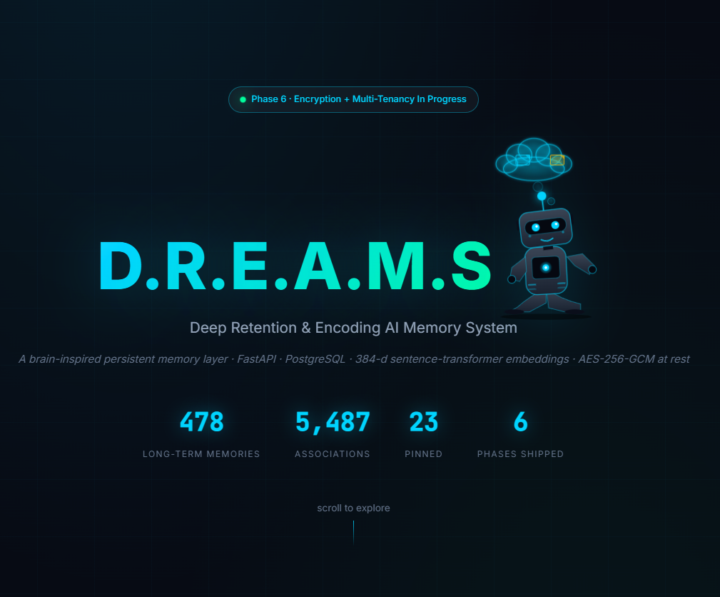
D.R.E.A.M.S, Interactive Memory System. Builder breakdown
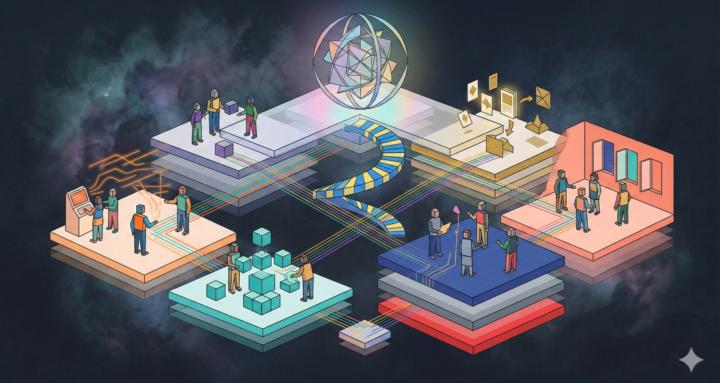
If you've ever had a great conversation with an AI assistant and watched all that context vanish the next morning, you know the problem. Models forget. Every session started from zero. We have all been there and we have either use prompts, handoff documents, and structured workflows. Or some mix of the three. I needed my AI to truly know my development environment. So, I built the structure of all three into the memory system. Not just the code, but the cohesion, not just the functions, but the impact. I've spent the past several months building a fix. It's called D.R.E.A.M.S, Deep Retention & Encoding AI Memory System, and I just put up an interactive breakdown of how it works. Overview @ DREAMS, Deep Retention & Encoding AI Memory System What it is, in one paragraph: DREAMS is a persistent memory layer for AI assistants, modeled on how biological memory actually works. Inputs flow through an encoder, sit in a working buffer, get evaluated by a consolidator, and graduate to long-term storage based on emotional weight and reinforcement, not just recency. Six memory types (episodic, semantic, procedural, emotional, contextual, perspective) get encoded, retrieved, and weighted differently. Memories are permanent. Append-only by design. Recall finds them forever. The non-negotiable: Your memory, in your database. DREAMS writes into a database instance you control. Not a vendor cloud. Not a black box. The corpus you build is yours. The continuity, the lessons, the perspective, the entire graph of associations, you take it with you. Any model that can call MCP can read it. Models will change. Your continuity won't. What you can do on the site: - Step through the live architecture, click each stage to see what it does - Read the six memory types and what each one is for, hover any card to see it in action - Type into the simulator and watch a memory encode, consolidate, and promote to long-term storage in real time - Run semantic recall against a seeded library of fifty memories from the build itself
1-30 of 1,330
skool.com/cliefnotes
Jake Van Clief, giving you the Cliff notes on the new AI age.
Leaderboard (30-day)
1

+883
2

+869
3

+814
4

+729
5

+663
Powered by