Activity
Mon
Wed
Fri
Sun
Jul
Aug
Sep
Oct
Nov
Dec
Jan
Feb
Mar
Apr
May
What is this?
Less
More
Memberships
AI Automation Society
380.8k members • Free
Clief Notes
33.6k members • Free
Cyber Pros Community
1.2k members • Free
GC
Growthworks Community
24k members • Free
Start Writing Online
20.5k members • Free
8 contributions to Clief Notes

3d •
I stopped calling them "agents," and my system got more honest
A few months ago, I had an idea for a build. Thanks to @Jake Van Clief 's folder architecture I succeeded. I built the thing! But then someone had a question about what I had built that turned out to matter more than I expected: are the things I built actually agents? I'd been calling them that out of habit. Then the question forced me to be precise, and being precise changed the design. Sharing the three things that came out of it, because I was being loose with the word, so I post as a cautionary tale based on all the hype around "agents" right now. 1. "Agent" in 2026 means an autonomous reasoner — establishes its own path, it adapts, it learns. But there's an older meaning: a thing that acts — that has a scope, runs different types of operations, produces different effects. My things are the second kind not the first. They can't learn, can't self-modify, can't pick their own goals. Once I admitted that out loud, I stopped saying "agent" unqualified and started saying bounded executor. That not a bad thing — it was me being honest about what I had designed. Here's the interesting thing, an autonomous agent can't be audited with certainty, because what I will do next isn't predetermined. A "bounded executor" can. I removed the autonomy feature, on purpose! If you're building "agents," ask yourself which of the two words you mean, the answer changes what you can promise about them. 2. Test for drift with identity, not observation. "Drift" changes quietly over time and is something most people try to monitor for: watch outputs, catch anomalies etc. I went the other way. Every component definition in my system is content addressed: it has a hash derived from its exact content. So, the drift test isn't statistical, it's binary. Same hash at time A and time B and BOOM! byte identical! Different hash > there's a recorded, authorized change I can point to. There is no third case. The idea here is to make drift unable to happen silently by fixing that thing's behavior to an inspectable definition.
0 likes • 6h
Kenneth, good to hear! I think bounded executors might become the road to stable AI. I'd be interested to know if the difference between automated reasoners and bounded executors IS architectural instead of policy governance. I'm not sure we can get automated reasoners to stop drifting or hallucinating. But maybe the LLM companies have something up their sleeves and I'm all wrong about. In any case I see non or low hallucinating and non drifting executors in high assurance, critical roles in the next 3-5 years.

Apr 14 •
12 Weeks. Real Projects. $250K in Prizes. Let's Talk.
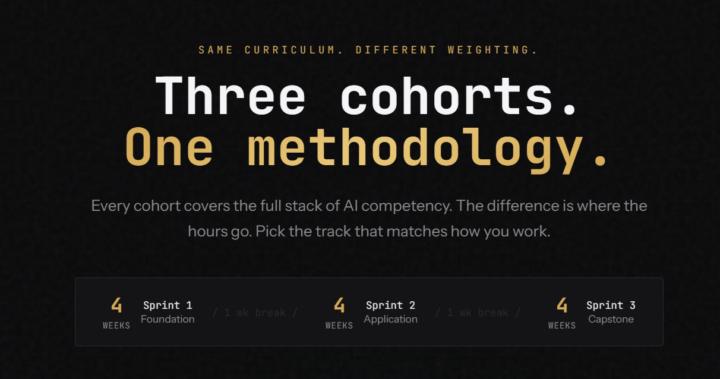
For those who missed the first post or just joined: The Lyceum is a 12-week program we're building. Live instruction from Jake and the Eduba team. Small cohorts. Real projects. You build something from week one, not watch tutorials. At the end, a competition with real prizes. Eduba's first certification, backed by the same methodology we've used to train Fortune 500 teams. Now here's what we've locked in since then. The Structure Three 4-week sprints with a 1-week break between each. Not 12 straight weeks of grind. You build, you breathe, you come back sharper. - Sprint 1: Foundation — Core methodology. Everyone starts here. - Sprint 2: Application — You're building. Real project, real progress. - Sprint 3: Capstone — Finish what you started. Demo day prep. The breaks aren't fluff. They're built in so you can catch up, refine, or just live your life without falling behind. The Cohorts Same curriculum across all three. The difference is where your hours go. Technical — Developers, engineers, technical founders. You're building a tool or production system. 30% of your time goes to Claude Code and integrations. Another 30% to production systems and capstone. This is the builder track. Business — Ops, managers, founders, consultants. You're automating a process or designing a system spec. Heavy emphasis on workflow design (30%) and decision frameworks (25%). You direct the work without writing the code. Creator — Marketers, educators, solo operators. You're building a content production system. One person replaces the team. 25% on content pipelines, 20% on workflow design. This is how you scale yourself. Pick the track that matches how you work. The methodology transfers no matter which one you choose. A 4th Cohort? We're considering adding a team cohort if there's enough interest. This would be for companies that want to enroll multiple employees, or for people in the community who want to form their own team and build together. If that sounds like you, let us know in the comments.
Poll
510 members have voted
1 like • Apr 21
Is this still happening? Cause I built something...
0 likes • Apr 21
Or was I supposed to wait lol
Apr 18 •
Working Full Stack CMMC workflow
So built a CMMC work flow today! I might even be a full company one day! Lol that's crazy to think but here we are @Jake Van Clief thanks for your work! Your information made it possible for me to progress to what I have accomplished today. PDF attached if you're interested.
1 like • Apr 18
Lol @Jason Carter
1 like • Apr 18
@Todd Reel Hey Todd, CMMC=Cybersecuriy Maturity Model Certification, small and medium defense subcontractors need the level II cert if they want to do business with the Defense Industrial Base here Hampton Roads VA
Apr 17 •
Built A cybersecurity company with AI agents.
Okk ive built a CMMC "company" with a vCISO orchestrating agent with 5 contexted sub-agents that engage the client, process gap analysis, SSP etc, routes to founder (me) for approval. Granted i might need to work on the workflow steps a little. The Agents self-assesses after each deliverable, routes to the CISO. CISO then turns in agent assessments and after action report with next steps for improvement after event concludes. Have the Legal Guardrails, Tax treatment. need to still build out 1. contract delivery, 2. Invoices 3. secure enclave (m365 High) 4. Marketing What else am I missing?
0 likes • Apr 17
***Update*** Ran a simulated client CMMC engagement, Agents self-assessed at Medium-Low during the simulation. Adding a legal Agent to apply DFARS legal framework to the engagement, creating templates and checklists used to capture client inputs....more to follow....
0 likes • Apr 17
***Updaate*** Success!!!!!This simulation walked through all 7 phases of a CMMC Level 2 readiness engagement using your firm's complete toolkit — from the Discovery Intake Form (T-01) through the Assessment Readiness Summary (L-07). The templates, agent workflows, scoring methodology, legal protections, and quality gates.
Mar 18 •
We're thinking about doing something big. Want your input!
Alright, I need to run something by you all. Jake and I have been talking about building something bigger. Not just more content. Something structured. Something with real accountability. Something for anyone who wants to actually build with AI, whether you joined this community yesterday or you've been here from the start. Here's what we're considering: The Lyceum — the original Lyceum was started in ancient Greece and known as the first school of Aristotle. Ours is a 12-week program with live instruction from Jake and other AI instructors from Eduba. Small cohorts. Real projects. You'd be building something from week one, not just watching tutorials. We're thinking three different tracks: - Technical — for developers, engineers, people building tools and systems - Business — for ops people, managers, founders, consultants who need to direct AI work without necessarily writing code - Creator — for content creators, marketers, educators, solo operators building their own production systems Same core methodology across all three. Different emphasis based on what you're actually trying to do. And here's where it gets interesting. We're thinking about making it a competition. A grand champion who gets a $100K build from Eduba. First, second, third place for each cohort. Demo day at the end where people present what they built. We'd also be issuing Eduba's first-ever certification. Something backed by the same methodology we've used to train Fortune 500 teams. This is still in the planning phase. We haven't finalized everything yet. But before we lock it in, I want to hear from you. Does this sound like something you'd actually want? Drop a comment. Tell me what excites you. Tell me what concerns you. Ask questions. If there's something you'd want to see included, let me know. More details coming soon! Eduba Case Studies: https://services.eduba.io/#cases
Poll
412 members have voted
2 likes • Mar 18
@Sonija Quinn good to know this type of environment exists. I have several other ideas like moral AI but have been cautious about where I voice those ideas for fear of criticizm lol.
2 likes • Mar 20
https://arxiv.org/abs/2510.11742 @Jake Van Clief Ok, sooo.... THIS IS GONNA BE LONG... Holy crap! I think I just solved AI Sentience!!! 😧(Not Really...but hear me out...lol) 😁 In reading your Morals of Machines article something struck me on page 3 as really profound regarding Binz and Schulz saying that "LLMs trained on appropriate human data not only replicate human responses but generate internal representations that partially correspond to human neural representations when performing similar cognitive tasks. This suggests that LLMs aren’t merely outputting statistically likely responses, they appear to be approximating, to some degree, the actual cognitive processes humans use to generate those responses in relation to the meaning of the words." "Internal representations that partially correspond to human neural representations..." this could represent human cognition reflected back to AI through the words. The AI wouldn't just be parroting answers back to us, it would be reflecting back "partial cognition" as part of the feed back loop. Im calling it "spotty emergence" (yep im coining this term right here). When we express words, they are a result of a lifetime of experiences, shaped by environment, internal perception, biases, trauma, identity.. etc. The words we use reflect that lived experience. When we train AI using the "compendium of human lexicon", I speculate that the imprints of the experiences driven by human sentience in general are "pasted" on to the words and also fed to AI. All speculation here but I believe the LLM's are sensitive enough to be aware of the underlying sentience in human beings by learning about the words we teach to it. In other words, we're not just training LLM's on meaningless words, those words got our "smell" on it. Im not saying AI's are animals but its like giving a dog a shirt to smell so the can dog find a human instead. Where we might be missing the bigger picture is that we are in essence giving the dog a shirt to smell and expecting the dog to find another shirt, not the source of the smell.
1-8 of 8

Active 6h ago
Joined Mar 13, 2026
Powered by