
Pinned

👑
⭐
14d •
Welcome to Clief Notes. Here's where to start.
1. Go check out 📚Navigating The Course to see how to get around and what's here. 2. Start with The Foundation. Concepts, folder architecture, prompting framework. Everything else builds on this. 3. Check in at the bottom of each lesson. Polls, discussion posts, other members working through the same stuff. Use them. 4. When you're ready to build real things join in on our Biweekly competitions and win some real cash. ⭐ Competitions Mega Thread 5. If you are wanting to dive into the masterminds, grab all the past templates, artifacts and resources. Upgrade and head into the The Vault for Premium and The Drawing Room (VIP) for VIP 6. Post your work. Ask questions. Help others when you can. What are you here to build?
Pinned

21h •
❗The Lyceum opens this Thursday: live webinar at 7 PM ET❗
Thursday, July 16 at 7:00 PM ET. Quick version for anyone who hasn't been following: The Lyceum is Eduba's 12-week AI certification program and the first credential we've ever issued. Over 3,000 people are on the waitlist and seats per cohort are limited. What we'll cover in the hour: 01 / The structure. 12 weeks, three sprints, nine live sessions, 18 hours of instruction, 12 instructors per cohort. 02 / The cohorts. Technical, Business, and Creator. Same core curriculum, weighted differently. We'll walk through how to pick yours. 03 / The competition. $250,000+ in prizes across the tiers and how your capstone feeds into it. 04 / The certification. What you have to do to earn it and what it actually certifies. 05 / The investment. What it costs, how payment works, and who should not enroll. Then live Q&A until the questions run out. One more thing. At the end of the session we're doing something for the people actually in the room. It's capped at a small number, it goes in the order people claim it, and we're not putting it in writing. Be there and stay to the end. The session is live only. No recording going out. Thursday · July 16 · 7:00 PM ET skool.com/live/XM7969jTG7L Come with the hard questions. Bring the skeptical ones too. That's what the hour is for.
Pinned
👑
⭐
7d •
🤝 NEW: The Connection Hub is live
👋 Welcome to the Connection Hub - The Vault · Clief Notes So I was on the onboarding call this today, and one thing kept coming up that I couldn't stop thinking about: The biggest value of this new age isn't just the tools. It's the people. 👥 Specifically — people who understand AI the way THIS community teaches it. Not "prompt hacks" and not "10x your output" nonsense, but actually building systems, thinking in workflows, and treating AI like a real part of how you work. That's a rare group. And a lot of you told me the same thing: 💬 "I'd love to work with someone who gets this." 💬 "I want to break into [industry] but don't know anyone in it." 💬 "Who else here does what I do?" So instead of letting those connections happen by accident... I built a place for them. 👇 🗂️👋 Welcome to the Connection Hub - The Vault · Clief Notes It's a simple set of pages, split by industry. You find your corner, drop a quick intro about what you actually do and what you're looking for, and connect with people who speak your language.

3h •
Markdown workspaces are single-player. What's your multiplayer plan?
The security thread from this week kept circling one thing, so I want to pull it out and look at it directly. We're all building the same architecture: folders of markdown, an agent on top, git underneath. And it's genuinely great. The agent reads files natively, you own the bytes, grep works everywhere, history is free. I run my whole operation this way and I'd recommend it to anyone working solo. But here's the thing I can't unsee. Every problem raised in that thread (who can read client seven's folder, the clone that walks out the door, the doc comparing two clients) is the same missing feature: the filesystem has no idea who is asking. A database ties every query to an identity. Git ties access to one question, "did you clone it," and after that it's manners. The irony is the industry spent thirty years building exactly what we want. SharePoint, Confluence, CRMs: identity, permissions, audit logs, the works. And we all walked away from it, because agents are dramatically better at files than at APIs. We traded the access model for the agent interface, and mostly we didn't notice we were trading. I've spent time in environments with real controlled-document systems. Documents live encrypted in a database, and reading one is a logged decryption event tied to a person. Nobody "has" a document there. You were shown it, once, on the record. Coming from that world, "unencrypted client data in a repo everyone clones" isn't a bottleneck to optimize. It's the part you'd never be allowed to build. So files scale content fine. They can't scale people, because they were never told people exist. Solo, that costs nothing. The question is what you do the day it's not just you. Bolt identity on top (hosted workspace, per-page permissions)? Split into a repo per boundary and live with coarse walls? Move the sensitive stuff into a database and keep files for the working notes? Put the whole brain behind the agent and let it answer questions instead of handing out files?

57m •
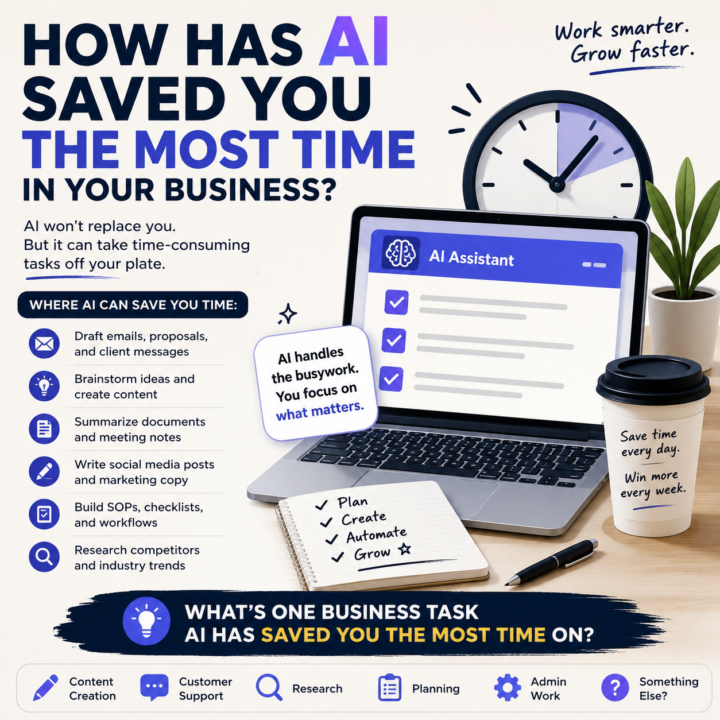
How has AI saved you the most time in your business?
When I first started using AI, I thought it was mainly for writing content. But the more I explored, the more I realized it's like having an extra team member that can help with brainstorming, research, planning, organizing ideas, drafting emails, creating marketing content, analyzing information, and much more. The biggest mistake I see new business owners make is expecting AI to do everything perfectly on the first try. Instead, treat it like a collaborator. Give it context, explain your goals, and refine the conversation. The quality of the output usually improves with the quality of your input. A few ways AI can save time every week: - Draft emails, proposals, and client messages. - Brainstorm content ideas when you're stuck. - Summarize long documents or meeting notes. - Create social media captions and marketing copy. - Build SOPs, checklists, and workflows. - Research competitors or industry trends faster. Even saving 30–60 minutes a day adds up to dozens of hours over the course of a year time you can spend serving customers, improving your products, or growing your business. What's one business task AI has saved you the most time on?
1-30 of 2,510

skool.com/cliefnotes
What we give away free beats most paid courses. Build durable AI systems with a Marine vet and Edinburgh researcher. 40+ lessons, growing.
Leaderboard (30-day)
1

🔥
+1712
2

+1295
3

+1016
4

+978
5

+936
Powered by