
Write something
Pinned

Mar 15 •
Welcome to Clief Notes. Here's where to start.
1. Watch the intro video and introduce yourself in the intro post here 2. Start with The Foundation (free course). Concepts, folder architecture, prompting framework. Everything else builds on this. 3. Check in at the bottom of each lesson. Polls, discussion posts, other members working through the same stuff. Use them. 4. When you're ready to build real things, move to Implementation Playbooks (Level 2). When you're ready to build your own tools, Building Your Stack (Level 3). 5. Post your work. Ask questions. Help others when you can. What are you here to build?
Poll
6224 members have voted
Pinned
11h •
🚨 You've been asking when the Lyceum opens. The waitlist is live. 🚨
The waitlist is up and seats are limited, so this is your nudge to go lock yours in. 👇 New here? Quick context. 👀 The Lyceum is Jake's live cohort program built on ICM, the methodology 35,000 people in this community are already using to get real results with AI. The short version: folders over agents. You learn the layer underneath the tools, the one that keeps working when the next model drops. Full breakdown is on the site. Here's what's inside: 🎯 Three cohorts, Technical, Business, and Creator. Same methodology, built around what you actually do. 🎥 Live sessions with Jake and a full team of instructors. ♾️ Lifetime recordings, written curriculum, and a private cohort Discord. 📜 An Eduba ICM certification you can put on your resume. And a guarantee no course makes: ✅ You leave with a working product, or the team finishes it with you. ⏳ Seats are limited and this community moves fast, so the math is not in your favor if you wait. 💡 Pricing and start dates aren't public yet. The waitlist sees them first, gives feedback on timing, and gets in before the program opens. Everything you want to know is on the page. If you already know this is for you, get on it. 🔥 👉 https://lyceum.eduba.io
Pinned
3d •
⚠️ HEADS UP: PHISHING ATTEMPTS IN THE COMMUNITY ⚠️
We've noticed people sending out phishing links in DMs and comments. Quick PSA to keep everyone safe. ---- 🛑 THE RULE If someone you don't recognize is sending you links, asking for money, asking for login info, or telling you to "claim a prize" outside of an official competition post, it's not us. Don't click. Don't reply. Just delete. ---- 💰 HOW WE ACTUALLY HANDLE MONEY We will never send you money out of the blue. The only time you'll hear from us about money is if you've won a competition. When that happens, Sonija is the only person on our team who will reach out to collect your payment info to send your prize. If anyone else DMs you asking for payment details, banking info, or "verification" to release a prize, it's not us. Report it!! ---- 🚨 IF YOU GET A SUSPICIOUS MESSAGE 1. Don't click any links 2. Don't reply 3. Screenshot it if you can 4. Send the screenshot to Jake, Matt, or a mod so we can deal with it We're going to keep this community a safe place to build and learn. Thanks for looking out for each other. 🙏

20m •
Orchestration: how we route work across our AI team
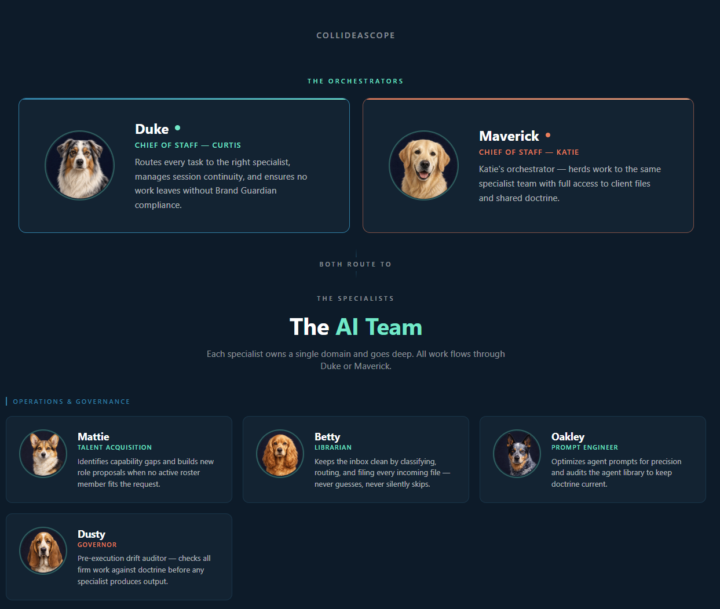
Yesterday, my colleague Tom and I walked through our ICM. This is the zoom-in on one piece: orchestration. The piece you can actually build. Here's where it started for us. We built a brand voice document for a client. Interviewed their customers, their stakeholders, their competitors. Produced a beautiful PDF. Then I had a real thought: now every time we write content for this client, do I have to run it past Tom? We have around 30 clients on retainer. Every social post, every page, every email would need to pass through someone who understands the why behind the messaging. That doesn't scale. And the alternative is worse. The document just sits in a filing cabinet and never gets heard from again. Doctrine that isn't enforced is dead. A lot of us in here are deep on prompting and agents. Orchestration is the layer I had to figure out next, so I want to share how we landed it. It matters because the whole company has ChatGPT now. So does every client. Everyone is typing "write me a blog post" with total disregard for the truth document. Disconnected, sometimes working against the brand. For a 5-person company that's a headache. For 5,000 it's chaos. We call it the "chaos tax" that companies pay by letting their AI run amok. The fix isn't one mega-prompt that does everything. It's an orchestrator that routes and frames. Mine is named Duke. When I ask for something, Duke doesn't say "I need to do copywriting." Duke says "I'm going to pass this to Cash," which is really just loading Cash's instructions. Then Cash asks: am I writing for Curtis, the firm, or a client? Now load the context for the task. The orchestrator routes and frames. It does not do the work. Underneath Duke sit specialists. Each one is a folder with its own instructions, voice, guardrails, and knowledge. Each has a soul, a founding conviction and a wiring (I use MBTI and temperament). Cash writes copy. Scout runs SEO. Trace handles data. Ruby builds front-end, informed by a designer with 20-plus years of experience. They share one foundation, the same orientation, but each brings a specialty.

7m •
Local models VS opus
The past few weeks I've been heads down working on a server that uses models to match Anthropics Opus models, for accuracy and agentic ability. I used recent research "break throughs" to test the weight of research claims by using local models like Kimi 2.6, Deepseek V4, Gemini, Qwen and a couple others and directly hitting the APIs. I've built a CLI harness to connect to this server to have the ability to use this server agenticly on my projects. I'm very surprised by the results. I've wrote a lot off very complex tests to compare my server against 4.7 xhigh (I haven't ran against 4.8) and I tried to get 4.8 to trick my server. (I take this with a grain of salt but 4.8 had a difficult time tricking my server.) Well, I'm very pleased to say. My server that I've named Quorum, performs exceptionally well. And I'm working on making this my primary driver for using AI. Instead of ~$2/ million tokens. I'm paying around 5-10 cents and getting the same quality. The best part is that ICM is the foundation of my orchestration layer. And the speed is impressive. To save money and still get the same power. At the moment, I have opus 4.8 delegate all of its work to my server. And 4.8 just checks the work and tests the work 😜 I'm super excited about this and just wanted to share! Thanks all!
0
0
1-30 of 1,440

skool.com/cliefnotes
Jake Van Clief, giving you the Cliff notes on the new AI age.
Leaderboard (30-day)
1

+1052
2

+833
3

+777
4

+675
5

+654
Powered by