
7h • 🛠️ Show Your Work
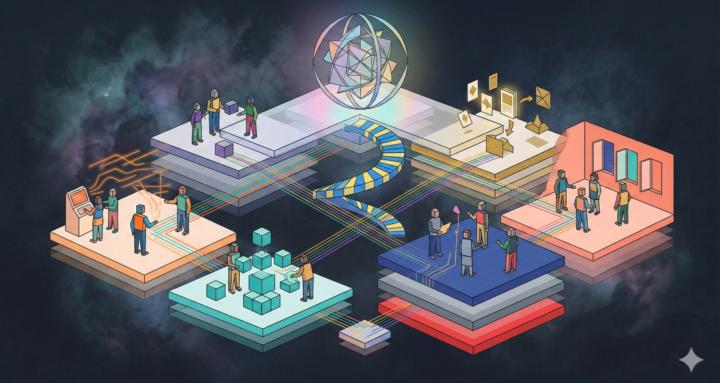
Orchestration: how we route work across our AI team
Yesterday, my colleague Tom and I walked through our ICM. This is the zoom-in on one piece: orchestration. The piece you can actually build.
Here's where it started for us. We built a brand voice document for a client. Interviewed their customers, their stakeholders, their competitors. Produced a beautiful PDF.
Then I had a real thought: now every time we write content for this client, do I have to run it past Tom? We have around 30 clients on retainer. Every social post, every page, every email would need to pass through someone who understands the why behind the messaging. That doesn't scale.
And the alternative is worse. The document just sits in a filing cabinet and never gets heard from again.
Doctrine that isn't enforced is dead.
A lot of us in here are deep on prompting and agents. Orchestration is the layer I had to figure out next, so I want to share how we landed it.
It matters because the whole company has ChatGPT now. So does every client. Everyone is typing "write me a blog post" with total disregard for the truth document. Disconnected, sometimes working against the brand. For a 5-person company that's a headache. For 5,000 it's chaos. We call it the "chaos tax" that companies pay by letting their AI run amok.
The fix isn't one mega-prompt that does everything. It's an orchestrator that routes and frames.
Mine is named Duke. When I ask for something, Duke doesn't say "I need to do copywriting." Duke says "I'm going to pass this to Cash," which is really just loading Cash's instructions. Then Cash asks: am I writing for Curtis, the firm, or a client? Now load the context for the task. The orchestrator routes and frames. It does not do the work.
Underneath Duke sit specialists. Each one is a folder with its own instructions, voice, guardrails, and knowledge. Each has a soul, a founding conviction and a wiring (I use MBTI and temperament). Cash writes copy. Scout runs SEO. Trace handles data. Ruby builds front-end, informed by a designer with 20-plus years of experience. They share one foundation, the same orientation, but each brings a specialty.
Two gates keep it honest.
Discuss gate: before anything gets built, agree on scope, constraints, and success criteria. When I said "write a blog post" once, the system didn't write. It stopped and asked what the product was, the angle, the audience, how we'd know it landed. It refused to build on a vague ask.
Verify gate: a different agent or a human checks the work. No self-grading. Data work like SEO is zeros and ones, easy to confirm. Design and interpretation need human judgment. When a human counterpart corrects a repeatable mistake, that correction gets written back into the agent's files.
Here's the why underneath all of it. The orchestrator is how the belief layer gets enforced at every handoff. Every route, every frame, every gate is a checkpoint asking: does this match what we believe, and what the customer believes?
Tom puts it as the math and the magic. The math is the mechanics, the engines, the schema. The magic is the context and belief layer, what the company and the customer actually believe. A great document in a filing cabinet is useless. A machine that doesn't know what it's amplifying is also useless. Only the combination works. Otherwise, it's mechanics searching for a soul.
If you want to start, don't boil the ocean. Build one orchestrator, one specialist, one verify step. An orchestrator that frames the task, one agent that does it, one check that it's right. That's where I'd begin.
Question for the group: for those building this, where are you putting the human in the loop?
Our AI Roster: https://collideascope.co/team/ai-team-roster.html
9
10 comments
Orchestration: how we route work across our AI team
skool.com/cliefnotes
Jake Van Clief, giving you the Cliff notes on the new AI age.
Leaderboard (30-day)
1

+1073
2

+820
3

+806
4

+669
5

+648
Powered by