
Pinned

👑
⭐
8d •
Welcome to Clief Notes. Here's where to start.
1. Go check out 📚Navigating The Course to see how to get around and what's here. 2. Start with The Foundation. Concepts, folder architecture, prompting framework. Everything else builds on this. 3. Check in at the bottom of each lesson. Polls, discussion posts, other members working through the same stuff. Use them. 4. When you're ready to build real things join in on our Biweekly competitions and win some real cash. ⭐ Competitions Mega Thread 5. If you are wanting to dive into the masterminds, grab all the past templates, artifacts and resources. Upgrade and head into the The Vault for Premium and The Drawing Room (VIP) for VIP 6. Post your work. Ask questions. Help others when you can. What are you here to build?
Pinned
👑
⭐
14h •
🚨 New one in the NLP Logix series is live 🚨
Sat down with Katie Bakewell, a data scientist who's been building this since 2011, back when it was still just called "natural language processing" 🧮 She came up through math (DNA computing, time series on commodities) and thinks about problems like proofs, not recipes. What we get into: 🪨 The Indiana Jones "build me a chatbot" boulder she ran from in 2023 🚨 The 7 neural nets that "found" a signal that was completely fake 🏎️ A $5M Pagani vs a $100 Toyota, and why "best" is a trap 🤖 The first chatbot was built in 1966 (ELIZA)... these aren't new ideas 🐬 Meta's SAM3 turning hours of labeling dolphin fins into a single prompt 🧠 Why half the companies asking for AI are solving the wrong problem ▶️ Go watch 💬 Then drop a comment: What surprised you most, or what would you have asked her? Happy learning 🙌
Pinned
👑
⭐
1d •
🤝 NEW: The Connection Hub is live
👋 Welcome to the Connection Hub - The Vault · Clief Notes So I was on the onboarding call this today, and one thing kept coming up that I couldn't stop thinking about: The biggest value of this new age isn't just the tools. It's the people. 👥 Specifically — people who understand AI the way THIS community teaches it. Not "prompt hacks" and not "10x your output" nonsense, but actually building systems, thinking in workflows, and treating AI like a real part of how you work. That's a rare group. And a lot of you told me the same thing: 💬 "I'd love to work with someone who gets this." 💬 "I want to break into [industry] but don't know anyone in it." 💬 "Who else here does what I do?" So instead of letting those connections happen by accident... I built a place for them. 👇 🗂️👋 Welcome to the Connection Hub - The Vault · Clief Notes It's a simple set of pages, split by industry. You find your corner, drop a quick intro about what you actually do and what you're looking for, and connect with people who speak your language.

1d •
How is everyone approaching Sonnet 5?
Some context: I was chatting with fable, asking about pros and cons of planning for code sessions using chat mode vs plan mode in Claude code. I worked out an entire plan and asked fable to generate the plan based on how Sonnet 5 operates, so it can do its job as best as possible. Reading and iterating over the entire plan, I noticed that fable wrote prompts that included quite a lot of steps per prompt. This surprised me and it made me chat in other chats using fable 5 as well as opus 4.8 (to reduce bias), and they all came to the same conclusion on how to best deal with Sonnet 5. It made me realize that the methodology of following a step by step prompting plan in Claude code may be outdated now that we have Sonnet 5 and I’m starting to think that it may be more worthwhile to work out a detailed plan using chat mode and give that plan in its entirety and the associated commands in larger chunks to Sonnet 5 for execution. Maybe this will save lots of tokens! What do you think? How do you use Sonnet 5?

🔥
1d •
We didn't find Jake by accident
There's something happening in here that I feel like I need to surface. I just cut a short from our conversation with Brian Clark on Bullhorns & Bullseyes. If you don't know Brian, he's the founder of Copyblogger—started it as a one-man site in 2006, before "content marketing" was even a phrase, and it's been called one of the most influential blogs in the world. He didn't invent blogging, but he's about as close as anyone to inventing what blogging became for business. Near the end of the episode, he says... "We're tribal. We can't shake our evolutionary upbringing, where you are attracted to people like you. That used to be based on appearance or geography, and now it's identity. And what is identity? It's a bundle of beliefs." He'd just said belonging is going to be more coveted, not less, as AI floods everything with things we can't tell are real. And the belonging that's left standing isn't geographic. It's not "we live near each other" or "we look alike." It's "we believe the same things." Now, for those of us in this community, we didn't all show up already agreeing on everything, and we didn't converge here because Jake is the guy to follow. We converged because @Jake Van Clief said something true first, and a few thousand of us recognized our own belief in it before we had words for it ourselves. That's how this works—someone has to say it first, most of us here, especially in the beginning, didn't need to be convinced. We were being reminded. This concept isn't new. It takes the same shape as every real reformation does. Belief stops living inside one person or institution and starts living in whoever recognizes it. Jake didn't build a following. He built a mirror, and we all walked up and saw ourselves in it. @Ruben Aguirre already did this in here—put his actual beliefs on the table, not a bio. If you're willing, I'd like to hear yours, too. But I'll go further than that. You've already been doing the belief work if you've built an ICM.
1-30 of 2,399
skool.com/cliefnotes
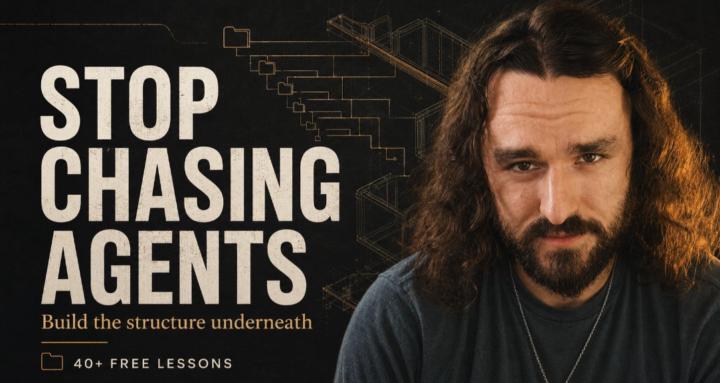
What we give away free beats most paid courses. Build durable AI systems with a Marine vet and Edinburgh researcher. 40+ lessons, growing.
Leaderboard (30-day)
1

🔥
+1713
2

🔥
+1531
3
🔥
+1440
4

+951
5

+864
Powered by