
Pinned

👑
⭐
13d •
Welcome to Clief Notes. Here's where to start.
1. Go check out 📚Navigating The Course to see how to get around and what's here. 2. Start with The Foundation. Concepts, folder architecture, prompting framework. Everything else builds on this. 3. Check in at the bottom of each lesson. Polls, discussion posts, other members working through the same stuff. Use them. 4. When you're ready to build real things join in on our Biweekly competitions and win some real cash. ⭐ Competitions Mega Thread 5. If you are wanting to dive into the masterminds, grab all the past templates, artifacts and resources. Upgrade and head into the The Vault for Premium and The Drawing Room (VIP) for VIP 6. Post your work. Ask questions. Help others when you can. What are you here to build?
Pinned

14h •
❗The Lyceum opens this Thursday: live webinar at 7 PM ET❗
Thursday, July 16 at 7:00 PM ET. Quick version for anyone who hasn't been following: The Lyceum is Eduba's 12-week AI certification program and the first credential we've ever issued. Over 3,000 people are on the waitlist and seats per cohort are limited. What we'll cover in the hour: 01 / The structure. 12 weeks, three sprints, nine live sessions, 18 hours of instruction, 12 instructors per cohort. 02 / The cohorts. Technical, Business, and Creator. Same core curriculum, weighted differently. We'll walk through how to pick yours. 03 / The competition. $250,000+ in prizes across the tiers and how your capstone feeds into it. 04 / The certification. What you have to do to earn it and what it actually certifies. 05 / The investment. What it costs, how payment works, and who should not enroll. Then live Q&A until the questions run out. One more thing. At the end of the session we're doing something for the people actually in the room. It's capped at a small number, it goes in the order people claim it, and we're not putting it in writing. Be there and stay to the end. The session is live only. No recording going out. Thursday · July 16 · 7:00 PM ET skool.com/live/XM7969jTG7L Come with the hard questions. Bring the skeptical ones too. That's what the hour is for.
Pinned
👑
⭐
6d •
🤝 NEW: The Connection Hub is live
👋 Welcome to the Connection Hub - The Vault · Clief Notes So I was on the onboarding call this today, and one thing kept coming up that I couldn't stop thinking about: The biggest value of this new age isn't just the tools. It's the people. 👥 Specifically — people who understand AI the way THIS community teaches it. Not "prompt hacks" and not "10x your output" nonsense, but actually building systems, thinking in workflows, and treating AI like a real part of how you work. That's a rare group. And a lot of you told me the same thing: 💬 "I'd love to work with someone who gets this." 💬 "I want to break into [industry] but don't know anyone in it." 💬 "Who else here does what I do?" So instead of letting those connections happen by accident... I built a place for them. 👇 🗂️👋 Welcome to the Connection Hub - The Vault · Clief Notes It's a simple set of pages, split by industry. You find your corner, drop a quick intro about what you actually do and what you're looking for, and connect with people who speak your language.

16h •
My exact project kickoff — take what's useful, then tell me what I'm missing
How you start a project quietly decides how it ends. So instead of asking what everyone else does, let me put my own method on the table first — take whatever's useful. Here's my kickoff, before I let myself build anything: 1. Brief before build. I open a brief.md and treat it as the one file the whole project has to answer to. Nothing gets built until it's clear on three things: the outcome, who it's for, and what "done" actually looks like. 2. Same skeleton every time. The project drops into the same numbered folder structure I reuse on everything, so I never design the container twice — I just fill it. The shape is familiar before the work even starts. 3. Lock scope before touching tools. I force the scope down to one sentence, and I write the non-goals explicitly — what this is not. That single step is what keeps it from quietly sprawling later. 4. Decide the upkeep on day one. I set how the project stays current from the start, because the mess is never made on day one — it's made on day thirty, when the context has drifted and nobody decided who keeps it honest. 5. The mistake I stopped making. I used to start building before the brief was finished, telling myself I'd write it up after. The build quietly locked in decisions the brief never got to question — and by the time I noticed, they were expensive to undo. That's my version. It works for me — but I know it has blind spots I can't see from the inside. So flip it on me: what would you do differently? Where is this weak, and what am I leaving on the table? 👇

1h •
When I joined the group, I couldn’t tell you what and APIwas
When Bas first added me to this group, I could barely have told you what an API was. I've been mostly quiet since, because I was heads down building something, and I finally get to show you. But the win I want to share isn't the one I thought I'd be writing about. A few weeks in, I was at my kitchen table testing a feature, and my own app wrote something back to me. A little message, the kind it sends to a stylist. I read it and I cried. Me. The person who built the thing. It had just made me feel seen, as a hairstylist, and I wasn't ready for that. I'm a solo hairstylist. That's my actual job. The app is called Rooty, a companion for stylists who are tired of being told the only way to stay booked is to become a full time content creator. I built it between clients over about seven weeks. Here's the part I think this group will appreciate, and it genuinely surprised me: the code was not the hard part. The boring receipts: - 212 commits, about seven weeks, built between appointments - One Python file, roughly 8,000 lines, zero dependencies, just the standard library - 132 tests - Multi-tenant, real logins, running live right now with actual stylists signing up - Claude Code did the heavy lifting on the code, Anthropic's Haiku model runs the AI features - I directed all of it. Every product decision, every word of the voice, every call about what it should and shouldn't do. I'm not a programmer. I'm the person who knew what it needed to feel like. That last line is the whole thing, so let me stay on it. The code, honestly, the AI and I got through together. What I could not outsource, what no prompt handed me, was knowing when a message sounded like a brand instead of a friend. When it was technically fine and emotionally wrong. I felt those the way I feel a bad section in a haircut, right away, in my gut. And I sent them back. So the "it feels like it gets me" that people react to, that came from real decisions: - The captions and replies learn from my actual writing, not a formula. They sound like a person because they're trained on one. - Every AI feature is its own little room with exactly one job. None of them is a general chatbot. A tool that tries to do everything feels like nothing. A tool that does one thing warmly feels like a friend. - And me. I was the reject button. I read hundreds of generated lines and killed every one that rang false.
1-30 of 2,503
skool.com/cliefnotes
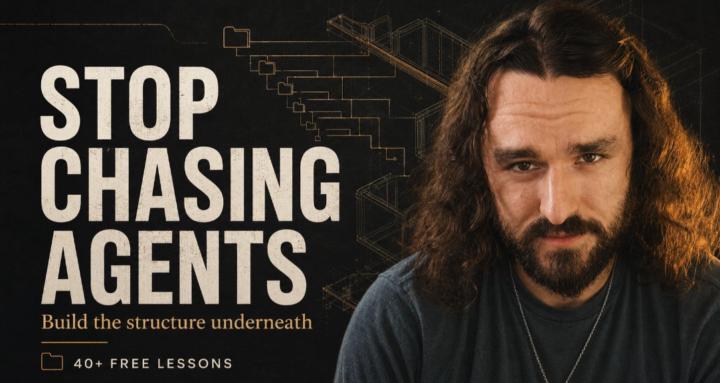
What we give away free beats most paid courses. Build durable AI systems with a Marine vet and Edinburgh researcher. 40+ lessons, growing.
Leaderboard (30-day)
1

🔥
+1707
2

+1308
3

+1011
4

+990
5

+935
Powered by