
Pinned

👑
⭐
13d •
Welcome to Clief Notes. Here's where to start.
1. Go check out 📚Navigating The Course to see how to get around and what's here. 2. Start with The Foundation. Concepts, folder architecture, prompting framework. Everything else builds on this. 3. Check in at the bottom of each lesson. Polls, discussion posts, other members working through the same stuff. Use them. 4. When you're ready to build real things join in on our Biweekly competitions and win some real cash. ⭐ Competitions Mega Thread 5. If you are wanting to dive into the masterminds, grab all the past templates, artifacts and resources. Upgrade and head into the The Vault for Premium and The Drawing Room (VIP) for VIP 6. Post your work. Ask questions. Help others when you can. What are you here to build?
Pinned
👑
⭐
5d •
🚨 New one in the NLP Logix series is live 🚨
Sat down with Katie Bakewell, a data scientist who's been building this since 2011, back when it was still just called "natural language processing" 🧮 She came up through math (DNA computing, time series on commodities) and thinks about problems like proofs, not recipes. What we get into: 🪨 The Indiana Jones "build me a chatbot" boulder she ran from in 2023 🚨 The 7 neural nets that "found" a signal that was completely fake 🏎️ A $5M Pagani vs a $100 Toyota, and why "best" is a trap 🤖 The first chatbot was built in 1966 (ELIZA)... these aren't new ideas 🐬 Meta's SAM3 turning hours of labeling dolphin fins into a single prompt 🧠 Why half the companies asking for AI are solving the wrong problem ▶️ Go watch 💬 Then drop a comment: What surprised you most, or what would you have asked her? Happy learning 🙌
Pinned
👑
⭐
6d •
🤝 NEW: The Connection Hub is live
👋 Welcome to the Connection Hub - The Vault · Clief Notes So I was on the onboarding call this today, and one thing kept coming up that I couldn't stop thinking about: The biggest value of this new age isn't just the tools. It's the people. 👥 Specifically — people who understand AI the way THIS community teaches it. Not "prompt hacks" and not "10x your output" nonsense, but actually building systems, thinking in workflows, and treating AI like a real part of how you work. That's a rare group. And a lot of you told me the same thing: 💬 "I'd love to work with someone who gets this." 💬 "I want to break into [industry] but don't know anyone in it." 💬 "Who else here does what I do?" So instead of letting those connections happen by accident... I built a place for them. 👇 🗂️👋 Welcome to the Connection Hub - The Vault · Clief Notes It's a simple set of pages, split by industry. You find your corner, drop a quick intro about what you actually do and what you're looking for, and connect with people who speak your language.

2h •
Beware of the Illusion
AI can make you think your smarter and more knowledgeable than you really are. The base phenomenon Psychologist Frank Keil found people rate their understanding of how things work (toilets, zippers, engines) much higher than they actually can explain — until you ask them to explain it step by step, and the confidence collapses. Fluent exposure to an explanation gets mistaken for possessing the explanation yourself. What AI adds on top 1. Fluency as a proxy for truth/competence. When output reads clean, structured, and confident, your brain uses “this is easy to follow” as a stand-in for “I understand this.” AI text is optimized for exactly that fluency, so the proxy misfires more than it does with a messy textbook or a mumbling human expert. 2. Co-authorship inflation. You typed the prompts, made choices, steered the direction — so you feel ownership over the output the same way you’d feel ownership over code you wrote. But steering isn’t the same as generating the underlying logic. You built the map; the AI built the terrain. 3. No friction, no failure signal. Normally, hitting the edge of your understanding feels like friction — you get stuck, you have to look something up, you notice the gap. AI smooths that friction away by answering immediately, so the gap never announces itself. You only find it later, when something breaks or someone asks you to defend a step. 4. Automation bias. Once a system has been right a few times, you extend it trust it hasn’t earned on the next output, especially in domains (like algorithmic finance) where verifying correctness is itself hard. 5. The practical tell, If you can use the model and get the right answer but can’t predict when it’ll be wrong or explain a step to someone else without the AI’s help — that’s the gap between “I operated it” and “I understand it.” Not a character flaw, just how fluency-based confidence works. The fix isn’t “understand everything.” It’s knowing which parts of the map you’re taking on faith vs. which parts you could rebuild from scratch. If you find what your working on leads to this, —pick the 2-3 load-bearing assumptions and force yourself to derive them without the AI, even roughly. That’s usually enough to convert vibes-confidence into real confidence, or to find out it doesn’t hold up.
👑
⭐
Mar 2 •
Who's here? Drop your intro.
Tell us three things: 1. What you do (job, industry, student, career-changer, whatever) 2. What brought you to Clief Notes 3. One thing you're trying to figure out right now related to computing or AI I'll respond to every single one. And read each other's intros too because the person who's stuck on the same problem as you might already be in this thread. I'll go first I am Jake, I have been working in tech for 15 Years, building with Generative AI for 3 Years straight now! Excited to teach and learn! That's it. Simple, scannable, gives you data on who's joining and what they need, and keeps the feed clear for content that retains people past week one.
1-30 of 2,488
skool.com/cliefnotes
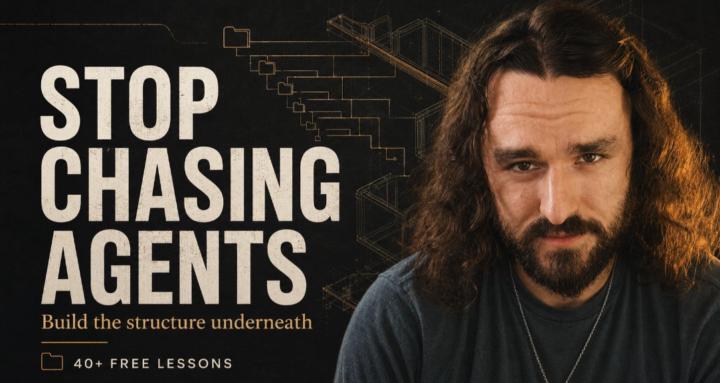
What we give away free beats most paid courses. Build durable AI systems with a Marine vet and Edinburgh researcher. 40+ lessons, growing.
Leaderboard (30-day)
1

🔥
+1707
2

+1436
3

+1069
4

+987
5

+964
Powered by