
Write something

7d •
The rubric trick: how to make ChatGPT grade its own work and fix it
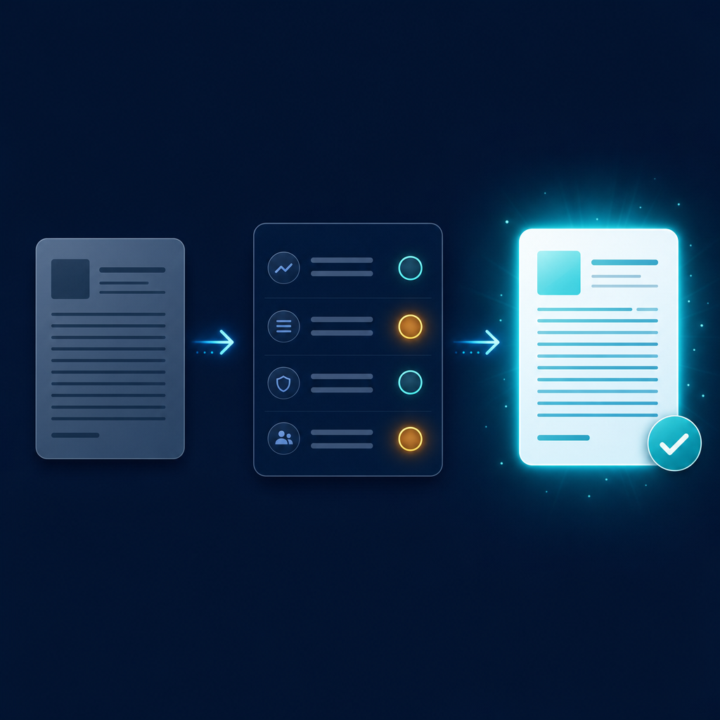
Most people accept ChatGPT's first answer, tweak it a bit, and move on. The single biggest upgrade you can make is to stop treating the first draft as the answer and start treating it as something to be marked. Here's the move. You give ChatGPT the task, then you hand it a rubric, the same criteria you'd use to judge the work yourself, and you make it score its own draft against that rubric before you ever see it. Then it rewrites to fix its lowest scores. Say you're writing a cold email. Most people prompt: "Write a cold email to a marketing director offering our service." You get something generic. Instead, try this: "Write a cold outreach email to a marketing director. Then score your own draft from 1 to 10 on each of these: 1) does the first line earn the second, 2) is it about them not us, 3) is there one clear ask, 4) would a busy person read it in under 15 seconds. Show the scores, then rewrite to fix anything under 8." Now you're not hoping for a good email. You've told it what good looks like and made it run the editing pass you'd normally do yourself. Two things make this work. First, the rubric is where your expertise goes. You know what a good email, landing page, or proposal needs, so you encode it once. The model is far better at applying a clear standard than inventing one. Second, asking for scores forces it to actually evaluate instead of just rephrasing, and it will usually catch its own weakest spot before you have to. Save your favourite rubrics and reuse them. A good-email rubric, a good blog-intro rubric, a sales-call-summary rubric. Over time that's a quiet quality system running on every task. What's a task you'd want a rubric for? Tell me the task in the comments and I'll help you build the criteria.

25d •
Epic Crystal Sphere Logo Transformation Prompt
Use the uploaded logo as the exact visual reference. Preserve its original silhouette, geometry, proportions, spacing, symbols, and identity with absolute accuracy. Transform it into an epic, hyper-realistic masterpiece: a luminous, precision-crafted brand artifact suspended inside a monumental multi-faceted optical crystal sphere, glowing with **[PRIMARY COLOR]** and subtle **[ACCENT COLOR]** energy. Place it on a premium dark titanium and polished obsidian pedestal inside a cinematic luxury environment. Use physically accurate crystal refractions, spectral highlights, realistic caustics, microscopic particles, controlled volumetric light, deep shadows, premium reflections, and dramatic studio lighting. Capture it with an 85mm macro lens, slightly low angle, shallow depth of field, razor-sharp logo focus, and high-budget commercial composition. Ultra-photorealistic, 8K, museum-quality, Octane/V-Ray/Redshift-level rendering, pristine materials, powerful atmosphere, refined contrast, and flawless cinematic polish. Do not redesign, distort, crop, mirror, duplicate, simplify, obscure, or replace the logo. No text, captions, watermarks, extra logos, visual clutter, cheap neon, excessive bloom, or cartoon styling. The uploaded logo must remain the sole hero and brightest point of attention.

May 21 •
How to get ChatGPT to interview you before it answers
Most prompting advice tells you to write the perfect instruction up front. For everyday business tasks, I think that's backwards. You're guessing at what matters before you've really thought it through, and you end up with a vague answer because you handed it a vague brief. Here's a simpler move: tell ChatGPT to interview you first. Instead of asking for the finished thing, add one line to your prompt: "Before you answer, ask me up to five questions that would help you give a better response." Now ChatGPT does the hard part. It surfaces the gaps: who the audience is, what the goal is, what tone you want, what you've already tried. Then you just answer in plain language. The final output gets built on real context instead of assumptions. This works best on the messy, higher-stakes stuff: a sales email, an awkward client reply, pricing for a new offer, a job description. Anything where the quality depends on details only you know. Two tips. Cap the questions. Five is plenty, or it spirals. And if a question doesn't matter, just say "skip that one." You're steering, not filling in a form. It feels slower for about ten seconds. Then the answer comes back sharper than anything a one-shot prompt would have produced. What's the last thing you asked ChatGPT for that came back generic? That's exactly the kind of task to try this on. Drop it below. Jason 🙌


Mar 7 •
Prompt Generator v2
I made some observations about @Bret Littlefield’s original prompt generator, definitely not for criticism (🤗), but for clarity of objective and improvement in outcome. Importantly, the original prompt did not force the model to diagnose ambiguity before writing, and it invites endless iteration instead of quickly aiming for a high-quality prompt. Interestingly, it also did not require the model to optimise for a defined outcome. So, over a few iterations, I reengineered the prompt using Anthropic’s and Google’s guidance on context engineering versus prompt engineering (see attachment - it’s in markdown format, which is easier for the models to process). Thank you @Bret Littlefield for the original promoter generator. 😊

Feb 26 •
3D video clip PROMPTS
Is there anyone who could tell me how to make a 3D prompt for 3D video clips like this: breakoutclips.com ?

1-30 of 204

skool.com/chatgpt
A home for entrepreneurs who use ChatGPT to discuss, discover, and connect with others using this incredible AI technology. ⭐️ Invite your friends ⭐️
Leaderboard (30-day)
1

+33
2

+22
3

+20
4

+17
5

🔥
+16
Powered by