Activity
Mon
Wed
Fri
Sun
Nov
Dec
Jan
Feb
Mar
Apr
May
Jun
Jul
Aug
Sep
Oct
What is this?
Less
More
Sawinery Woodworking Guild
2.2k
Free
383 contributions to Sawinery Woodworking Guild

Jul 5 •
Refinish Victrola
Purchased a Victrola , very early 1900’s. Its top is a bit wavy. Does anyone know a good book to tell me how to refinish the top and also to give the cabinet a deep gloss look so it all comes out like the 14th coat of hand rubbed lacquer on a finely finished Jaguar. It’s dark mahogany

0 likes • Jul 6
I've never seen a book like that. From what you say, that sounds like the top is veneered and the waviness is in the veneer itself. I've seen that happen on old furniture, like dresser tops and small tables. When I have, what I've done is to peel off the old veneer and apply new veneer. The problem with that is finding good quality veneer. I'm not saying that's the right way or even the best way to do it, that's just how I do it. As for the finish, if you want a really high-gloss finish, then you should probably wax it. You can either do that directly on the wood surface, or over a few coats of hand-rubbed varnish. The big advantage of a wax finish is that you can buff it, like waxing your car, bringing out the gloss.
Jul 4 •
Wood Movement
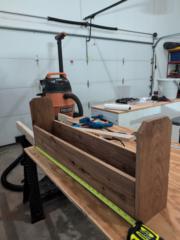
Not that kind, everybody tells us about wood changing shape and size. I'm talking about picking it up and carrying it. No one talks about that, unless it's plywood. But plywood moves one sheet at muscle-straining, finger-crushing, toe-breaking time. But boards, if there is a glue up, you're moving at least two at the same time. How do you handle it? Carry one board at a time, or picking up a whole, maximum carry load?
1 like • Jul 6
I tend to move them one board at a time. There's nobody in my workshop I need to impress with how strong I am, so there's no sense in straining my muscles, just to move wood. Of course, once I've got it glued together, I have no choice but to move it all at once. Moving them one board at a time also gives me the opportunity to inspect each board, especially the edge. Sometimes, cutting them to width leaves saw blade marks, which show up as gaps once it's glued up. So, I always check for that, looking to see if I'll need to plane the edges (I do my jointing with a jointer plane, not a power jointer).

Jun 13 •
Folding workbench
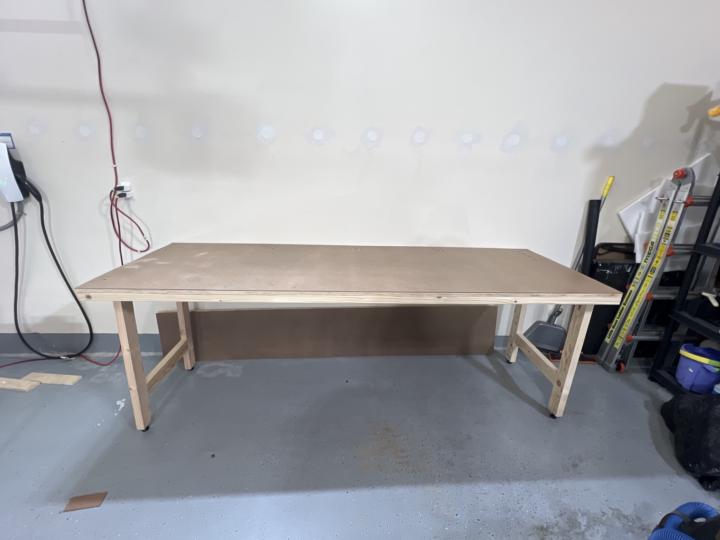
Made this to use a part of the garage. Used an h frame for the folding legs. Now looking at how to lock them folded. Found some strong magnets on Amazon and gonna give it a shot. Does anyone have any other suggestions?
0 likes • Jun 22
I would do some sort of a cam design, like Tracy mentioned.

Apr 30 •
Need help — I’m destroying my cutting board
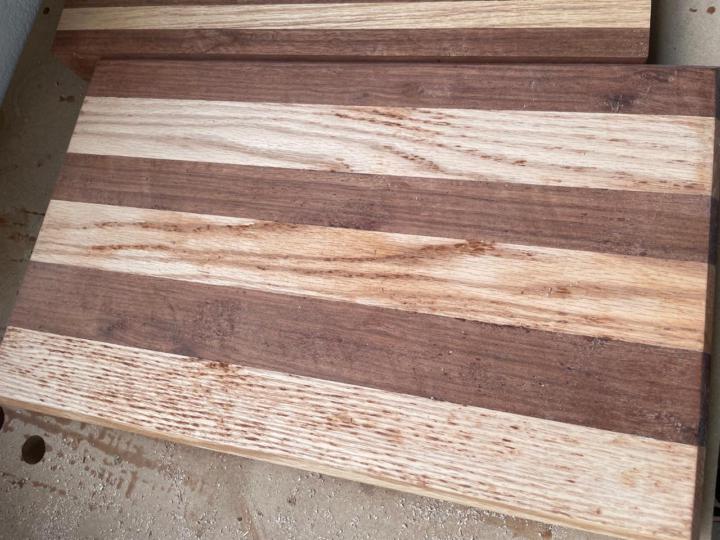
Hello everyone, this is Rani. I’m still in my first year of woodworking. I made a cutting board and I ran into two problems: 1- While planing it, I realized I can’t use my hand planer in both directions. Some parts of the wood got chipped out, and I think it’s because I glued the strips in opposite grain directions. So if I go one way, I ruin the adjacent strip. 2- I used a router and guided it with a piece of wood to make a shallow groove around the frame, but it didn’t come out straight. Then when I tried going slower, I ended up cutting too deep in some spots. Any advice would really help, thank you
0 likes • May 15
Ouch! Looks like you're having a bad day. 1 - It's not unusual to have grain mismatch, going in opposite directions, when doing a glue-up. Unless you really pay attention, that's likely to happen. Even if you try, you could still end up with spots where the waviness in the grain causes you problems. The solution is to plane across the grain, at about a 45-degree angle. You'll need a really sharp hand plane to do that and to take the thinnest shavings you can, but that's the best solution to your problem. 2 - There are several things here. First, it looks like you've tried to make that juice groove really close to the edge of your cutting board and used a router bit that's leaving a square bottom. Juice grooves are usually more rounded. At this point, you're probably going to have to cut off the bad juice groove, making the board smaller. But at least you'll be able to salvage it. You said you're using a board to help you make a straight line. What most people do is to make or buy an adjustable-size frame, called a "juice groove jig." Do a quick Google search and you'll find both commercial ones and pictures of DIY ones. That will give you straight lines all around. But even with that, make sure that you hold your router's base firmly up against the jig, as it might want to wander away. I'd also recommend buying a different router bit. There are bits made just for juice grooves. But if you want to save money, you can buy a set of bullnose router bits and pick the appropriate size. Even cheaper is to buy a set of bowl-making router bits and use the smallest size.

May 13 •
Woodworking folly
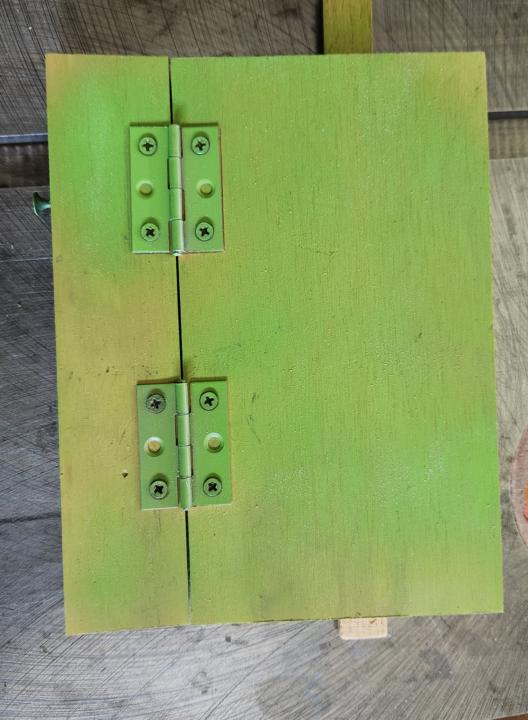
I made this jig some months ago thinking it would be very helpful. But now months later, I cannot remember why I made it or how to use it. It looks clever enough to have come from Sawinery. I welcome a reference, a link. Or general advice. Many thanks.
0 likes • May 15
David, that's a homemade thin rip gauge, from a short I recorded about two years ago.
1-10 of 383

@rich-murphy-2953
Rich is a second-generation woodworker, "making sawdust" in his dad’s workshop, 50 years ago. Through the years he's been an engineer and writer.
Active 3d ago
Joined Feb 1, 2024
Mathis, TX
Powered by