Activity
Mon
Wed
Fri
Sun
Sep
Oct
Nov
Dec
Jan
Feb
Mar
Apr
May
Jun
Jul
Aug
What is this?
Less
More
Memberships
Welcome Home
76 members • Free
The Entrepreneur Village
390 members • $1/year
WavyWorld
50.3k members • Free
GC
Growthworks Community
24k members • Free
✨ Digital Boss Hub ✨
1k members • $3/month
Diva Network
477 members • Free
Magnetic Memberships
4k members • Free
Non-Fiction Author Lab
1k members • Free
157 contributions to Non-Fiction Author Lab

Aug '25 •
📚 Choosing a book title
I’ve seen some great conversations about titles this week, and it got me thinking, for those of you further along in your publishing journey, how did you land on your title? Did it come to you early and stick, or was it a long process of testing and tweaking? For those still brainstorming, what’s been your biggest struggle so far in finding the ‘right’ one?


5 likes • Aug '25
Great subject, @Kate Duncan! So, here's a cautionary tale: Do NOT do what I did -- use the title of your published poem as the title of the book... too literary, to vague, and while it makes sense as the theme of the book it does not make sense as a way to sell the book. And it's not like my editor didn't try to talk me out of it! So, cautionary tale #2: listen to your editor; s/he'll always have important insights you should consider. In my defense, I was a marketing baby back then. Didn't have the faintest clue. I was fresh out of my MFA and really needed to be thinking like an MBA instead. 🤣

Aug '25 •
Thank you to the July Winners
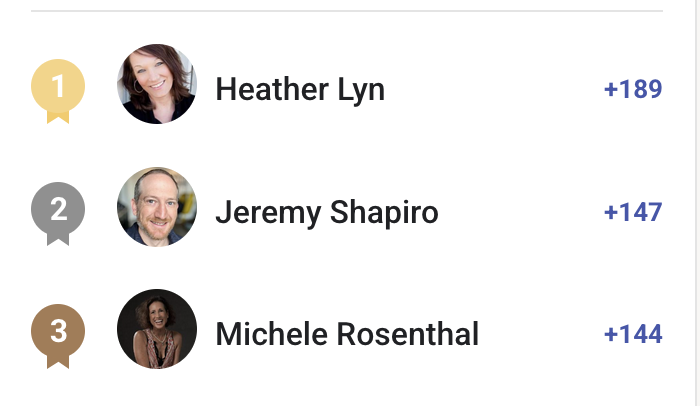
And in a complete repeat from June ... our top three contributors for the month are Heather, Jeremy and Michele. :) Thank you for all your contributions. This month we're going to do something different for prizes. Please email @Angela Jones at team@booklaunchers.com with a 3D image of your book and a short blurb (like 20 words or less) on what the book is about and who should read it with your preferred link for people to purchase it. We are going to put together a little promo graphic for each of you that we will post here and in a YouTube video in the near future. :) Thank you for making this community special!
1 like • Aug '25
woot, woot! thank you so much, @Julie Broad & Team! Had to step back a bit to meet a deadline but excited to return to the BL tribe now.... xoxo
2 likes • Jul '25
How does Monday roll around again so fast!?! I've started revising the early chapters. Now that I've got the main ideas down, fleshing out with extended research, adding in some more nuanced content. So the first draft of half the book is done and before I keep going with new content I'm reviewing what I've got to make sure I straighten out the track, stay on message, deepen the insights, and solve the problem at the most meaningful core level. Which is to say: this week's goal is revising chapter 1!
Jul '25 •
Which email marketing platform do you use -- and why?
I'm getting ready to exponentially grow my email list, so I'm revisiting the tech I want to use. In the past I've used Aweber and MailChimp. Now, I'm looking at Kit.... What are you all using? Plus, why did you choose it, how do you like it, and why do you think it's the best to serve your needs? @Julie Broad, if you're willing to share, I'd would love to hear why you chose Kit over ActiveCampaign and the others mentioned above.

1 like • Jul '25
@Cynthia Moore There's a Kit event tomorrow (Tuesday) you might find interesting: https://partners.kit.com/julie-workshop
1 like • Jul '25
@Katrina Schroeder Yeah, MC has a lot more now but it still feels clunky to me. My favorite was Aweber back in 2009-16. I'm getting up to speed on Kit. I like the platform better than MC already, just the vibe itself is better. I know that sounds weird, but Kit has better energy, lol.
Jun '25 •
Part 1: LLMs vs. Google (stats, data, & what you can do)
@Julie Broad has mentioned the rise of LLM impact on Google/SERPS several times in the past couple of weeks. Great recent article in EMARKETER puts the general idea into bold relief: To fully understand the impact of what's happening -- and why Julie's suggestion to focus (more) on how to get AI to notice you rather than Google -- take a look at these stats... --Google’s AI Overviews and instant answers are reducing click-through rates (CTRs) by 34.5% (Ahrefs). --Wikipedia, which relies on Google for referral traffic, has seen a drop of 20 million visitors in the past 18 months (Comscore). --Global visits to the top 100 web domains fell nearly 7% from March 2022 to March 2025 (Semrush). --Google’s traffic is down 6.4% (Similarweb). The bottomline: "AI-native discovery is killing traditional funnels." What does this really mean? For one thing, informative and educational brand-evocative content (optimized for long-term relevance) that creates human connections through your ICP's language becomes even more key for marketing success -- especially when you design it to be easily understood and processed by AI algorithms. For another, a big trend is coming in which marketers will shift away from optimizing static content for Google. Instead, they'll begin creating brand experiences that target customers in their local geographic locations. Quick summary: Since AI can do so much more than Google, e.g. analyze search trends, user intent, and location data, it can deliver more highly targeted and relevant search results (e.g. location-specific) -- that no one has to click through ten sites to fully grasp. We're about to shift from prioritizing SEO (Search Engine Optimization, i.e. get ranked for relevant keywords) to prioritizing GEO (Generative Engine Optimization, i.e. get 'ranked' for relevant keywords easily understood by AI). Specifically, this means creating content to intentionally expand the likelihood of its recognition by AI-driven search engines, and in conversational AI responses.

1 like • Jul '25
@Heather Lyn Well, if Neil posted about it, it must be significant!
1 like • Jul '25
@Heather Lyn 100%, for SURE! He's so cute and earnest in everything he does.
1-10 of 157
@michele-rosenthal-4318
Trauma Recovery Specialist, CPC, CHt, MNLP. | Award-winning blogger + Award-nominated author. | Serial entrepreneur and marketing junkie.
Active 171d ago
Joined Apr 4, 2025
Powered by