Activity
Mon
Wed
Fri
Sun
Aug
Sep
Oct
Nov
Dec
Jan
Feb
Mar
Apr
May
Jun
What is this?
Less
More
Memberships
Aegis Nutrition Academy
1k members • Free
DDT Method
201 members • $10/m
Castore: Built to Adapt
1.1k members • Free
105 contributions to Castore: Built to Adapt

2 likes • 2d
@Zach Bivens seems like you got some great options. In another SKOOL group I’m in they introduced yet another one which I have found to be the best price and I used it myself and it was just like any other service. They use quest or lab corp https://dirtcheaplabs.com/

20d •
Exogenous Ketones
I have been reading more about exogenous ketones and their potential role during a fat-loss phase, particularly around energy availability, training performance, and appetite management. For those who have used them successfully, when do you find they provide the most benefit? Pre-workout, during fasting periods, between meals, or at another strategic time? I am especially interested in whether you have found them more useful for performance, adherence, or actually improving body composition outcomes.
2 likes • 20d
I started taking them fasted in the am when I was pulling myself out of chronic fatigue and it certainly helped. Now I’m working on a growth phase and I’m using them in the AM fasted and right before bed. All my sleep scores improved when I did this and I find it helps me stay asleep through the night
22d •
🎉 We're officially open — and your first gift is on the house
Hey everyone — the community is live, and I'm kicking it off with something free for everyone: two expert webinars now, a third on Monday. Here's how to watch, what's inside, and how to join us. ▶️ Watch the free webinars — free for everyone through Friday, June 19 Leonard Pastrana and Dr. Dean St Mart are open to all right now. I've extended the free window through Friday, June 19 so anyone who couldn't catch them live still gets the full sessions — no rush, no FOMO. After Friday they move into the members' area. 1. Click Classroom up top. 2. Open "Expert Series: Leonard Pastrana" or "Dr Dean St Mart." 3. Click the lesson title on the left to open the post. 4. Click the share.descript.com link near the top — the video plays with the full transcript beside it. 5. Not loading? Tap the link, then Open in browser (Chrome/Safari). Fixed. 👍 🗓️ Monday: my brand-new Coach's Protocol webinar — also free for everyone through Friday, June 19, then it becomes a monthly members' feature with the full archive. Don't miss the free window. ⏳ Here's the thing: after Friday these live in the members' area — and there's a new expert interview + Coach's Protocol every single month. If you want to keep watching, now's the moment to join. 🔬 Start here: Biochemical Fluency (the one that flew under the radar — don't sleep on it) Ever felt lost when people throw around AMPK, mTOR, Nrf2, redox? This is the course that fixes that for good. The idea: you're not bad at science — you were just never given the map. This is the map. An 8-week program that teaches you to think in mechanisms, not memorize facts: • Wk 1–2: the cell's operating system + decoding any term from its name • Wk 3–4: energy currencies, redox, and mitochondria up close • Wk 5: the master switches — AMPK ⇄ mTOR, Nrf2 ⇄ NF-kB, HIF-1α + PGC-1α • Wk 6–7: inflammation, repair, and reading any intervention or claim like a pro • Wk 8: capstone — the whole map on one page Every week ends with a Fluency Lab, worksheets, and Quizlet flashcards so it sticks. By the end you'll follow — and join — conversations that used to go over your head.
2 likes • 21d
@Anthony Castore @Jessica Pierce on the membership if you click join for $49/mos the next window will give the annual option for $399 which is $33/mos.
May 28 •
Your Testosterone Isn’t Low. Your Cells Are Out of Power.
The guy sitting across from me usually does not say, “My mitochondria are exhausted.” He says he cannot get moving in the morning. He says the weight feels heavier than it should. He says he sleeps eight hours and still wakes up like somebody pulled the battery out of him overnight. Then he tells me his testosterone is low, like we have already found the villain, like the lab number finally gave a name to the thing he has been feeling for the last five years. I get why he says it that way. Testosterone is tangible. It has a number. It has clinics, podcasts, ads, syringes, patches, gels, before and after photos, and a whole cultural mythology wrapped around it. Mitochondria do not have that kind of marketing department. They just sit there inside the cell, making energy, managing stress, shaping signaling, deciding whether the body has enough capacity to build, repair, reproduce, and perform. That last word matters. Perform. The body does not hand out reproductive horsepower when it thinks the factory floor is on fire. Testosterone is made in the Leydig cells of the testes, and those Leydig cells are not floating around with a magic hormone button inside them. They are living cells. They have membranes. They have enzymes. They have mitochondria. The early steroidogenic step, where cholesterol is moved and converted into pregnenolone through the StAR protein and CYP11A1 system, lives right at the mitochondrial level. That step requires energy. It requires a clean transfer of electrons. It requires NADPH. It requires redox conditions that let the cell do precision work instead of emergency work. So when a man says, “My testosterone is low,” I hear a second question underneath it. Can the cell afford to make testosterone right now? Because that is the question biology is asking. Not whether the man wants to feel more driven. Not whether he misses his morning erections. Not whether he wants to squat what he squatted at 27. Biology is colder than that. Biology looks at available energy, oxidative stress, inflammatory tone, sleep architecture, nutrient density, circadian input, thyroid signaling, insulin dynamics, and recovery debt. Then it decides how much building, repairing, and reproducing the system can afford.
1 like • May 28
Thank you Anthony this is such a great post. This is incredibly applicable to female hormones as well - that cellular capability question could be asked for so many deficiencies 🤔
May 22 •
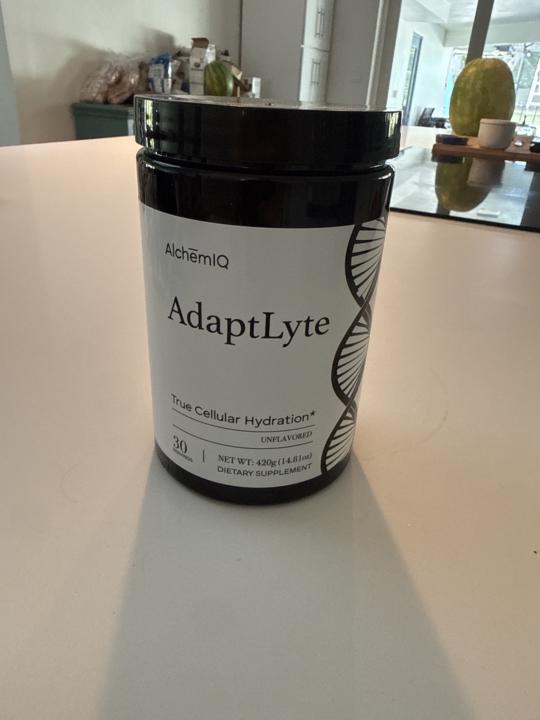
AdaptLyte - honest review
I consider myself a supplement connoisseur, meaning I have pretty much tried it ALL. Honestly most of it isn’t in my rotation anymore because I didn’t see the return. I ordered AdaptLyte when I first heard about it from @Anthony Castore. I figured it would be just another good electrolyte I took 1 scoop in my water the morning after I received it. I had a jam packed morning of work and a gym session. I was on fire all day- thinking faster, moving better, feeling lighter. I chalked it up just a good day, not the drink powder. Next day I forgot my scoop. I felt heavier, I developed a mid day headache which is common when I have a stressful morning and just not as great of a day. Morning 3 I remembered my scoop and now I see this isn’t just placebo anymore. I had another epic day. I recommend this for literally anyone. My cells are more functional and the downstream is really enjoyable.
2 likes • May 22
@Kyle McDonald love to hear your feedback. I really didn’t want to hype it up too much but honestly I really noticed a change. Hope you love it too
2 likes • May 24
@Christine Heartsill I mix it with my electrolytes which makes the flavor quite palatable for me. That said, my taste buds are different. I even like ketones now 🤷🏻♀️
1-10 of 105
@leelan-sala-8493
CPT specializing in kiddos on the spectrum. Dog and animal lover.
Active 2d ago
Joined Aug 1, 2025
Tampa Fl
Powered by