Activity
Mon
Wed
Fri
Sun
Aug
Sep
Oct
Nov
Dec
Jan
Feb
Mar
Apr
May
Jun
What is this?
Less
More
Owned by Holly
Your health journey begins with your identity in Christ. Helping women align their faith into fitness, nutrition, and daily life without guilt or fads
Memberships
Grow2GetherCoaching
13 members • $10/month
Skool Growth Free Training Hub
8.6k members • Free
Rooted
8 members • Free
Proverbs 31 Women
245 members • Free
TH
The Holy Reset
9 members • Free
Skoolers
167.5k members • Free
123 contributions to Selah Wellness

2d •
Intentionality Calendar Exercise
📝 Look at your calendar for the next 30 days. Write down all the commitments that are non negotiables and add them to the calender. Now write down all the things you want to be intentional about doing, (example: family camping trip, icecream date, outdoor movie night) and mark that down. Now think about all the things that could, might, or will come up over the summer that you DON'T want to commit to. Write these on a separate piece of paper and be specific and include everything! You now have a summer of intention and a summer "No-no" list to remind you to set boundaries around a simple summer. Share below: After this exercise, how do you feel in your body about your summer calendar and your "no-no" list?
1
0


0 likes • 23d
@Crystal Charbonneau thank you so much for your prayers! I definitely have felt them this week. 💜💜
1 like • 2d
@Crystal Charbonneau CONGRATULATIONS!!! 🥰 🎊✨️ What a big accomplishment to read through the book of Genesis! It's so good to hear that you have found the SOAP method helpful and that you're applying it to your study. And its okay to go slower if you need to. Don't be discouraged, you’re not behind. God is showing you so much through His word and its evident from the stories that you mentioned. I love the part where you said it was very soap operaish 😆😆 It totally is and I think that what I find so interesting about the Bible. Once you dig into it, there is every genre in there. Murder, betrayal, restoration, romance, love, history, poetry. It's such a powerful book! I'm proud of you and I can hear your love for God's word in your words Crystal. Keep going, it only gets better!

3d •
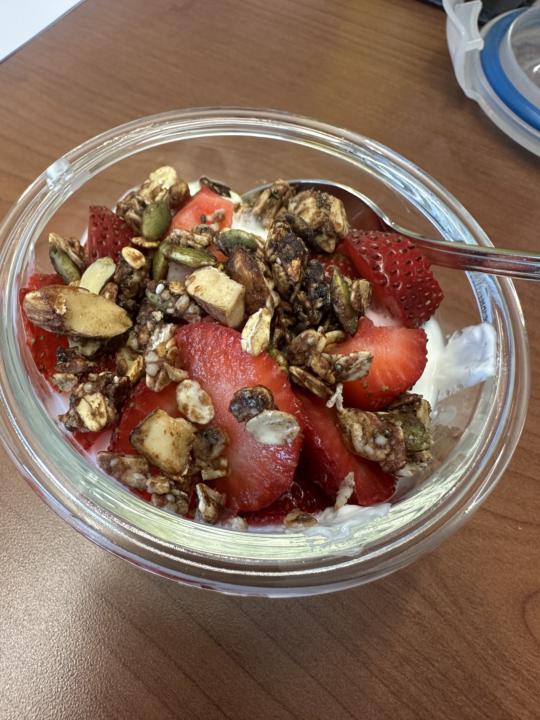
My fave breakfast
I’m always looking for different ideas for breakfast and snacks (meals in genera). So I thought I would share my favourite breakfast. It’s so good it could even be classified as a dessert. Oikos 0% Greek yogurt, sliced strawberries, and bird & Co. PB and chocolate granola And 2 hardboiled eggs
1 like • 3d
Strawberries and granola! Delicious! Love that you add in eggs for your protein. 😉 Thanks for sharing @Lindsay Clausen
6d •
Dig Into Your Bible To Find Your July Verse
Welcome to our July theme: A Simple Summer! If you haven't yet had a chance, feel free to scroll down to find our monthly coaching call where we dive into everything that we'll cover this month. The goal is to slow down and take the summer in. Not with a FOMO attitude or feeling the need to cram it all in, but rather listening to the call of Jesus to rest and be still. On our call, Lindsay had a wonderful idea to find a scripture that resonated with her about slowing down and rest. Because I love this idea so much, I thought we'd open it up to the group! What is a verse that resonates with you about rest and creating simplicity in your life? Share your verse with us in the comments! As we move into July, let your verse be your foundation. Meditate on it every day. Let it guide you in the little and big decisions you make each day. Let's have a Simple Summer!!

0 likes • 3d
@Mandy Watters this is powerful! I think this is why so many women struggle with this verse. We think "Lord, how am I supposed to be still when theres laundry, dirty dishes in the sink, and a garden full of weeds?!" Its not a physical posture, rather a heart posture. The fact that you meditated on this, which caused you to dig deeper makes me so happy. You ladies are all really digging into the word and it makes Jesus so pleased. Thank you for sharing my friend. I needed this reminder too. 💜
25d •
Your Workout Isn't the Whole Story
Most people think their metabolism is determined by their workouts. But exercise is only one piece of the puzzle. One of the biggest contributors to daily energy expenditure is something called NEAT (Non-Exercise Activity Thermogenesis). NEAT includes all the calories you burn through movement that isn't intentional exercise: ✔ Walking around the house ✔ Cleaning ✔ Grocery shopping ✔ Taking the stairs ✔ Standing instead of sitting ✔ Fidgeting ✔ Playing with your kids In fact, for many people, NEAT contributes more to total daily calorie expenditure than a single workout. This is why we don't support our metabolism through one workout alone. We support it through consistent movement throughout the entire day. A 45-minute workout is great. But if you spend the other 15 hours awake sitting, your overall daily energy expenditure will be much lower than someone who moves frequently throughout the day. So here's a question: What is one way you could increase your NEAT today without adding another workout to your schedule?

2 likes • 24d
@Norma Huffman awesome work!! 👏👏 I was in the city yesterday, so unfortunately I was sitting most of the day, but I decided to get some walking in at the mall and Costco! Even little things like mall walking and grass cutting counts!
0 likes • 3d
@Crystal Charbonneau these are all great NEAT activities!! Love them all!
1-10 of 123

@holly-hallwachs-2709
Founder of Selah Wellness 💜
Happily Married and Boy Mama of ✌️
Loving Jesus & Lifting Heavy 💪
Helping Women Live Their Best Lives, God's Way ✝️
Active 19h ago
Joined Jan 14, 2026